

HOW TO GET A PERMANENT JOB IN THE EUROPEAN UNION? THE DIFFERENCES BETWEEN EU INSTITUTIONS AND AGENCIES
By: Aurora Dagnino
Reading Time: 4 minutes

European Personnel Selection Office- YSE – Home
Working for the EU is one of the most desired and prestigious jobs in the world, especially among law students. But how can you become an EU employee? What do you have to do after your traineeship?
Unfortunately, completing a traineeship does not automatically lead to a permanent job; once you are inside the Union, you should already start thinking about how to secure a position.
The main route is through EPSO (European Personnel Selection Office) competitions. EPSO serves as the HR agency for the European Union; it centralises the recruitment process for most of the institutions and selects qualified candidates to create reserve lists, from which those various institutions can then recruit.
EPSO recruits candidates for EU institutions, bodies and agencies, such as the:
European Parliament
Council of the European Union
European Commission
European Court of Justice
European Court of Auditors
European External Action Service
European Economic and Social Committee
European Committee of the Regions
European Data Protection Supervisor
European Ombudsman
I will not get into details about how the EPSO tests works since you can already find an article on that in this blog; however, it is important to highlight the main features.
The selection process involves different steps:
It starts with the publication of the Notice of Competition in the Official Journal of the EU, which contains important details such as the deadline, the eligibility criteria, the numbers of available roles, etc.
Applicants can use the Experience Assessment Survey Instrument (EASI) to check their eligibility based on qualifications and experience.
The applicant can submit their application in the single candidate portal
Then we have the most important step: the EPSO exams, which consist of a series of tests depending on the grade and profile you are applying for. Candidates may have to pass reasoning tests as well as EU knowledge, digital and written tests.
Eligibility checks are then conducted to ensure candidates meet all requirements, including language proficiency and other criteria, before being added to the list of successful and recruitable candidates, known as the Reserve List.
The reserve list is published on the EPSO website and is available for EU institutions to draw from when filling vacancies. This does not guarantee a job, as institutions recruit based on their needs. Reserve lists are usually valid for one to two years and can be extended.
Request for review: You may request a review of the test results if there has been an error or procedural breach impacting the outcome of results.
It is important to take into consideration that these tests are highly selective and a lot of people are competing for a job in the EU. Usually, 35,000-50,000 applications are lodged annually across all 27 Member States; from these, around 90% of the people who take the EPSO tests fail to get on a reserve list.
Additionally, passing a competition is not a guarantee of employment. However, the overwhelming majority (around 80% to 85%, of people who pass the EPSO tests) ending up on the reserve list, do get a permanent EU job.
You might be asking yourself: is this the only path to a permanent EU job? Not at all. European Agencies follow a different selection process.
EU decentralised Agencies are public authorities that, unlike EU institutions created by the Treaties, are established under secondary legislation to carry out tasks of a technical or scientific nature, or specific management functions.
Getting a job at an EU agency is, relatively, much easier than at the Commission. This is because, in most cases, agencies do not recruit new staff members through EPSO competitions, but conduct their own selections.
A typical competition for a vacancy usually attracts only a few dozen applicants, although in rare cases it can reach several hundreds. Furthermore, agencies have reserve lists just like in the European institutions, so even if you don’t secure the job on your first attempt, you may still be hired later.

European Medicines Agency- COVID-19 vaccines: Development, evaluation and EU approval
There are multiple locations where EU agencies post their vacancies:
EPSO website
Their own websites
The most trustworthy source of information of vacancies in EU agencies are their own websites.
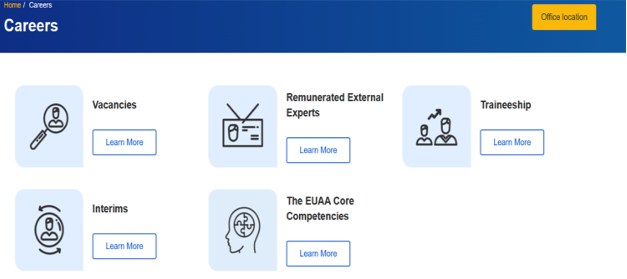
Screenshot of the website of the European Union Agency for Asylum- Careers | European Union Agency for Asylum
A good strategy to secure a position at a European agency is to first narrow down your list to a few target agencies and then monitor their websites regularly. Additionally, subscribing to agency newsletters ensures you receive new vacancy announcements as soon as they are published.
In conclusion, the differences in the selection processes are an important factor to consider when deciding where to do your traineeship, but the fear of not passing the exams should not stop you from applying to your dream institution.