

Climate Change in Times of Rearmament - How Green Can Defense Really Be?
By: Anneke Pelzer, Reading time: 4 min
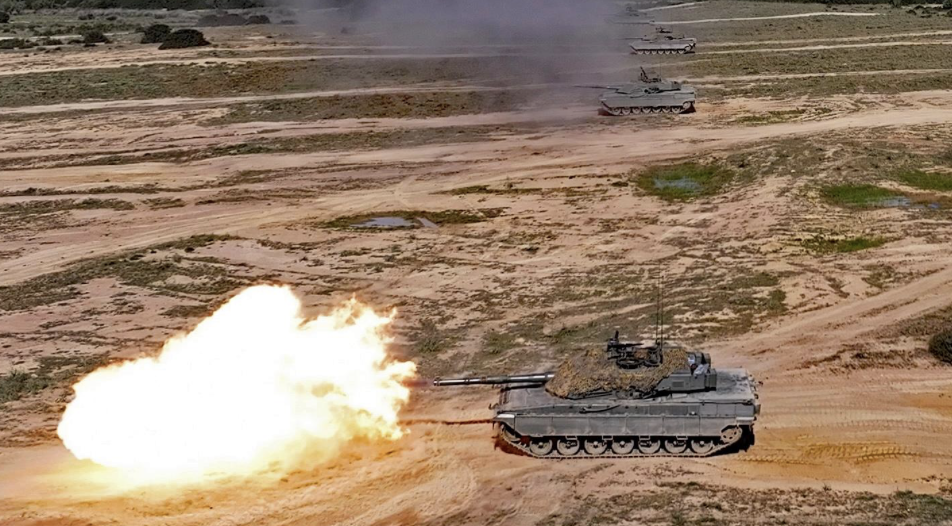
www.esercito.difesa.it, CC BY 2.5 <https://creativecommons.org/licenses/by/2.5>, via Wikimedia Commons
When Greta Thunberg stood up at the podium at the UN Climate Action Summit in 2018 and spoke her famous words „How dare you?“ over and over again, she was trying to get the world’s political elite to take action against mankind’s greatest threat, climate change. Today, in 2025, frustratingly little progress has been made. Instead, it seems like other problems and crises have always been more important. The covid pandemic and the Russian invasion of Ukraine have both challenged European economies unexpectedly, which has led to the postponing of efficient measures to lower the European Union’s (EU) greenhouse gas emissions. Existing goals like the EU becoming climate-neutral by 2050 or the 2015 Paris Treaty limiting global warming to 1.5 degrees celsius get increasingly unreachable as more time without action passes. In the present day, European member states’ worries mostly revolve around protection of Europes’ borders, which has caused military spending to have reached a new high in the EU. With rearmament’s new importance, the question arises as to how the EU wants to include its new focus on military advances in its climate goals.
Dirty militaries
Before Russia’s invasion and Europe’s wake from its pre-crisis hibernation, all military sectors of Europe combined produced around 25 million tonnes of CO2 in 2019. Internationally, the military sector is responsible for an astonishing 5,5 percent of all greenhouse gas emissions. Europe will not reach its goals written down in the European Green Deal and neither will the world meet their limit of stopping global warming at 1,5 degrees Celsius if military and defense measures are not taken into account. This lack of measures to prevent military-related emissions is illustrated by the fact that the European Climate Law, which sets the goal of climate-neutrality by 2050, does not apply to military. In the 2015 Paris Climate Treaty, military emissions that are produced abroad are excluded as well. Additionally, EU-NATO members have reported collective emissions of 6,9 million tonnes in 2021, but according to the Conflict and Environment Observatory, a much bigger reporting gap has to be expected. These findings entail that military greenhouse gas emissions remain largely unreported and therefore opaque.
New Challenges
Global warming being the greatest threat to mankind, it is time it gets recognized for what it is: a phenomenon as dangerous as military threats from other countries. Europe needs to be able to also defend itself against global warming, which makes change inevitable. Militaries need to begin ensuring that they will also be able to operate in catastrophic weather events that will occur more often and how they can adapt to function under new environmental challenges. Aside from that, emissions caused by militaries need to be included in agreements like the European Green Deal to start to get countries thinking about how they can use new green technologies for defense purposes. At the moment, too little renewable resources are being used in defense. Militaries still greatly rely on fossil fuels, such as gas and oil. Not only is the usage of those energy sources preventing the EU from meeting its climate goals, but it also makes Europe’s armies dependent on powers like Russia. Relying on fossil fuels will also only get more expensive over the next decades as those resources will get less available.
Setting off towards a greener future
On the way to more sustainable European armies, one of the key factors will be the efficient use of energy and natural resources. In March 2022, the EU launched a Climate Change and Defense Roadmap. It recognizes the instability climate change will cause and the military risks it will bring. Furthermore, it states that the „armed forces need to invest in greener technologies throughout their inventory and infrastructure“, which is to be implemented in the Common Security and Defense Policy. 133 million euros were made available in the European Defense Fund Work Programme to develop solutions for sustainable and efficient use of energy, reduce energy consumption, and make military mobility more sustainable. With help of instruments like PESCO, where member states collaborate on improving defense, and the European Defense Fund, the EU sets out to „boost technological innovation to make military equipment more efficient and less reliant on fossil fuels“.
The European states are desperate for solutions; otherwise, they will risk their competitiveness in the future. Current crises might hold a potential for getting Europe on the right path. With record investments, it would also be possible to put a greater focus on greener inventions and steer Europe's armies in a more sustainable direction. The question that remains is whether the EU recognizes this potential, and if it continues to be willing to accept higher spending on green defense and the training that comes along with the new technologies.