

Space Law : As Unexplored as Space Itself?
By: Anneke Pelzer
Reading time: 5 minutes
Space surrounds us constantly. It is what we look up to when wishing on a shooting star, what has guided generations of sailors, and what is likely to become a battleground for global powers in the upcoming century. Contrary to expectations, few regulations and agreements exist to guide states’ actions in space.
The disagreements begin with the very definition of space. To decide where space starts, one must first point out where the world ends. Generally, two different points are considered to define the end of our atmosphere, as different actors refer to the thermosphere or the exosphere. NASA and the US Army define space to begin 80 kilometres above Earth, where the thermosphere ends. However, other actors and scientists, such as the Federation Aeronautique Internationale (FAI) or the United Nations, consider the exosphere at 100 kilometres above Earth to be the starting point of space.
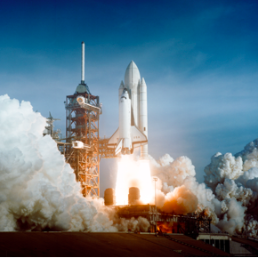
NASA, Public domain, via Wikimedia Commons
Space as a playground for the curious
Against this backdrop, such disagreements leave a vacuum that increasingly gets explored by multiple public and private actors. Headlines like “Katy Perry sang ‘What A Wonderful World’ while in space, and no, this isn’t satire” perfectly underline the shift the world is currently experiencing. While cosmic expeditions used to be a substantial part of the Cold War during the Race to Space, more and more non-state actors are exploring their commercial possibilities above our sky. This will substantially change the way space looks today.
The world’s richest man, Elon Musk, already holds a lot of power in space due to his ownership of SpaceX. The company operates around 14 000 active satellites in space already, and the number can be expected to drastically grow in the upcoming years. This also allocates expanding political power to private companies like SpaceX, whose technology, for example, is already in use to support Ukraine’s defence systems. This increases the dependency of states on private actors.
After the Cold War, the US interest in space fell, and some states strive to fill the vacuum left behind. China is currently drastically expanding its space programme, planning a busy 2026 with two manned missions and a resupply flight to Tiangong space station. This year will also be an important one for India’s space program with plans to test the human-rated safety of its Gaganyaan spacecraft. Next to that, countries like South Korea and the United Arab Emirates are actively working towards establishing their own space programmes as well.
No boss, no rules?
However, this comes with a catch: the more satellites, the harder it is to coordinate all the different vehicles operating. Anarchy greatly challenges cooperation on this issue. Therefore, the risks deriving from the fast development of the space industry urgently call for an international agreement on what rules should apply.
According to the European Union, more than 50 000 additional satellites can be expected to launch in the next ten years. From all the material uncontrollably floating through space after missions end, the amount of debris will increase as well. The EU calculated that around one million pieces of debris larger than one cm could orbit our Earth. This raises the question of how a collision between an outlasted satellite and the International Space Station would be prevented. The current laws in place do not regulate dangers like this. The vacuum left open by international law’s neglect of space holds the potential of becoming a security threat.
Currently, most treaties regulating state’s actions in space were drafted during Cold War times. The United Nations Office for Outer Space Affairs has set up five important treaties setting “principles on space-related activities”. However, these were all signed more than 40 years ago, ranging from 1967 to 1984. The insufficient character of present regulations and agreements gets underlined when considering that, based on current international law, the question of how to prosecute crimes committed by astronauts in space depends on their nationality, whether they are on board the International Space Station (ISS) or still in a rocket on their way up.
The EU is reaching for the stars
The international system must come to an agreement on how to make shared use of space and clarify responsibilities for debris. From a liberalist perspective, the challenge posed by the state of anarchy in outer space could potentially be explored by international organizations, targeting closer cooperation and striving towards a working legal groundwork.
One organization recognizing and striving to close the governance gaps left open is the European Union, which has identified a potential EU Space Act as a key priority for the Union’s future security and competitiveness. In 2025, the Commission introduced a legislative proposal aiming at setting a harmonizing framework for space activities across the EU. It is currently under review by the European Parliament and the Council under the Ordinary Legislative Procedure.
Based on the Commission’s proposal, it will be made up of three pillars. To ensure safety, rules for tracking space objects and mitigating space debris shall be introduced to secure Europe’s access to space. As cybersecurity becomes increasingly important, the second pillar strives to strengthen Europe’s space infrastructure and commercial resilience. Lastly, in line with the Union’s narrative of being a global leader in climate protection, the EU aims at ensuring sustainability for future space enterprises by pointing actors towards innovative technologies reducing the environmental impact.
Providing a common framework for joint action can also be a way of strengthening ties within the Union, in contrast to a fragmented international system. The legal act still has to be finalized, and only then can its effectiveness be evaluated. However, the EU Space Act will only harmonize actions within the EU, and the inherently anarchic problem of how to split up space between countries will persist. One thing is certain: any step the EU takes towards a clear legal framework, is one in the right direction.