


EU’s Upcoming Media Freedom Act - Tackling the Decline of Media Freedom in the EU
By Aari Helmelaid, 7 minutes. The EU Member States are often praised for their respect for democracy and human rights, but recent trends demonstrate that media freedom in the EU is under threat and the journalistic profession is no longer as simple, stable, or safe. Lack of transparency, threats of violence or murder, draconian laws toward the press, censorship, and cybersecurity risks are only the tip of the iceberg of the tough barriers that journalists and media companies face in their everyday operations. Read the article to find out how the EU is tackling the decline of press operations in the member states, and what to expect from the upcoming Media Freedom Act in 2022.

Source: European Commission
by Aari Helmelaid, 7 minutes
The decline of Press Freedom in the EU
On May 3rd, Europe celebrated World Press Freedom Day. However, it was done in the shadow of the recent Press Freedom Index that revealed some dark truths about the state of freedom of the media in The European Union. For example, Greece was ranked as the worst country in the EU for press freedom, ranking 108th out of 180 countries on the index, falling a substantial 48 spots compared to ranking 70th in the previous year.
The Freedom of the press in the European Union has been in steady decline for the past couple of years. In some European countries, independent media outlets are targeted as enemies and are hindered in their work by draconian laws that aim to limit the spread of information that is not in line with the status quo of certain governments. In addition to this, individual journalists are targeted with threats of violence for reporting on issues of public interest.
To protect and promote media freedom, the EU has a variety of legislative acts, but so far, no singular harmonised act.
The European Union in the first place gives constitutional value to media freedom, committing to protecting it through Article 11 of the EU Charter of Fundamental Rights, which reads:
“1. Everyone has the right to freedom of expression. This right shall include freedom to hold opinions and to receive and impart information and ideas without interference by public authority and regardless of frontiers.
2. The freedom and pluralism of the media shall be respected.”
However, It has become visible that primary law is not sufficient to protect media freedom in the EU, which is why, in January 2022, the Commission launched a public consultation on the upcoming European Media Freedom Act (EMFA) - a proposed act to safeguard the pluralism and independence of the media in the EU internal market.

Source: EU Neighbours
Why is there a need to regulate Media Freedom in the EU?
The world of press and media is a complex landscape filled with social and political intricacies. Journalists, bloggers, media companies and their sources are facing a wide range of obstacles that hinder their role as watchdogs for the public. They are confronted with an increase in the politicisation of the media, a decrease in the protection of the right to information, a lack of transparency of media ownership and a lack of independence of media regulators in several Member States. In some alarming cases, journalists in the EU have even been murdered, due to their work on high-profile crime cases. In 2021, a Greek investigative journalist reporting on crime, Giorgos Karaïvaz, was killed unexpectedly, for his work on controversial crime topics. In the same year, a well-known dutch journalist, Peter R. De Vries was also murdered in a mafia-style attack. De Vries in particular was closely covering the Marengo trial, a high-profile case involving seventeen members of the Mocro Mafia, a Dutch-Moroccan criminal gang accused of murder and attempted murder on several counts. After leaving the studio or RTL Boulevard (Dutch national television), De Vries was shot in the head. De Vries had a respected reputation as an investigative journalist and was respected by the Dutch public. His murder shook the nation and invoked emotional reactions calling for action both from home and from the European Commission.
Direct attacks toward journalists show the urgency of the matter, but more subtle risks arise from a lack of transparency to the public regarding ownership of these portals. A lack of independence can be inferred in a media outlet if it is funded and staffed by bigger corporations or public authorities. When larger bodies own most of the media portals in a country, there is inevitably less media pluralism. Media pluralism is the notion describing that media shall have independence from private control. It promotes the idea of having a diversity of viewpoints available and consumed across the media without significant hindrances to accessibility and the rights of journalists to report. Press freedom, on the other hand, is related to the lack of state monopoly or state intrusion in the press.
Although many EU states score among the top 20 on the Press Freedom Index, others fall into the lower rankings. In Poland (66th) and Hungary (85th), governments have intensified draconian laws against journalists. For example, the Hungarian government has for the last 10 years pursued a clear strategy to silence independent media through manipulation of the media market – pushing the forcible closure or government takeover of independent media.
Due to the subtleness of the control of the media by governments, legislating for press freedom and media pluralism is a difficult task that the Commission must face.
The state of media Freedom is also a concern in western Europe. For example, the Netherlands ranked 6th in 2021 and has fallen a significant 22 spots to 28th place in 2022.
Audiovisual Media Services Directive
The upcoming European Media Freedom act will build upon the Audiovisual Media Services Directive. This directive lays down rules for the independence of media regulators, promotes transparency of media ownership and recognises that editorial decisions should be free from interference. The Directive enables the Member States to ensure that major events are available on a free-to-air basis for their population. The Directive also facilitates the cross-border dissemination of TV channels based on the country-of-origin principle. This principle promotes the right of a company providing services in one country to be automatically qualified to provide services in any other Member State on the basis of home-country regulation.
Not only does the directive regulate traditional audiovisual media providers, but it also extends certain audiovisual rules to video-sharing platforms. Services such as social media are hence included, where the provision of videos and programmes is not the principal purpose of the service, but still constitutes an ‘essential functionality' thereof.

Source: European Parliament
What can we expect from the European Media Freedom Act?
The EMFA is meant to take strong consideration of the Commission’s Recommendation on the protection, safety and empowerment of journalists. The Recommendation emphasises four main areas to improve the rights of journalists:
1. General Recommendations:
In light of the increasing number of attacks on journalists, the recommendation calls on the Member States to vigorously investigate and prosecute criminal acts targeting journalists. Member States should create more cooperation between law enforcement and media bodies to address the threats faced by journalists. It is also of utmost importance that the media has non-discriminatory access to information from public authorities.
2. Protests and Demonstrations
As a great portion of violence against journalists occurs in demonstrations, the Member States should provide regular training to law enforcement authorities to ensure that journalists can work safely during high-risk events of public interest.
3. Online safety and digital empowerment
Journalists frequently receive threats online and are hindered by cybersecurity risks and illegal surveillance. Hence why the Member States are encouraged to promote cooperation with online media platforms to tackle threats against journalists.
4. Women and minority groups journalists and those reporting on equality issues
Female journalists and journalists from minority groups are especially vulnerable to threats. Member States should therefore support initiatives to empower these groups and those reporting on equality issues, thereby improving transparency and effective reporting on attacks. In General, equality and representation should be present in the media professional market and in its workforce.
In Addition to this, the EMFA is also closely tied to the Digital Services Act package, which is another legislative initiative that is constituted by the Digital Services Act (DSA) and the Digital Market Act (DMA). The main goal of the package is to create a digital space where the fundamental rights of users are protected and to establish a level playing field fostering innovation & growth. Essentially the act addresses the rapid growth of digitalisation, social networking and online platforms, and their effect on the internal market. Online services have numerous benefits, but they are also prone to be misused and manipulated to spread disinformation and may put the fundamental rights of their users at risk.
As is evident, the regulation of media freedom in the EU is still a chaotic patchwork of a variety of different hard and soft law instruments. The EMFA is set to be presented between July to September 2022. It remains to be seen how the EU will move forward with the European Media Freedom Act and whether it will bring concrete results to improving the safety of journalists and media pluralism in the member states.

Updates on the European Green Deal - On the urgency of climate action and on the measures being taken
By Aydın Clara Orberk, 13 minutes. You may have heard about the European Green Deal (EGD), Europe’s roadmap to climate neutrality by 2050. How is this climate neutrality to be achieved? This article entails updates about measures being taken. A set of proposals aims to make the industry of products more sustainable and circular. Some measures concern the textile industry, specifically - why is this so important? Check the article to find out more!

Source: European Commission
by Aydın Clara Orberk, 13 minutes
On the 4th of April 2022, the latest Intergovernmental Panel on Climate Change (IPPC) report was released, urging governments to take measures for CO2 emissions to peak by 2025 and be reduced by a quarter by 2030. To paraphrase United Nations Secretary-general Antonio Guterres, unprecedented and unlivable conditions in significant parts of the world are forecast unless governments everywhere reassess their energy policies.
The bottom line of the Report is twofold: We have alternatives in all sectors to at least halve emissions by 2030, but we have to act now. Indeed, measures are being taken on a European level. With all the talk about climate change, what is actually being done? This article discusses updates on the European Green Deal. It starts with proposals to make sustainable products the norm in the EU, then moves on to measures being taken in the highly polluting textile industry, and concludes with a critical stance on the Corporate Sustainability Due Diligence proposal.
Updates on the European Green Deal
You may have heard about the European Green Deal (EGD), Europe’s roadmap to climate neutrality by 2050. Our blog first wrote about the EGD here. It is laudable that it comprises the largest legislative package to ever pursue climate goals. But it has yet to live up to its slogan, fair, just and deliverable, as argued on our blog here. Two new sets of proposed measures within the EGD framework have been brought forward and will be analysed in this article.
First, on 30th March 2022, the Commission brought forward a package of proposals in the ‘sustainable industry’ domain to implement the Circular Economy Action Plan, one of the main building blocks of the EGD. Besides measures applying to all products, a set of measures for the textile industry, in particular, will be discussed.
Second, on 23rd February 2022, the Commission adopted a directive on Corporate sustainability due diligence after the European Parliament and the Council called upon it to do so in 2020.
Towards sustainable products becoming the norm in the EU?
Essentially, the measures brought forward in the ‘sustainable industry’ package include rules to make physical goods as energy efficient as possible, considering the design, daily use, repurposing, and the goods’ end-of-life. They relate to climate action as they will contribute to resource independence and less pollution. Furthermore, job creation in remanufacturing, maintenance, recycling and repair is expected.
Let’s turn firstly to product design: the proposal for a Regulation on Ecodesign for Sustainable Products addresses the crucial design phase which determines up to 80% of a product's life cycle environmental impact. According to the Commission, the new framework could lead to 132 megatons of primary energy savings by 2030, a saving which, in terms of natural gas, would be almost equivalent to the EU's import of Russian gas.
The proposal extends the already existing Ecodesign rules (Directive 2009/125/EC) which have saved consumers €120 billion in 2021 in two ways. First, the eco-design rules will apply to more products; and second, the scope of requirements is diversified, criteria are not limited to energy efficiency but include circularity and an overall reduction of the environmental and climate footprint.
For each product or category of products, the Commission will progressively set out the ecodesign requirements. It must be noted that the update from the former directive to a regulation leaves less room for the implementation to the Member States, such that incorrect transposition into national law or incorrect enforcement is less likely.
Moving on, once products are designed and come to the market, product-specific information requirements on the sustainability of products will ensure that consumers are better-informed and thereby support consumer awareness of the environmental impacts of their purchases. Currently, about 30 Energy-related products (‘ErP’) are regulated through some 50 measures under the current Energy Labelling Framework Regulation (Regulation (EU) 2017/1369). About half of the EU's total energy use is consumed in products already falling under the scope of this legislation. But the framework provides for two-yearly working plans in order to update and increase the ambition for already regulated products until a new regulation enters into force.
The Ecodesign and Energy Labelling Working Plan 2022-2024 was thus adopted to extend the energy-related products falling under the Regulation. It now includes consumer electronics (smartphones, tablets, solar panels), the fastest growing waste stream.
Further measures introduced in the package, but that are yet to be concretised and will not be elaborated upon further in this article include digital product passports to help track substances of concern during recycling, an extension of green public procurement, and other, to be determined incentives for sustainable products.
Textile, an industry with a high environmental impact
Concrete measures were also adopted to reduce the carbon footprint of particular product groups with significant ecological impact: construction products and textiles.
Construction products have a significant ecological impact because they determine the energy efficiency of buildings, which are responsible for about a third of the EU’s energy consumption, as well as a third of energy-related greenhouse gas (GHG) emissions. A revision of the Construction Products Regulation thus aims to make construction products more circular, in order to deliver on GHG objections. This article will however focus on measures to make the textile industry sustainable.
European textile consumption has the fourth-highest environmental and climate change impact after food, housing and mobility. It also has the third-highest water and land use consumption, and the fifth-highest use of primary raw materials. In terms of GHG emissions, in 2015 the textile industry totalled more CO2 than all international flights and maritime shipping combined. It thus is an industry with high global warming impact which requires reform in order to attain climate goals.
Essentially, the EU Strategy for Sustainable and Circular Textiles will ensure that textiles on the EU market are more long-lived and recyclable, made of recycled fibres as possible, free of hazardous substances, and produced in respect of social rights and the environment.

Credit: Tom Finsk. One garbage truck of textiles is landfilled or incinerated every second.
The EU Strategy for Sustainable and Circular Textiles up close
Firstly, the Strategy for Sustainable and Circular Textiles will introduce mandatory Ecodesign requirements such as fibre-to-fibre recyclability and mandatory recycled fibre content. Most of our clothes are made of blended fibres (e.g. the prevalent addition of elastane). This hampers recycling due to the low availability of technologies separating textile waste by fibre, such that very few clothes, if at all, are recycled - most end up in landfills in developing countries, which pollutes the ecosystems, or incinerated, releasing a lot of CO2 in the process.
In factories, 25-40% of all fabric used is leftover or thrown away, and only around 20% of collected used textiles in Europe are downcycled as industry wipes or other applications. The significant destruction of unsold or returned textiles is to be strongly minimised and eventually stopped given the important GHG release.
As a disincentive for this practice, under the Ecodesign for Sustainable Products Regulation, the Commission proposes a transparency obligation requiring large companies to publicly disclose the number of products they discard and destroy, including textiles.
Companies may rethink their business model and dealings with unsold, but undamaged clothes if consumers become aware of their practices, since revelations of practices in stark contrast to green claims - statements that products are sustainable - may drive consumers away if they turn out to be greenwashing - false or misleading claims about ecological commitments of the company.
Second, microplastic pollution will be tackled as well. Fibres in clothing are predominantly and increasingly synthetic. They release microplastics with each wash, amounting to up to 40,000 tonnes of synthetic fibres every year, which eventually enter our food chain. This can partly be remedied through mandatory design requirements under the Ecodesign Regulation. In the second half of 2022, the Commission will introduce a set of microplastic prevention and reduction measures including ecodesign requirements (to reduce the usage of synthetic fibres). Because the highest amount of microplastics is released during 5-10 first washes, target prewashing at industrial manufacturing plants and microplastic-capturing washing machine filters may also be encouraged or rendered mandatory.
Third, green claims will be verified to avoid greenwashing and allow consumers to pick truly sustainable textiles. Consumers willing to purchase more sustainable products are often discouraged from buying them by the unreliability of claims (greenwashing), as studies show that 39% of green claims could be false or deceptive. To protect consumers against greenwashing, the initiative on Empowering Consumers for the Green Transition proposes to amend the Unfair Commercial Practices Directive and the Consumer Rights Directive to only allow substantiated and verified general environmental claims such as ‘green’ or ‘eco-friendly’, notably based on EU Ecolabels. The Commission will present in the second half of 2022 a set of minimum criteria for all types of environmental claims in the context of the Green Claims Initiative.
Fourth, besides banning the combustion of unused textile, Extended Producer Responsibility (EPR) requirements will boost the reuse and recycling of textile waste. ERPs essentially make producers responsible for the waste that their products create, which is crucial to decouple textile waste generation from the growth of the textile sector. EPR requirements have proven effective in improving waste management in line with the waste hierarchy: as producers become responsible for their waste, EPR can incentivise product design that promotes textile circularity avoiding waste in the first place, and several EU Member States have already enacted or considered the introduction of EPR requirements for textiles, in line with the obligation under EU waste legislation to establish a separate collection of textile waste by 1 January 2025. The Commission will propose harmonised EU extended producer responsibility rules for textiles with eco-modulation of fees, as part of the forthcoming revision of the Waste Framework Directive in 2023.
Fifth, for textiles, information requirements and digital product passports will be introduced.
The textile industry of tomorrow: Driving fast Fashion out of Fashion
Looking forward, the EU aims to create enabling conditions for a more sustainable industry through a forthcoming Transition Pathway for the Textiles Ecosystem. This collaborative tool is currently being co-created with stakeholders. The Transition Pathway will, as the name indicates, allow for a transition to reverse the overproduction and overconsumption of clothing - companies are notably called on to reduce the number of collections per year. The Industrial Strategy of the EU will also be updated with measures aiming to drive fast fashion out of fashion, in favour of clothes of quality that are made to last, and circular.
Innovation and investments in sustainable clothing and the development of skills needed for the green and digital transitions will also be supported.
Finally, the EU aims to introduce sustainable textiles value chains globally. The focus lies on addressing the challenges arising from the export of textile waste, and on establishing due diligence for environmental and social fairness. The Corporate Sustainability Due Diligence Directive is part of that, and crucially in light of the scandal of brands having allegedly made use of forced Uyghur labour, the Commission is preparing a legislative initiative to effectively prohibit the placing on the EU market of products made by forced labour.

The Sustainable Corporate Due Diligence legislative proposal - Towards sustainable businesses becoming the norm in the EU?
The Corporate Sustainability Due Diligence Proposal comprises rules for companies to respect human rights and the environment in global value chains. Concretely, companies must:
integrate due diligence into policies;
identify actual or potential adverse human rights and environmental impacts;
prevent or mitigate potential impacts;
bring to an end or minimise actual impacts;
establish and maintain a complaints procedure;
monitor the effectiveness of the due diligence policy and measures;
and publicly communicate on due diligence.
The proposal applies to the company's own operations, but also their subsidiaries and their value chains, i.e. direct and indirect business relationships.
Companies will be obliged to take ‘appropriate’ measures to mitigate adverse impacts, the appropriateness of which will depend on the severity and likelihood of different impacts, the measures available to the company in the specific circumstances, and the need to set priorities (‘obligation of means').
Crucially, a supervision mechanism will be in place at the national level: national administrative authorities will guard the application of the due diligence and rules and have the discretion to impose fines in case of non-compliance or give orders to cease the conduct.
National authorities will also be required to set up rules governing the civil liability of companies for damages arising from a failure to carry out adequate due diligence, allowing victims who suffered damages that could have been avoided with appropriate due diligence measures to take legal action.
The rules apply to 2 groups:
Group 1: all EU limited liability companies of substantial size and economic power (with over 500 employees and over EUR 150 million in net turnover worldwide). Group 1 companies furthermore must adopt a plan to ensure that their business strategy is compatible with limiting global warming to 1.5 °C in line with the Paris Agreement.
Group 2: Other limited liability companies operating in defined high impact sectors, which do not meet both Group 1 thresholds, but have more than 250 employees and a net turnover of EUR 40 million worldwide and more.
The scheme applies to any company active in the EU with turnover thresholds aligned with the criteria generated in the EU, thus both EU and non-EU companies.
Where companies' directors enjoy variable remuneration, directors will be incentivised to implement due diligence.

A drop in the Ocean?
The Sustainable Corporate Due Diligence proposal is yet to be adopted by the European Parliament and Council but it has received important criticism. The World Wildlife Fund notably regrets that since it excludes Small and Medium Enterprises, it will apply to a tiny fraction of EU companies only, in fact only 0.02% of EU businesses. Indeed, the Directive’s name changed from Sustainable Corporate Governance to Sustainable Corporate Due Diligence following strong lobbying, reflecting a reduction in scope.
Furthermore, SMEs in high-risk sectors are not included despite their substantial environmental impact, inconsistent with the Corporate Sustainability Reporting Directive, and the list of high-risk sectors for group 2 is extremely narrow to begin with: sectors like high-carbon power production (coal, gas-fired power plants), high-carbon transport (aviation), high-carbon industry (steel, cement, chemicals) are excluded from high-risk sectors.
Furthermore, unlike in earlier, leaked versions of the proposal, the variable remuneration of directors being linked to their due diligence is discretionary and not mandatory anymore.
Finally, for group 2 companies the measures will apply two years later than for group 1, despite climate urgency.
To conclude, the Due Diligence Proposal is a step forward but excludes 99.8% of businesses in the EU.
Climate measures: the State of Affairs
As a take-away message, the latest IPCC report showed that ambitious carbon emissions cuts are much needed but not being made. The Commission released a package of new European Green Deal measures concentrating on high impact sectors, i.e. textiles, construction products, and products in general, as well as a Due Diligence Directive whose scope is however tremendously restricted as it will apply to only 0.02% of businesses. The EGD framework must be used to its full potential to move away from a fossil-fuel addicted society toward sustainable, and also more independent consumerism. The IPCC report urges governments and businesses alike to rethink their policies and business models ambitiously in order to cut emissions in order for GHG emissions to peak by 2025, and measures such as the EU Strategy for Sustainable and Circular Textiles do indeed incentivise companies to do better and contribute to climate goals. There is no better time to act than now - A shift towards a circular model would also boost Europe's overall resource independence, and our dependence on authoritarian supporting hydrocarbons is excruciatingly reminded these days.
This article would not be complete without mentioning POP Boutique Maastricht, a local student-founded and student-driven online second-hand shop. It advocates against fast fashion and donates 100% of its profits to Samos Volunteers, an NGO providing basic needs for refugees and asylum seekers arriving on Samos island, Greece. Second-hand clothes shops contribute to making the textile industry more circular by giving a new life to clothes that would otherwise be incinerated or end up in landfills. You can find POP boutique on Instagram and Vinted.’

Students & the EU - what rights do we have?
By Jeanne Gallien, 7 minutes. Everyone is aware of their nationality, but how many Europeans are actually aware of their EU citizenship? And the rights that follow it? This article aims to inform young people about their rights given by European citizenship in higher education, which may encourage them to consider a period of study abroad. For this reason, it will solely focus on EU nationals and not on third-country nationals.

source: Debating Europe
by Jeanne Gallien, 7 minutes
Since 1992, the Maastricht Treaty has established the free movement of goods, services, capital, and persons. Travelling to the territory of another Member State is a great opportunity for young people to develop themselves, boost their future professional opportunities, learn from others, make contacts, and complement their culture. In an ever-changing world, the need to adapt and be mobile is even more relevant for today's youth. However, as a French student studying in the Netherlands, I realized that many students, including myself, were not aware of their rights under EU law. We are all aware of our national citizenship, but few know much about their European citizenship, which was introduced in 1992 and is now codified in Art. 20 (1) TFEU that reads:
Citizenship of the Union is hereby established. Every person holding the nationality of a Member State shall be a citizen of the Union. Citizenship of the Union shall be additional to and not replace national citizenship.
This article aims to inform young people about their rights given by European citizenship in higher education, which may encourage them to consider a period of study abroad. For this reason, it will solely focus on EU nationals and not on third-country nationals.
To provide guidance and make these complex terms more understandable, an example of a German student named Alix, wishing to start her bachelor's degree in European Studies in Maastricht, starting in September 2022 will be used.
Right to free movement
Article 18 TFEU states that “any discrimination on grounds of nationality shall be prohibited.” It means that everyone should be treated the same, irrespective of their nationality and that any direct or indirect discrimination, is forbidden. Direct discrimination occurs when people are discriminated against because of their nationality, that is, when a national and a foreign student are treated differently in law and fact. Indirect discrimination occurs when, nationals and foreign students are treated equally in law but in fact, the foreign person must deal with an extra burden. In the case law Commission v Austria C-147/03, students had to provide evidence of a diploma and show that they would have satisfied entrance to their home-country university. The court ruled that this requirement is likely to affect nationals of other Member States more than nationals of the Member State concerned so that the difference in treatment established by that national rule entails indirect discrimination contrary to the principle of non-discrimination on grounds of nationality contained in Article 18 TFEU.
However, this type of discrimination can sometimes be justified by justification laid down in cases Bressol C-73/08 and Commission v Austria C-147/03, as long as the measure is proportionate. It must be suitable to achieve the aim, meaning that there is no less restrictive measure able to do it.
In the case where Alix would like to study in another Member State in the EU (the Netherlands), she should not face obstacles that run counter to the principle of equal treatment. She must not be refused access to university purely based on her nationality; she must be subject to the same acceptance criteria to which all nationals are entitled.

Source: Debating Europe
Residence rights of students
Let us assume that Alix has been accepted into her university in the Netherlands and, she is looking for housing. She is wondering whether she has the right to reside in the Netherlands, or if she should apply for a visa.
Articles 20 and, more specifically, 21 TFEU highlight that any citizen of the Union shall enjoy the right of free movement. Article 21(1) TFEU reads:
“Every citizen of the Union shall have the right to move and reside freely within the territory of the Member States”.
This provision is further elaborated in Directive 2004/38/EC which expands the treaty provisions and lays down specific conditions and limitations. To take advantage of the benefits of the Directive, Alix must satisfy its personal and material scope. The personal scope corresponds to the beneficiaries of the Directive. Article 3(1) states that “This Directive shall apply to all Union citizens who move to or reside in a Member State other than that of which they are a national, and to their family members as defined in point 2 of Article 2 who accompany or join them.” Alix is an EU citizen moving from Germany to the Netherlands, thus the personal scope is fulfilled. Moving on, the material scope is what the Directive covers substantively. It provides for the conditions of lawful residence. The Directive does not cover wholly internal situations but only when there is a cross-border element. This is also fulfilled, as Alix wishes to cross the German-Dutch border in to study in the Netherlands, a country which is not the Member State of her nationality. Therefore, as an EU citizen wishing to study in another Member State, she can rely on this Directive.
If a student wants to stay in another Member State for three months, article 6(1) states that a Union citizen shall enjoy the right of residence on the territory of another Member State for the period of three months without conditions other than a valid identity document.
If a student wants to stay in another Member State between three months and 5 years, which is the most common situation for the students, they can rely on article 7(1)(c) of the directive. They need to fulfil certain conditions:
Be enrolled in a private or public establishment, accredited, or financed by the host Member State;
Have comprehensive sickness insurance cover in the host Member State and must inform the relevant national authorities in line with the national rule, and
Have enough resources not to become a burden on the social assistance system of the host Member State.
If a student wants to stay in another Member state for more than 5 years, article 16 applies. A student who has registered legally for a continuous period of 5 years in the host Member State can acquire the right to live there permanently and be treated the same way as a national.

Source: Maastricht University
Eligibility for benefits
Assuming that Alix is enrolled at a university and knows that she can legally reside in the Netherlands, she is wondering if she is eligible for any study benefits.
The financial benefit from the home Member State
Many Member States provide loans or grants to help their own students with their living costs when studying. Under the current law, the choice to grant such aid lies with the Member States. If they decide to do so, they must not restrict or discourage a student from exercising their right to free movement within the European Union (Thiele Menes C-220/12).
The financial aid from the host Member State
The issue of financial aid from the host Member State (the State to which a student moves) is explained in Directive 2004/38/EC. This Directive explicitly excludes maintenance grants and loans from the principle of equal treatment. Article 24 states that host Member States are not obliged to extend social assistance, to grant maintenance aid for studies, including vocational training constituting student grants or student loans to students prior to the acquisition of the right of permanent residence, equivalent to 5 years residence.
Conclusion
Summing up the above considerations and applying them to the case of Alix, she is now aware of her rights under EU law. She knows that she has as much chance as nationals to be accepted in a school in another EU country. She can also reside lawfully in that Member State where she is studying. However, most likely she will not receive financial aid from the host country, the Netherlands. She will have to ask her home Member State Germany if she is eligible for benefits.
This article was inspired by the EU Law II course given in the second year of the European Studies bachelor programme at Maastricht University, coordinated by Dr Andrea Broderick.

The AI Act as a Shield for the EU Cyberspace
By Federico Durante, 7 minutes. The EU has the largest market in the world, which gives it immense regulatory power. Decisions related to products and services taken by the EU have repercussions in other jurisdictions. The AI Act shows how the EU, by simply regulating its internal market, can (in some sectors) affect the distribution of power in international geopolitical conflicts, and defend itself from actors that want to disrupt our European sovereignty. Read the article to know more about the AI Act and its influence on data protection and privacy.

by Federico Durante, 7 minutes
The war in Ukraine has sparked global attention because of the physical harm that affected Ukrainian civilians and cities. European media focused on the impact of tanks, ballistic missiles, military convoys, drones, and fighter jets that the Russian Federation deployed on Ukrainian territory. Nevertheless, if Europe believes these to be the overarching menaces to European security, we might have missed a much wider scope of threats that are already affecting us directly. Along with what it called a “special military operation”, Russia launched a range of Distributed Denial of Services (DDoS) attacks on Ukraine, which are cyberattacks that disrupt the normal functioning of a server or network. DDOS aimed at introducing malware into Ukraine’s banking system, government-related websites, civilian infrastructure, and spreading disinformation. NATO and EU Member States sent dozens of teams of experts in cybersecurity to help respond to such non-conventional attacks by Russian hackers. Moreover, some 300,000 volunteers from all over the world have joined Ukraine’s IT Army, sponsored by the Ukrainian defence ministry. Unfortunately, these efforts might not be enough if you consider the quantity of data available in cyberspace.
A key term that increasingly appears in the debate about cybersecurity is ‘granularity’ – the level, or scale, of precision and detail of a given data structure. At first glance, data does not provide any strategically valuable insight, however, if combined with other data structures it can reveal very sensitive information. For example, in the U.S. some police officers were able to find out in a few minutes who were the individuals attacking Capitol Hill on January 6 last year or to identify those who participated in riots after George Floyd was killed. It was done by aggregating facial recognition from billions of pictures, allowing them to identify and track the individuals they were looking for. Alternatively, in 2017, an Australian hacker decided to amuse himself by posting information on social media that revealed the activities of secret U.S. military bases in Afghanistan. The same person released personal data of individuals working in a French base in Niger, and an Italian one in Djibouti.
This aggregation of relevant data structures is explained by the ‘mosaic theory’. It establishes that when apparently meaningless parcels of data are selectively merged, a single coherent piece of information can be derived from it. This data is readily collected not only through our phones and computers, but also from smart-watches, -refrigerators, -showers, -cars, -bikes, -lamps, -toilets, -speakers, etc. The Internet of Things (IoT) is an awesome tool as it enables physical objects with sensors and processing ability to exchange data with each other on the Internet, thus enhancing the ability of those products to mutually help each other in order to better satisfy our needs. But the IoT still allows our geopolitical rivals, such as Russia, to be aware of where we are, how we are behaving, and for how long. If Russians would manage to merge huge amounts of EU citizens’ personal data, they could draw very precise conclusions about us, Europeans. They are already observing our social media contents, our search engine tendencies, our pictures, and our apps. By combining all this information into a single mosaic, they are going to improve their ability to design strategies to harm us with DDoS and disinformation campaigns.
Now, this is no longer possible since the European Parliament and Council found a consensus on the Artificial Intelligence Act. This piece of legislation, which is the first-ever regulatory framework for AI technologies, is primarily related to data protection and harmonisation of the AI market between the Member States. Firstly, it establishes what kind of personal (granular) data can be collected from consumers, how and where it can be processed, and with whom and for what purposes it can be shared. Secondly, it harmonises the regulatory framework concerning the use of algorithms, previously decided by the Member States, in products that include AI technology. What needs to be stressed with this long introduction to cybersecurity, however, is that the AI Act completely avoids addressing AI’s importance in cybersecurity. The legal basis that was used by the Commission to propose the AI Act is Art. 114 of the Treaty on the Functioning of the EU (TFEU). This Treaty provision is the most widely used legal basis since it relates to the functioning of the internal market, which prevents market-oriented legislation from being interpreted in light of the current geopolitical situation.
No matter how market-oriented this legislation might be, the AI Act inevitably and unintentionally assumes a geopolitical value. It limits foreign actors’ ability to access EU citizens’ data, which restrains their success in carrying out DDoS and disinformation campaigns. The comparative advantage in cyber warfare is represented by the amount of data available to one actor relative to the amount available to all other actors: the more parcels you have, the better you can be at obtaining a ‘mosaic’ that gives you a strategic advantage over the others. If hackers can architect their attacks on a smaller amount of data, the impact of their actions will be lessened, since they will be able to target individuals, firms and governments less precisely and on less relevant fronts. Therefore, by limiting the amount of data that stems from products that involve AI technology (especially in the IoT), the AI Act protects us from being attacked in an effective manner, ultimately preventing the EU’s Internet infrastructure from suffering major disruptions.
Summing up, the lessons that can be derived from the impact of the AI Act on geopolitics and on European cybersecurity are twofold:
Privacy is not just individual liberty and a right that EU citizens enjoy in the form of a legal principle, but is also a tool to be used to prevent foreign actors from acquiring precise ‘mosaics’ about EU citizens’ behaviour. Data protection must be relevant not only in an economic and commercial context, where firms are prevented from using data to extensively target customers, engage in unfair competition, and use algorithms in a discriminatory and unethical manner. It is also a security tool to prevent our geopolitical rivals from acquiring too much strategic advantage over the EU itself. The AI Act will make things much harder for Russian hackers to attack our IoT network and algorithms (through DDoS), or to use our data entailed in it in order to obtain clearer mosaics about us.
Art. 114 TFEU is a legal basis that can be used for purposes related to the functioning of the internal market, such as competition, regulation, and safety, but it can be intelligently used in order to pass legislation that would have geopolitical significance, as the AI Act turned out to do. The EU’s Common Foreign and Security Policy (CFSP) and Common Security and Defence Policy (CSDP) tend to be shortcomings in relation to the EU’s security needs, and are often adopting the lowest common denominators of all Member States: such policy areas are strictly intergovernmental and anyone can veto EU action. Both the EU and NATO have been cohesive in responding to Russia’s aggression on Ukraine, but is this likely to last forever? Some geopolitical issues, such as cybersecurity, can be solved by regulating relevant parts of the market. Therefore, it is better to avoid the legal framework of CFSP and CDSP, and to bring legislation under the scope of consumer protection and the internal market (Art. 114 TFEU); where the bargaining power is more distributed, negotiations are smoother, and legislation is more likely to be adopted.
The EU has the largest market in the world, which gives it immense regulatory power. Decisions related to products and services taken by the EU are likely to have repercussions in many other jurisdictions because they import our regulatory standards through market forces. Even if the EU seems reluctant and divided when it comes to geopolitics, it does not mean that it is unable to affect geopolitics and the global security architecture through its market power. The AI Act shows how the EU, by simply regulating its internal market, can (in some sectors) affect the distribution of power in international geopolitical conflicts, and defend itself from actors that want to disrupt our European sovereignty.

How does the European Union protect human rights?
By Lucrezia Nicosia, 7 minutes. This article aims at explaining how the European Union guarantees the protection of human rights of its citizens/residents; this will be done by explaining the scope and content of the EU Charter, its similarities with the ECHR, and the main bodies involved in the framework.

Source: Debating Europe
by Lucrezia Nicosia, 7 minutes
The protection of human rights represents one of the main values of the European Union, as laid down in the Treaty on the European Union (TEU) and in the Treaty on the Functioning of the European Union (TFEU).
The main provision outlining the concept is Article 2 TEU, which states:
The Union is founded on the values of respect for human dignity, freedom, democracy, equality, the rule of law and respect for human rights.
Furthermore, according to the wording of Article 3(5) TEU:
[The EU] shall contribute to peace, security, the sustainable development of the Earth, solidarity and mutual respect among peoples, free and fair trade, eradication of poverty and the protection of human rights, in particular the rights of the child, as well as to the strict observance and the development of international law, including respect for the principles of the United Nations Charter.
For what concerns the area of common foreign and security policy, and according to Article 21 TEU (later confirmed in Article 205 TFEU):
The Union's action on the international scene shall be guided by the principles which have inspired its own creation, development and enlargement, and which it seeks to advance in the wider world: democracy, the rule of law, the universality and indivisibility of human rights and fundamental freedoms, respect for human dignity, the principles of equality and solidarity, and respect for the principles of the United Nations Charter and international law.
Two specific legal instruments play an important role when discussing the topic of human rights protection within the European Union: the European Convention on Human Rights (ECHR) and the Charter of Fundamental Rights of the European Union (EU Charter). While being closely connected to each other, they have been issued by two different entities: the Council of Europe and the European Union respectively.
This article aims at explaining how the European Union guarantees the protection of the human rights of its citizens/residents. This will be done by explaining the scope and content of the EU Charter, its similarities with the ECHR, and the main bodies involved.
What is the European Convention on Human Rights?

Source: Council of Europe
The ECHR is a regional instrument drafted on the 4th November 1950 and to which all Contracting Parties that belong to the Council of Europe (CoE) are parties. The CoE is an international organization primarily concerned with developing and spreading awareness on human rights around Europe and which must not be confused with the European Council or the Council of the European Union. Indeed, while these institutions are part of the EU, the CoE is an independent organization that comprises 47 States, including all 27 EU Member States.
The ECHR forms part of the general principles common to all the Member States now in Article 6(3) TEU:
Fundamental rights, as guaranteed by the European Convention for the Protection of Human Rights and Fundamental Freedoms [ECHR] and as they result from the constitutional traditions common to the Member States, shall constitute general principles of the Union's law.
This way, within the framework of the European Court of Human Rights (ECtHR), an international court of the CoE which interprets and applies the provisions of the ECHR, the EU Member States hold a so-called “presumption of equivalent protection”. The latter was elaborated in the Bosphorus case and it has been used by the ECtHR in order to balance the Contracting States’ obligations under the ECHR and EU law: when a case against an EU Member State is brought before the ECtHR, and the alleged violation concerns the application of EU law, the Court will presume that there has been equivalent protection of the ECHR. However, such presumption may be rebutted if there are signs of manifest deficiency.
What is the Charter of Fundamental Rights of the European Union?

The Charter of Fundamental Rights of the European Union was initially proposed by the European Council in 1999 and it was solemnly proclaimed on 7 December 2000 by the European Parliament, the Council of Ministers and the European Commission. Nevertheless, it was initially not legally binding, but taken into consideration as soft law. The EU Charter gained full legal effects on EU Member States when the Treaty of Lisbon entered into force in December 2009. Currently, the EU Charter is considered, together with the TEU and the TFEU, as part of EU primary law.
The EU Charter is divided into six chapters, which divide the different categories of rights:
Dignity (e.g. human dignity, right to life, right to integrity of the person, prohibition of torture and inhuman or degrading treatment or punishment);
Freedoms (e.g. right to liberty and security, respect for private life and family life, freedom of thought, conscience and religion);
Equality (e.g. equality before the law, non-discrimination)
Solidarity (e.g. workers’ right to information and consultation, fair and just working conditions)
Citizen’s rights (e.g. right to vote, right to good administration, right of access to documents held by any EU institutions)
Justice (e.g. right to an effective remedy and to a fair trial, presumption of innocence and right of defence)
As laid down in Article 51 EU Charter:
The provisions of this Charter are addressed to the institutions and bodies of the Union with due regard for the principle of subsidiarity and to the Member States only when they are implementing Union law.
Therefore, Member States are bound by EU human rights standards at the moment that they implement EU law, when national legislation falls into the scope of EU law, and when they derogate from fundamental freedoms.
Member States technically have the possibility to opt out from legislation or treaties of the European Union, meaning they do not have to participate in certain policy areas. This seems to have happened to the United Kingdom and Poland according to Protocol no. 30 EU Charter. However, this cannot be considered an actual opt-out, but better as a “clarification” since the Protocol cannot exempt the UK and Poland from human rights standards already recognized by EU case law and that belong to the general principles of law under Article 6(3) TEU. Indeed, EU Member States are always bound, when acting within the scope of EU law, by the human rights standards already recognized by EU case law and that belong to the general principles of law under Article 6(3) TEU.
To review the progress in implementing and respecting human rights standards, the European Commission draws up annual reports prepared in close collaboration with all institutions and relevant stakeholders on the application of the EU Charter by the Member States.
Furthermore, the EU Agency for Fundamental Rights (FRA) covers an important role in this field. On the one hand, it gives independent advice to EU institutions and the Member States on the rights set out in the Charter; on the other hand, it conducts legal and social research to better improve the level of protection of human rights in the EU and to align them to international standards.
What are the main differences between ECHR and EU Charter?
The ECHR was drafted by the Council of Europe, an international organization that includes 47 Contracting Parties. On the other hand, the EU Charter is an instrument of the European Union, applicable only to EU member states.
Contracting Parties to the ECHR are bound by it in all actions or omissions within their jurisdiction, while Member States are bound to the EU Charter only when acting within the scope of EU law.
The EU Charter enshrines some rights that are not guaranteed in the ECHR, as for example the right to asylum or the right to data protection. Although the latter is not expressly governed in the ECHR, there is a lot of ECtHR case-law on the matter on the basis of Article 8 ECHR.
Within the framework of the ECHR, there is a specific court that checks on the observance of the Convention. Indeed, individuals whose rights have been violated can take the case to the European Court of Human Rights. On the contrary, within the system of the EU Charter, there is no court to which individuals can apply directly. This can be done only indirectly through the work of the Court of Justice of the European Union.
That being said, the system of the European Union and of the Council of Europe are intertwined because the provisions laid down in the ECHR have been used as a basis for the EU Charter of Fundamental Rights. Furthermore, all 27 EU Member States are also members of the Council of Europe and therefore bound by its human rights standards.
The Multiannual Financial Framework - policy up close
By Erik Schmidt-Bergemann, 5 minutes. Every seven years the EU needs to pass a new budget. The last Multiannual Financial Framework (MFF) was passed in 2020 and the new budget will run from 2021 till 2027. This article will explain what the budget entails and how the policy-making process works.

by Erik Schmidt-Bergemann, 5 minutes
Every seven years the member states of the European Union come together and decide on the new multiannual financial framework or the budget of the European Union (EU). The last budget ran out at the end of 2020, in the middle of the Covid-19 pandemic, and member states had to come together and negotiate the new framework for the 2021-2027 budget period. This article will cover the new budget in detail and will offer a short explanation of the budget in general.
What is the multiannual financial framework?
The so-called multiannual financial framework (or short MFF) has been used in the EU since 1988. The MFF usually runs for seven years (the required minimum is five years) and touches upon basically every aspect of the EU. For example, programs such as Erasmus or Horizon Europe are funded by the MFF. The MFF sets a yearly limit on commitments and payments that the EU can make. However, in the case of unforeseen circumstances, such as a sudden crisis, the EU has several financial instruments at its disposal to address these sufficiently.
But who makes the initial proposal of the budget and who are the key players in the decision-making process? The Commission starts the process of passing the budget by presenting an initial proposal. This initial proposal will then move on to the Council which may change the proposal by the Commission. Thus, the member states play a central role in the budget decision-making process and can influence the budget. After the Council is done with changing the proposal from the Commission, the budget moves on to the European Parliament. However, it cannot make any official changes to the proposal at this stage since it is not a co-legislator but rather is only asked for consent since the MFF is following the consent procedure. Thus, the Parliament needs to inofficially influence the budget while the EU member states are negotiating it in the Council. After the European Parliament has given its consent to the budget, the Council needs to adopt the budget through a unanimous vote. The legal basis for this is article 312 in the TFEU.
The new budget 2021-2027

Figure 1: European Commission The 2021-2027 MFF
In 2020 the member states had to pass the new budget for the period of 2021-2027. The new budget will encompass €1.211 trillion which are combined with €806.9 billion in the recovery package. The recovery package is what makes this MFF particularly interesting. Due to the unprecedented Covid-19 crisis and its impact on the European economy, the member states have decided to set up a recovery package to limit the negative effects of the Covid-19 crisis on European economies and help the states that have been hit the hardest by the pandemic. The influence of the pandemic on the MFF will be covered in detail below.
The MFF has seen some changes since the first budget was adopted in 1988. Whereas the first three decades had seen a focus on the Common Agricultural Policy and Cohesion Policy, the new budget will shift its focus to new priorities. These new priorities include investments into research and innovation, combating climate change, the transition to the new digital era and the recovery from the Covid-19 pandemic. This exemplifies the new focus on the budget and Figure 2 shows that these new priorities are receiving the largest share in the 2021-2027 MFF. If you want to dive into the details of the new MFF, this brochure by the EU is a good starting point.
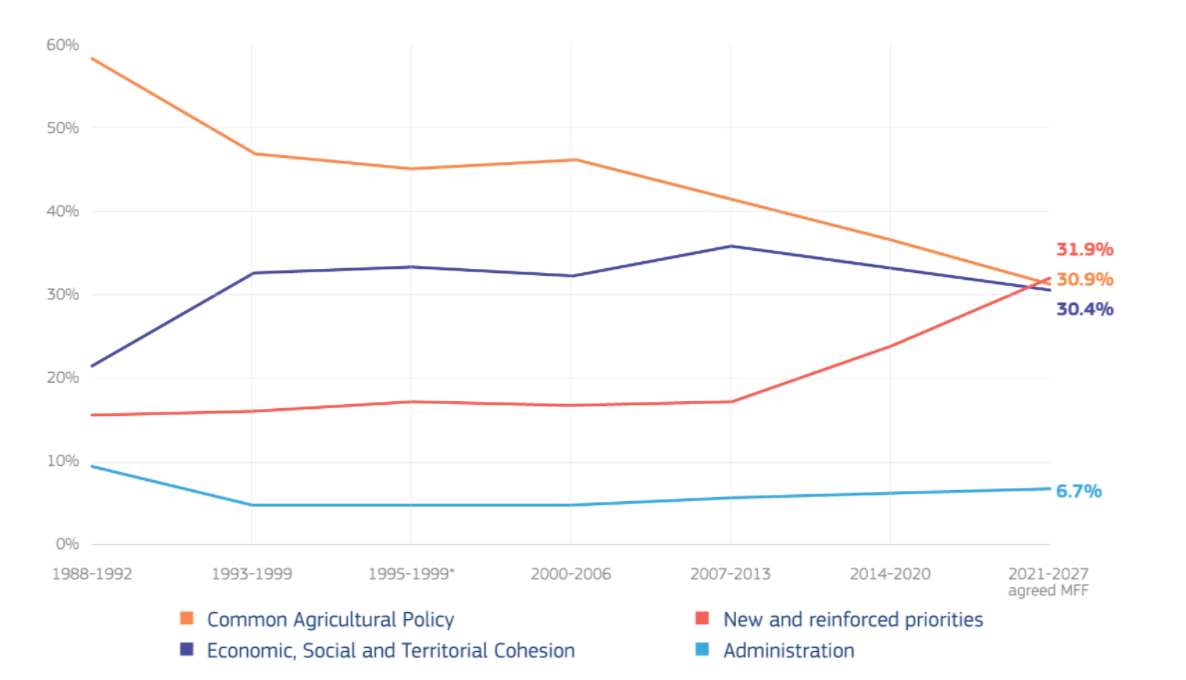
Figure 2: European Commission
Another new addition to the 2021-2027 MFF is the so-called “conditionality regulation”. This new regulation has been introduced to address rule of law breaches by member states. An example of a rule of law breach would be if a certain member state does not implement rulings by the Court of Justice. However, this conditionality only applies if “a given member state threaten the EU financial interests” (Source: European Commission). Thus, rule of law breaches that do not threaten the EU’s financial interests are not affected by the new conditionality regulation.
Yet, if a member state should threaten the financial interests of the EU, the Commission is responsible for proposing appropriate measures to the Council to address the breaches by the member state in question. After the Commission has proposed measures to the Council, the Council will make a final decision on the proposal.
The Covid recovery package
Due to the Covid-19 crisis and its huge economic impact on the European economy, the EU has decided to include a recovery package in combination with the new MFF. The main aims of this recovery package are to limit the negative effects of the Covid-19 pandemic and to transform Europe into a digital and sustainable continent. The funds that are allocated under the Recovery and Resilience Facility are directly paid to the member states after the member states have submitted a Recovery and Resilience plan. These plans need to address several challenges including climate change and digitalisation. Once a member state has submitted its plan the Commission will assess it and the European Council will approve it. Once the plan has been approved by the European Council, the member state will receive its allocated funds.
As aforementioned, most of the funds will be used to increase Europe’s digital capabilities and to make European economies ‘green’ and sustainable. Figure 3 showcases several areas that will receive funding under the Recovery and Resilience Facility such as improving digitalisation in public administration or investing in renewable technologies such as solar energy.

Figure 3: European Commission