

Europe's Shared Wallet: Inside the Multiannual Financial Framework
By: Anneke Pelzer
Reading time: 3 min
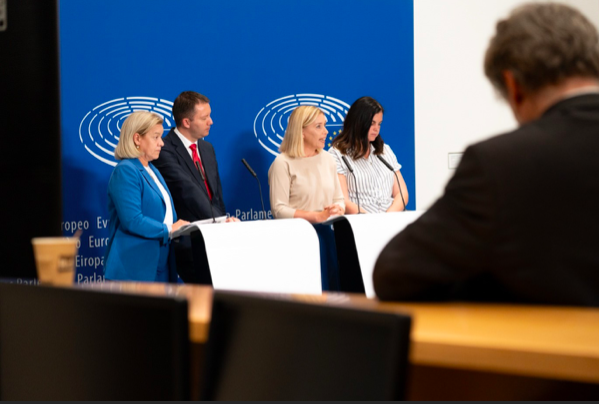
Picture: EP’s co-rapporteurs for the MFF and own resources, from left to right: Carla Tavares (S&D), Siegfried Mureşan (EPP), Danuše Nerudová (EPP), and Sandra Gómez López (S&D);
Source: European Parliament from EU, CC BY 4.0 <https://creativecommons.org/licenses/by/4.0>, via Wikimedia Commons
The saying “money buys power” couldn’t be more accurate to capture current discussions over the Unions long-term spending plan. More so, the planning of the next so-called Multiannual Financial Framework (MFF) has turned into a standoff between Member States and institutions over which direction the Union’s future should take.
The MFF is the plan the institutions adopt to govern the European Union’s expenditures for the next seven years, with the next one reaching from 2028 to 2034. What might sound very technical and abstract is one of the highest-ranking political decisions taken in Brussels.
Under the long-term budget, the Union plans ahead for all the annual budgets that fall into the seven years of the MFF. What is particularly challenging is the fact that no one knows what the future might bring – and what policy areas and categories of expenditure will need the most financial attention. Discussions over what should be the points of budgetary focus to be prepared for pathbreaking years ahead, with the EU facing countless challenges, are looming large in Brussels.
The Commission proposed a 2 trillion Euro budget in July 2025 that prioritizes crucial areas like competitiveness, security, and defence. At the same time, it aims to give citizens easier access to funding opportunities and reform cohesion and agricultural funds to allow for more flexibility. To acknowledge the uncertainty that lies in planning for the future, the Commission’s proposal sets out for a more flexible MFF that can be adapted to unexpected changes that affect policy priorities.
The Parliament on the other hand pushed for a 10% increase of the MFF that the Commission proposed. “If the Union has to do more, this has to be reflected in the budget. Telling the people that the Union can do more with a smaller budget is a myth. It won’t happen. A smaller budget means a weaker Union. It means we will be able to do less, and it means that at the end of the day, we will disappoint people,” the MFF co-rapporteur from the Parliament Mureșan told Rapporteur. The Parliament does support the focus the Commission set out on competitiveness, security and defence, as well as improved flexibility of the budget, but has different ideas for the proposed reduced funding for civil society.
Now, those discussions are spilling over into the Union’s capitals. The Multiannual Financial Framework has to be adopted in the Council with unanimity, whereupon parliamentary consent is required. The problem is that the Member States represented in the Council have very different ideas on how big the budget should be and what it should prioritize. Money does buy power, and each of the Union’s Member States has their own agenda to push for allocating budgetary power to the areas its most concerned by.
On one side, there are traditionally frugal countries like the Netherlands, Germany, Sweden, or Austria. They are arguing that the current financial scope of the budget is unrealistic and unreasonable, pressuring for cuts of “several hundred billion euros”. All of those countries are net contributors the European Union budget, meaning that they are paying more into the Union than they receive in direct funding.
The other side is made up of the so-called “Friends of Cohesion”, consisting out of Eastern European and Baltic States, as well as Italy, that are affirming the current scope of the proposed budget. In response to the frugal camp, they are dismissing the idea of cutting the budget and lobbying for more resources to be spend on agriculture and regional development. Simultaneously, they are pushing for a budget that places security matters at the forefront of EU spending.
The power fight over the Union’s future-determining budget cannot be expected to cool down anytime soon. Negotiations are now entering into the final phase but are still far from the finishing line. Next to discussion on scope and focus, the question of “own resources” is only adding to the boiling conflict. Proposed by the Commission, such revenues streams would support the funding of the MFF and help repay the Union’s debt. While the proposal gets backed by the Parliament, especially the frugal block has shown themselves to be sceptical.
Bridging the different positions will be challenging, and the clocks are ticking as the deadline to agree on the next MFF by the end of 2026 approaches fast. The Irish Council Presidency is expected to propose a compromise before the Heads of State and Government of Member States will meet for a European Council summit on 15-16 October.