

The “Winner” Takes It All: Was Eurovision 2026 Hijacked By Politics?
By: Nikola Kirkov | ‘Beyond the Flags’
Reading time: 8 minutes
Eurovision – a cultural phenomenon that came into existence for the first time in 1956 as a means through which to unite Europe after the unimaginable pain that the last century inflicted on the continent. The contest has grown exponentially ever since, becoming the world’s biggest non-sport event, seeking to unify nations and people, despite borders and differences, through the universal language of music. Nonetheless, a key feature of the contest is the apolitical label it has given itself, despite the very premise and history of the competition being political in nature.
For a show that claims to be apolitical, Eurovision has an uncanny habit of turning into a political battleground. From protests, scandals, state propaganda, and boycotts to international diplomatic crises being fought through the unconventional outlet that Eurovision represents, the contest has repeatedly become a stage on which Europe’s deepest political tensions play out in real time. Whether it’s about deep historical bruises that cannot seem to heal, long-lasting geopolitical conflicts between neighbouring states, or state pressure resulting in disqualifications and boycotts, Eurovision and scandal are two terms which have proven to be inseparable. They continue to validate that very pattern to this day.

The trophy of the 70th Eurovision Song Contest, photo: EBU
Eurovision as a Cultural & Political Phenomenon
Precisely seventy years ago, Eurovision was born in Lugano, Switzerland, as a cultural experiment that would go on to forever alter and transform the cultural landscape of Europe. Launched and governed ever since by the European Broadcasting Union (EBU) in the immediate aftermath of the Second World War, Eurovision emerged as a cultural piece of the broader post-war effort to repair the fractured state of the continent through cooperation based on unity.
Established as a means of uniting Europe after the devastation of the post-war reality left behind on the continent, the Eurovision Song Contest became synonymous with renewal. By offering a radical “ointment” to the political divisions and tensions in the Cold War era in Europe, Eurovision forcefully opened a crucial new chapter in European history and cooperation: a stage upon which European nations could come together, despite borders and differences, not through conflict, but through the universal language of music.
What began as a modest broadcasting experiment in 1956 involving just seven countries, centred around building bridges on the foundation of music, steadily evolved into arguably one of the most recognisable symbols of Europe. Crucially, the contest quickly expanded far beyond its original Western European confines, becoming a key element of the broader framework for continental reintegration. Following the collapse of the Iron Curtain and the dissolution of the Soviet bloc, Eurovision became an important platform for the rebuilding of the fragile relationship between Western Europe and the newly emerged Eastern European nations and a crucial gateway through which newly independent Eastern European states could symbolically reintroduce themselves to Europe and assert their place within the wider European community. As such, Eurovision represented far more than mere entertainment for the region, as it offered an opportunity to reclaim national identity, dismantle decades of Soviet-imposed narratives, and showcase the uniqueness and modernity of their cultures to an international audience.
Over its seventy years of history, Eurovision today represents far more than a peculiar cultural landmark and cultural export of Europe to the world. With new countries joining the show and even continents in the case of Australia, which was invited to the contest in 2015, eager to proudly present their culture and identity via the inconceivably enormous platform the contest offers, Eurovision has also long established itself as the world’s most-watched non-sporting event, with hundreds of millions of viewers from all corners of the world tuning in each year to witness which country comes out victorious. Therefore, it might be reasonable to conclude that the contest has become a symbolic reflection of Europe itself, with all its diversity, tensions, aspirations, and contradictions.
Crucially, the contest cannot reasonably be reduced to just an entertainment programme with three nights of glamour and spectacle. While conveniently framed as “apolitical” by the EBU itself, as exemplified by the provisions of Eurovision’s very own rulebook stating that any content or behaviour that may harm the integrity, reputation or non-political nature of the Contest is not permitted, the organisation itself has acknowledged the political undertones and implications the contest brings. The very premise of Eurovision, being countries from Europe and beyond competing under national flags before an international audience, inherently transforms the contest into more than a purely musical and cultural event. Thus, one cannot deny the fact that politics has been interwoven into the very essence of the contest since its inception in the 50s.
As early as 1964, political protest barged onto the Eurovision stage when a Danish activist interrupted the live broadcast of the final, holding a banner condemning the Franco and Salazar dictatorships. Subsequently, Austria boycotted the contest in 1969 as a measure against the Franco dictatorship in Spain, inspiring Norway, Sweden, Portugal, and Finland to do the same in 1970. In the following decades, geopolitical rivalries, bloc voting, diplomatic tensions, and violent conflicts increasingly became impossible to separate from the contest itself. Regarding such political realities shaping the contest in the past decade, an unprecedented situation presented itself in 2022 when the Russian Federation began its illegal full-scale invasion of Ukraine. Despite the fact that initially the EBU denied the request made by the Ukrainian broadcaster Suspilne to disqualify Russia from Eurovision 2022, criticism and pressure from nine countries who threatened to withdraw if Russia was not immediately expelled from the contest forced the EBU to exclude Russia from Eurovision 2022, fearing that it “would bring the competition into disrepute.” An even more dire obstacle loomed over the seventieth-anniversary edition of Eurovision even prior to the contest taking place in Vienna two weeks ago.
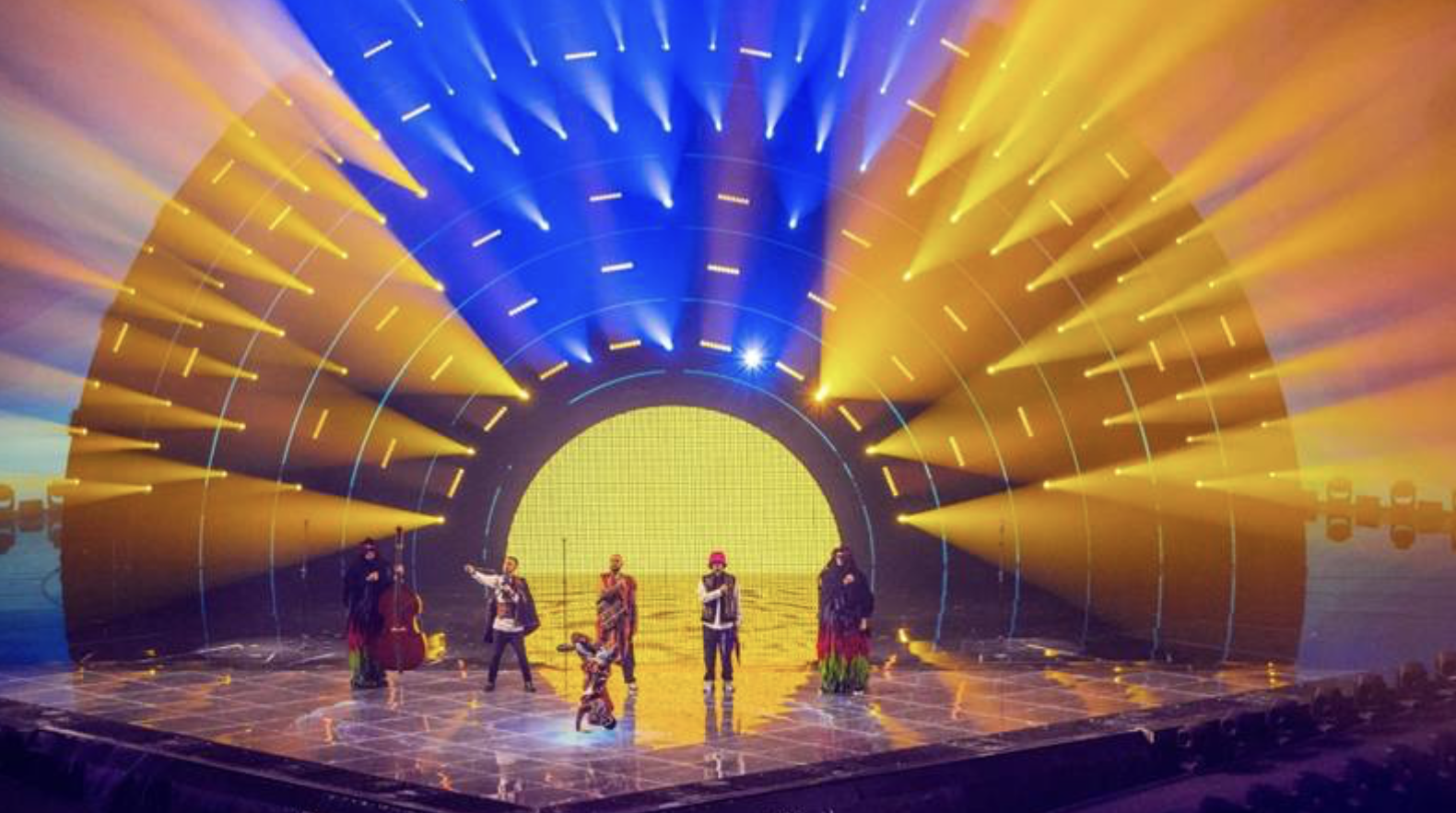
Ukraine’s Kalush Orchestra and their winning performance at Eurovision 2022, Jens Büttner/picture alliance via Getty Images
Eurovision, weaponised as a soft power tool
Despite the EBU’s continued formal insistence that Eurovision exists completely outside the realm of politics, Eurovision’s interplay with geopolitics entered an utterly unprecedented territory following the outbreak of the humanitarian crisis in Gaza in late 2023. Once limited to occasional political tensions overflowing into the competition and harmless bloc voting accusations, the politicisation of the contest rapidly escalated into a full-scale crisis over the image of the contest entering disrepute territory and the weaponisation of Eurovision as a tool of soft power image-building by Israel, later labelled as “whitewashing.”
According to an extensive investigation conducted by The New York Times, Israeli state institutions became deeply involved in efforts to secure Israel’s position within Eurovision amid growing backlash across Europe, calling for the expulsion of the country due to its military actions in Gaza. The investigation, which involved a thorough and never-before-seen review of Eurovision’s internal documents, exposed that senior Israeli diplomats and government officials actively lobbied European broadcasters behind the scenes in order to prevent the calls for Israel’s exclusion from coming to fruition. While still only alleged, it might be safe to assume that Eurovision has clearly been viewed as a strategic political platform within Israeli political circles for the past three years, thereby motivating Israeli institutions to undertake the task of transforming the contest into a self-encompassing soft power sandbox to improve Israel’s increasingly deteriorating international image.
This conclusion is further supported by the uncovered financial records, which indicate that Israel spent at least $1 million on Eurovision-related promotional campaigns in the 2024 and 2025 editions of the contest, with part of the funding allegedly originating from Benjamin Netanyahu’s public diplomacy apparatus. While governments are formally prohibited from interfering in Eurovision voting processes according to the contest’s rulebook, extensive coordinated campaigning surrounding Israel’s participation took place in the past three years. Concretely, official social media accounts linked to the Israeli government apparatus generated a substantial number of promotional videos, encouraging audiences to vote for Israel up to the maximum of twenty times permitted under Eurovision rules. The campaign efforts were, arguably, aimed at boosting Israel’s public image by fabricating an overblown televote result in hopes that it would convince the international community that the majority of the public supports Israel’s inclusion in international events and the overarching political actions of the state.
The controversy intensified after Israel secured exceptionally colossal televote results since 2023, despite comparatively weak support from the juries, which account for 50% of the results, alongside the increasingly negative public view of Israel in Europe. As a result, the tense reality of the contest prompted accusations from several broadcasters that the integrity of the public vote and the contest as a whole had been jeopardised and effectively compromised. The EBU has repeatedly denied any evidence of successful vote manipulation in favour of Israel in the contest. Yet, the allegations nevertheless fuelled growing criticism that Eurovision’s claim of political neutrality had become increasingly untenable.
Consequently, the largest crisis in Eurovision’s long history unfolded, culminating in an unprecedented collective boycott ahead of Vienna’s anniversary edition of the contest. Following the EBU’s December 2025 General Assembly vote, which led to the adoption of a new framework of voting safeguards, and crucially the preservation of Israeli participation in the contest, the public broadcasters of Spain, Slovenia, Ireland, Iceland, and the Netherlands withdrew from Eurovision in protest against Israel’s continued participation, marking the largest coordinated boycott in the competition’s modern history. As such, the slogan of Eurovision, “United By Music,” became a symbol of division and an organisation’s consistent sacrifices in the name of preserving one single country’s opportunity to instrumentalise the contest as a political tool, at the cost of several European countries, which have become institutions within the contest, missing out completely.
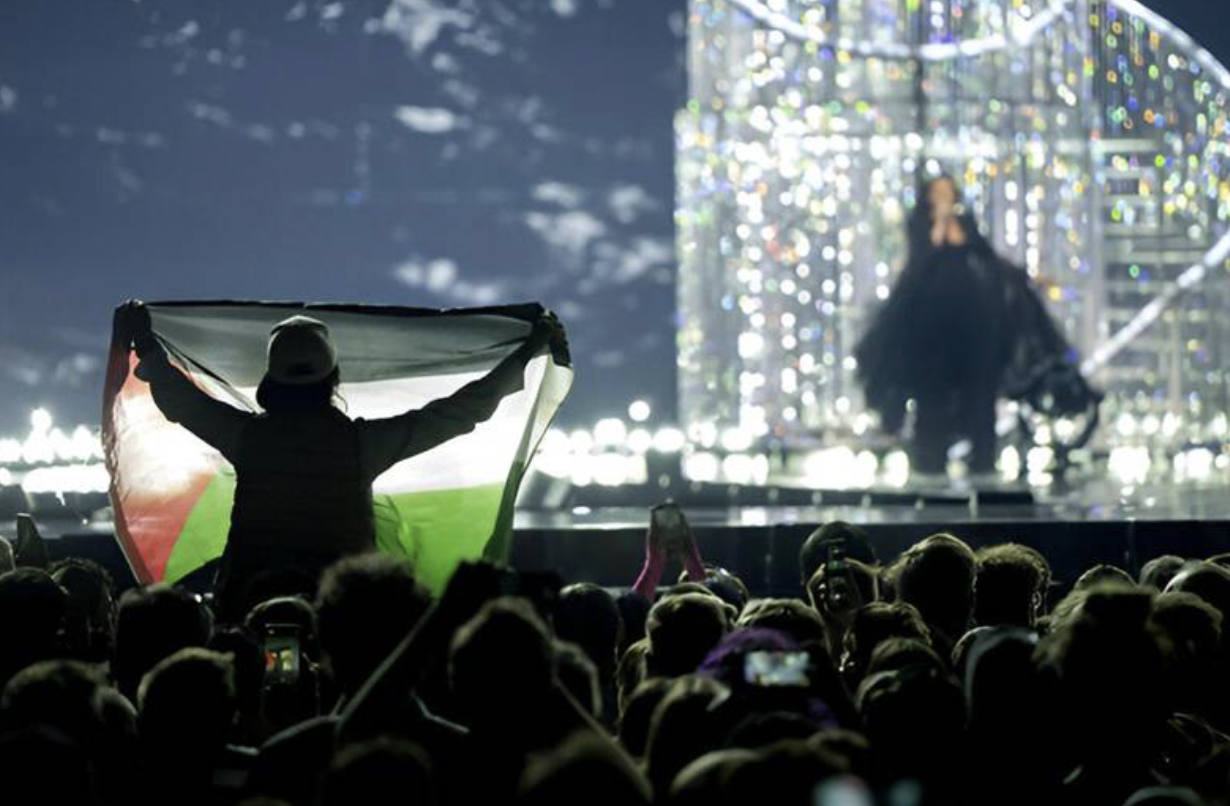
AFP file photo of a visitor holds up a Palestinian flag during Yuval Raphael's performance for Israel in Basel last year.
Eurovision 2026: The Year of Eastern Europe
In spite of the unprecedented controversies and deep political turmoil that accompanied the contest throughout the entire process, Eurovision 2026 still managed to produce one undeniably historic moment in the face of Bulgaria’s first-ever victory in the contest. Against all expectations, DARA stormed the Wiener Stadthalle in Vienna with her winning entry, Bangaranga, an ode to personal strength and resilience amidst chaos and uncertainty, and managed to secure a long-awaited landslide victory for Bulgaria, winning both the jury and televote for the first time since 2017. Despite the fact that the odds consistently overlooked the country prior to the contest and predicted Finland to lift the trophy, Bulgaria’s indisputable victory successfully broke the record for the biggest margin between first and second place in Eurovision’s entire history.
Moreover, the victory of Bulgaria feels even more monumental considering the fact that the contest will finally return to Eastern Europe after ten years, with Ukraine being the last Eastern European country to host the contest back in 2017. The triumph not only led to scenes of profound celebration across Bulgaria, with colossal crowds gathering at Sofia Airport to welcome the winner, but also triggered the country to descend into utter madness and pandemonium, with public transport in the capital flashing the word “BANGARANGA” the day after Bulgaria’s victory.
In many ways, Bulgaria’s triumph in Vienna serves as a reminder of one of Eurovision’s greatest strengths: its ability to provide smaller and often overlooked European nations with a cultural platform unlike any other. For countries such as Bulgaria, Moldova or Ukraine, Eurovision has long represented a rare possibility to make their voices and messages heard, which proves to be especially crucial in current times when their very identity is under threat. Undisputedly, Eastern Europe came out as the biggest winner in Eurovision 2026 and effectively dominated the competition, with the returning countries, in the face of Bulgaria, Romania, and Moldova, managing to all comfortably enter and overwhelmingly occupy the upper half of the scoreboard, reaffirming the immense role the contest continues to play in the process of shaping cultural visibility for the European “periphery.”
Yet Bulgaria’s victory could not entirely mask the profound crisis surrounding the contest itself, since the symbolic weight of Eurovision’s seventieth anniversary was ultimately crushed by the political fire the contest found itself in. Many of the criticisms have been directed at the fact that the 2026 edition felt beyond hollow, particularly due to the absence of the five countries which walked out and the calls for boycotts and endless debates surrounding Israel’s participation, casting a considerable shadow over the contest. Despite the aforementioned turmoil, Israel received 220 points from the public, finishing in second place.
Most damaging of all, however, was the reputational cost the controversy inflicted upon Eurovision itself. What was once widely regarded as one of Europe’s few genuinely unifying cultural institutions now finds itself associated with accusations of hypocrisy and governmental interference. The EBU’s insistence on preventing Israel’s disqualification ultimately came at an extraordinary price: the largest boycott in Eurovision history, growing internal fractures among broadcasters, significant damage to the contest’s credibility and financial standing, and some of the lowest viewership and engagement figures in modern Eurovision history. Planning for Eurovision 2027 might already be underway, but before the contest eventually arrives in Sofia next year, the EBU will have to prepare an answer to the question looming ever since the Vienna edition ended: was it worth it?
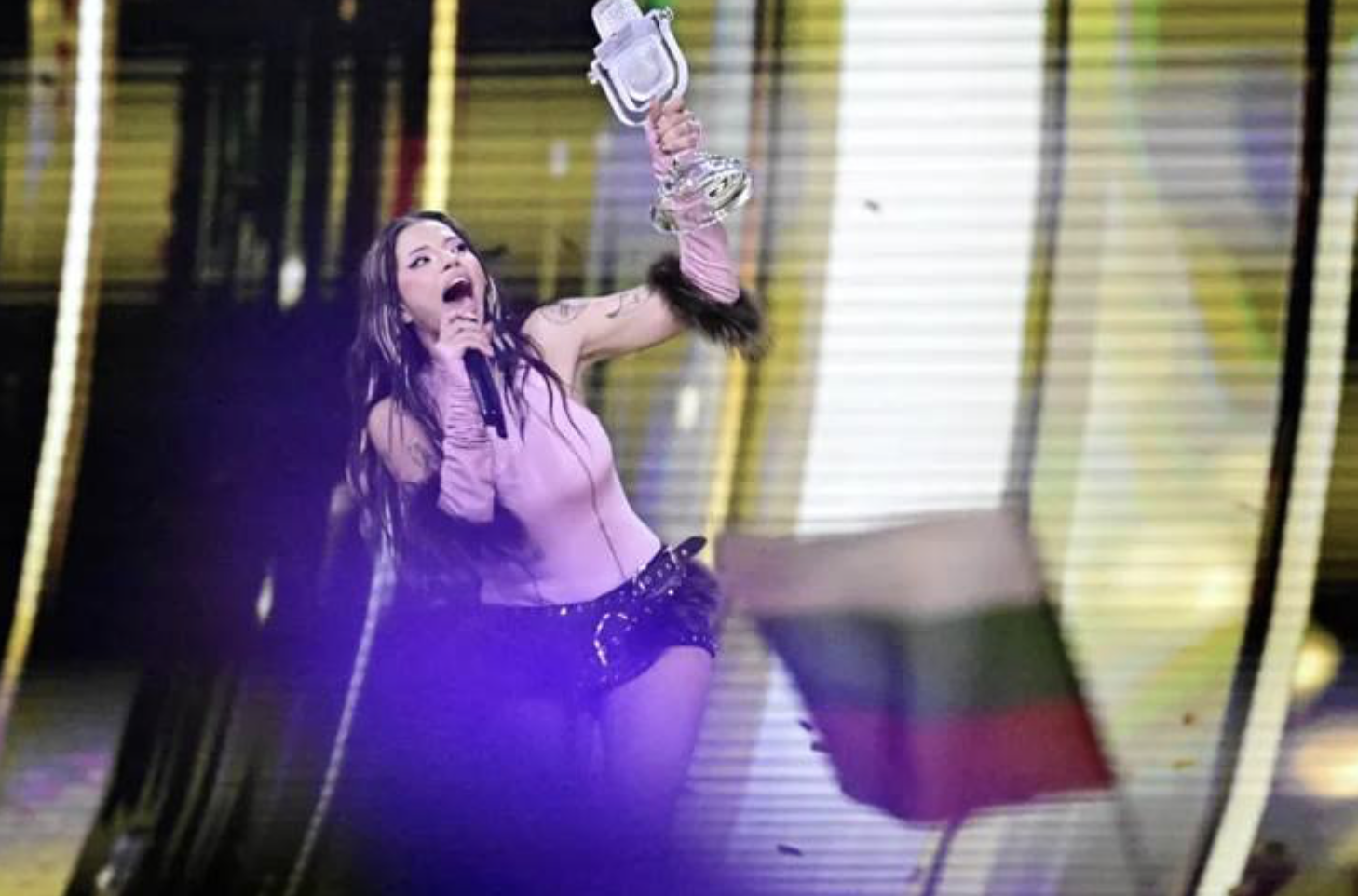
Bulgaria's DARA celebrates with the trophy after winning the final of the Eurovision Song Contest 2026 in Vienna, Austria, on May 16, 2026 [Tobias Schwarz/AFP]
Seventy years after Eurovision was created to heal a divided continent through the universal language of music, the contest now finds itself more divided than ever before. Bulgaria may have won Eurovision 2026 and an Israeli victory may have been successfully prevented for the third year in a row, but the competition itself emerged from Vienna exhausted and facing an existential question that can no longer be ignored: for how long can Eurovision deceive itself by assuming an “apolitical” label under a slogan of unity when the music itself has become secondary to the politics surrounding it?