

The Internet Frontline: How the White House and Iran turned conflict into content
Juliane Trabandt
Reading time: 4min
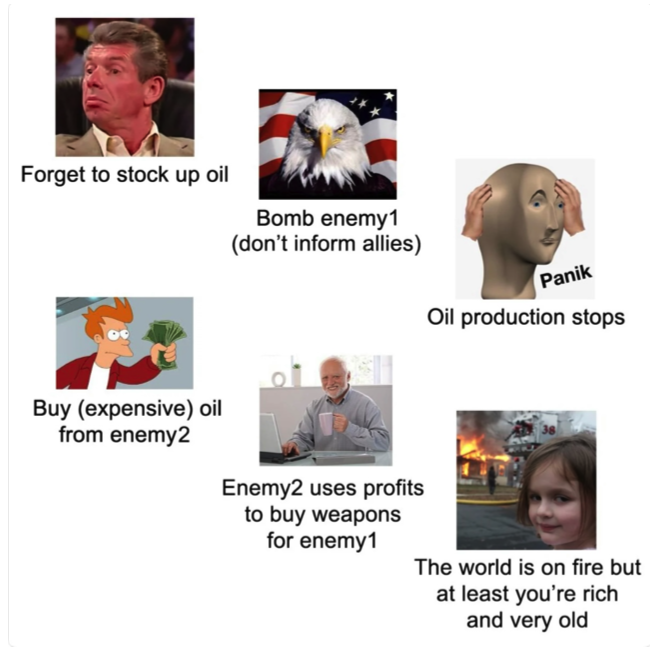
Meme by ec_dg_meme
When we talk about wars, memes used to be one of the last things we thought about. Yet, the war in Iran has opened up the floodgates to a new era of war-time propaganda.
But how did we get here? When the US and Israel first launched their attack against Iran, which is prohibited under international law, the US government needed to sell this war to its people – especially because Trump portrays himself as one to end conflicts, not start them. So, Trump needed to not only convince his political adversaries, but also his own voter base, that this war is justified. To do so, the White House has thrown traditional wartime communication strategies out the window and replaced it with a new strategy: the memefication of war. With this, the White House is trying to reach Trump’s core voter base of young men. Hence, the White House Social Media channels have been flooded with videos that intertwine real war footage with that of video games like Call of Duty and Blockbuster movies. What cannot be understated is that this communications strategy is deeply dehumanising, as it turns a real-life war where people are dying into entertainment. A senior White House official even admitted that there is “an entertainment factor” to this communications strategy to Politico.
The Iranian regime retaliated on the internet front – and is now winning that side of the war. Explosive Media, which is said to be independent from the Iranian regime, is behind the creation of several viral pro-Iranian, anti-US, and anti-Israel Lego videos that have gone viral. But these Lego videos are not the only reason why Iran is winning the internet war of framing this war. Iranian embassies all over the world have taken on a completely new communication strategy and are now repeatedly trolling the US president with their “shitposting” strategy. With this Iran is playing into the US’ downplaying of the seriousness of the war, as well as undermining the legitimacy of the US government itself. The Iranian videos capture many of the ailments the US president or government are facing – their connection to Epstein, for example.
With their Lego videos, the Iranian regime was able to capture American audiences and favouritism from both sides of the political aisle, because they learned how to speak American Internet Code. This does not only show Iran’s incredible deep media literacy, but also reveals something about the American hubris when starting this war – the US never bothered to understand the regime they are fighting. Iran’s internet communication strategy is clearly not targeted at Iranians, but at Western onlookers of the war. This is obvious when we consider the references and the fact that there is currently an internet blackout in Iran. With their communication strategy, Iran is helping the White House to downplay the seriousness of this war; however, they are also changing how to story is told. Iran’s Lego videos, as well as their other social media content, have garnered millions of views and audiences are highly receptive to them. Iran managed to make users forget or ignore the regime’s human rights violations, but paint itself as the underdog – and who doesn’t love an underdog story? Iran’s Lego videos, as well as their other social media content, have garnered millions of views and audiences are highly receptive to them. However, researches say that this goes further than just the war in Iran, as this opens new channels of framing wars and may change the future of diplomatic online communications of authoritarian countries. Iran’s rebranding from a repressive, theocratic regime towards a witty underdog is undoubtedly a big win of the regime and might be used as a blueprint for other regimes trying to achieve the same.
Iran’s partly successful reframing of the regime is not the only consequence of this side of the war. With tying the actual war to an internet-meme war, the war loses its seriousness. When looking at funny AI Lego diss tracks, it is easy to forget that people are dying because of this war. Nonetheless, the success of this strategy makes it likely that this will be repeated. Therefore, future wars also run the risk of being gamified, memefied, and with that dehumanised.