

Military mobility via railways - Interview with Terk Felix Kraft Part II
By: Olaia Mujika Anduiza and Lavinia Tacke
Reading time: 7 minutes
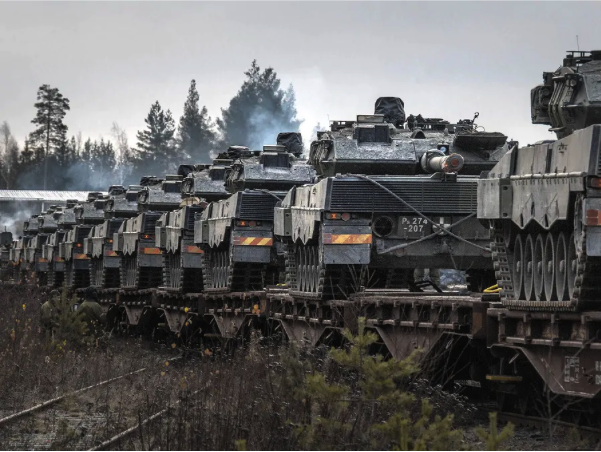
Source: Defense Industry Europe
Following the article in which we revealed the severe shortcomings of the EU’s military mobility infrastructure with expert Terk Felix Kraft, this article further specifies the Commission’s plans to change this scheme.
In July 2025, the Commission proposed a Military Mobility Package that came as no surprise. For some time now, both the Commission and EU Member States have highlighted the lack of military mobility coordination among Member States as a serious issue that needs to be addressed. The package thus appears intended to provide a concrete framework for addressing these long-standing coordination challenges.
Much remains unknown, as the legislative package has only been announced and still remains in the drafting phase. What we do know so far is that it aims to remove regulatory hurdles and to prioritise around 500 strategic projects, the identities of which are still unknown to the wider public, although it is possible to speculate on their likely scope.
Based on the general outlines already made public, we decided to interview a sector professional, Terk Felix Kraft (whom we also interviewed for the first part of this article), about the industry’s perspective on military mobility. His first impression is that the package is comprehensive, addressing border-related bureaucracy and introducing a degree of prioritisation in terms of which projects should be implemented first. With the sense that the Commission “really did its homework”, Felix sees the package as a long-awaited step in the right direction, one that reflects many of the sector’s longstanding requests, while still leaving room for improvement.
Below are the main takeaways we have gathered about this proposal:
1. When the military hires the market
Today, military equipment is increasingly transported using civilian means. Felix stressed that the involvement of civilian companies in military logistics is standard practice, since “our armed forces (those of EU and NATO members) simply do not have sufficient capacity”, and because “if we wanted the military to fully cover and maintain these capacity needs, it would be extremely expensive”. This, he emphasised, is ultimately “a political decision”.
This is a trend the Commission’s proposal explicitly reinforces. Beyond benefits such as optimisation and clear infrastructure improvements, it also helps ensure that the resulting reforms are sustainable in the long term.
However, recent cases in Germany, where military equipment was stolen during civilian road transport, have raised security concerns. Felix reassured that civilian contractors are generally subject to security clearances and strict standards, noting that incidents such as theft or infrastructure disruption are “not always politically motivated”. In some cases, such as copper theft, the motive is purely financial, with materials stolen for resale on the black market.
Sabotage, by contrast, is often carried out by “throwaway” or disposable agents, recruited online (frequently via Telegram) who may be ideologically sympathetic, blackmailed, or simply paid, and are often “not aware of the full purpose of their actions”. Their tasks can range from placing objects on railway lines to using drones to monitor logistics hubs.
Ultimately, Felix pointed to the need for national governments and the EU to strike “a balance between the measures you are willing to take, the cost you are willing to bear, and the level of security you want to achieve”. While singular countries have so far found their own equilibrium, he warned that Europe may now need to “agree on a common one”.
2. Tracks, clouds, and solidarity: Inside the Mobility Package
During the interview, we also focused on three elements of the package: digitalisation, the solidarity pool, and the European Military Mobility Enhanced System (EMMES).
Despite near-daily cybersecurity threats (many attributed to Russia), Felix stressed that digitalisation remains indispensable. He described the accelerated rollout of ERMTS (which creates a digital double of each train, pooling them in one system) and FRMCS (a common European communications standard) as a long-standing industry demand and argued that their implementation should be mandatory, noting that “governments would be able to requisition these assets in a conflict anyway”. Such a system, he added, must be accessible, digitally managed, and resilient to satellite disruptions or major power outages, relying on European cloud providers.
On the solidarity pool, Felix said it had been “one of our core demands”. He observed that policymakers themselves lacked a clear overview of where key assets are located, calling the initiative “a very good starting point”, while regretting that participation remains voluntary for EU Member States.
Turning to EMMES, Felix argued that the railway sector is well prepared to manage EU-wide prioritisation in times of crisis. However, he cautioned that while infrastructure managers are ready, much of the specialised rolling stock is owned by private companies, and it remains unclear whether these actors would be willing to contribute under the same conditions as state-linked operators such as SNCF or Deutsche Bahn.
3. If Felix had the pen: Funding first, geography second
Still, Felix was clear that the proposal is not perfect. If he could amend it, his first priority would be to “increase the level of funding”. Beyond financing, he would place much greater weight on the military relevance of projects than on ensuring a proportional geographic distribution among EU Member States. He would also make the military mobility catalogue (or solidarity pool) mandatory.
Felix further stressed the need to prioritise the security and resilience of digital railway systems, notably ERTMS and its communications counterpart FRMCS. Referring to last year’s train accident in Greece, which “could likely have been prevented” had ERTMS been fully operational, he underlined that these systems also have a clear military dimension. Drawing lessons from the war in Ukraine, he argued that secure communications are essential, particularly in extreme scenarios such as evacuating “up to one million people from the Baltic States through the Suwałki Gap” while military forces are simultaneously moving in the opposite direction.
4. Racing the clock, mind the gaps!
When it comes to implementation, challenges extend beyond sovereignty and funding; above all, Felix notes that “the key constraint is time”. Although intelligence assessments differ, there is a broad consensus that by around 2030–2032 (possibly even earlier), Russia could be capable of launching a conventional attack against Europe. This sense of urgency makes the timely delivery of infrastructure projects “absolutely critical”, in Felix’s words.
Flagship examples of work to do, and possibly within those 500 projects that will be prioritised include Rail Baltica and elements of Poland’s high-speed rail network, which would “free up capacity on conventional lines” for military movements. Other frequently mentioned corridors, such as the Iron Rhine, Betuweroute, and the Montzen line between Antwerp and the Cologne region, highlight how military mobility depends not only on missing links but also on political will and technical constraints, including “steep gradients and tunnels that require specific locomotives for heavy military convoys”.
In Southern Europe, the Lisbon–Madrid high-speed line is closely tied to the strategic role of the port of Sines as “a potential landing point for North American NATO forces”, yet building the line in Iberian gauge with plans for later conversion is criticised by Felix as “unnecessarily inefficient”. Finally, projects once abandoned are re-entering the debate: the cancelled Rotterdam–Groningen–Bremen/Hamburg line is now being revived, with Dutch provinces explicitly “using the military mobility argument” in negotiations in The Hague.
5. When connectivity becomes strategy, all aboard!
When asked about possible Russian reactions, Felix stressed that “building infrastructure on one’s own territory is not an act of war under international law”. Russia may frame such projects as hostile, but that does not make the claim legally or politically credible.
In Felix’s own words, “one has to ask why Russia would object so strongly to a railway project like Rail Baltica, unless it had intentions related to the Baltic States”. Running north-to-south from Tallinn to Warsaw, Rail Baltica does not enable an attack on Russia, but it strengthens NATO and EU resilience and mobility in the region, which is precisely why Moscow has previously mobilised Russian-speaking minorities and orchestrated media campaigns against it. Similar tactics can be expected as new military mobility projects advance.
Still, Felix notes that Russian resistance should not deter Europe; on the contrary, it “underlines why these projects are necessary”. Russia has fired intercontinental, nuclear-capable missiles at Ukrainian cities and attacked nuclear power plants in Ukraine. “They don’t need us Europeans in order to needlessly escalate.”, Felix says. They have violated NATO airspace with armed aircraft, including recent incidents over Estonia, an act that “could have been interpreted as acts of war, if Estonia and NATO wanted to”, and the fact that it was not reflects political restraint rather than legal obligation. As a dictatorship, Russia “will use any pretext it sees fit”, but that reality cannot shape European decision-making down to its mobility infrastructure policy.
At the same time, the package makes a modest but tangible contribution to Europe’s military autonomy. By strengthening the European rail industrial base, it reduces reliance on non-European suppliers, “a positive step,” according to Felix. Other EU initiatives, particularly in satellite infrastructure linked to systems such as ERTMS and FRMCS, may go further. Expectations should nonetheless remain realistic: enhanced rail-based military mobility will not fundamentally alter Europe’s security dependence on the United States.
At the end of the day, “ground transport is not where that dependency lies”.