

By: Pia Ajdarovič
Reading time: 7 minutes
From a continent devastated by two world wars to a Union of 27 Member States, European integration has undoubtedly come a long way. What began as a peace project, primarily intended to prevent another armed conflict between European powers, gradually developed into one of the most ambitious political and economic projects in modern history. Yet, the European Union as we know it today was not established through a single agreement. Instead, its foundations were laid through decades of negotiations, political compromises and international treaties. From Rome to Maastricht and eventually Lisbon, each treaty brought Europe one step closer to the Union we know today.
The EU Was Not Built in a Day
Much like Rome, or really any other great thing for that matter, the European Union was not built in a day. Following the end of World War II in 1945, many European countries felt incentivised to form a union in any shape or form in order to provide for mutual safety.
The destruction in war-torn Europe was staggering. Approximately 60 million deaths, including civilians, destroyed infrastructure, severely weakened economies, political instability, food shortages, large-scale displacement, and another generation lost. These are just some of the many destructive consequences the Second World War left on the European continent.
Since the 1870s, France and Germany, leading European forces, had fought three major wars: The Franco-Prussian War in 1870, the First World War from 1914-1915 and the Second World War from 1939-1945. For France and Germany, whose rivalry led to devastating consequences for the continent, reconciliation had become a political necessity. In order to prevent further armed conflict between them, Western European governments increasingly viewed economic and political cooperation as a way to strengthen the continent’s security. Today, the EU is more than a means of preventing another war, but at the beginning, this was its primary incentive. Before Europe became a common single market, a political union or a community of free citizens, it was first and foremost a peace project and the Union as we know it today was born from this very peace project of the last century.
The First Steps Towards European Cooperation
Zurich, September 1946. Speaking at the University of Zurich, Winston Churchill, in one of his most famous speeches, called for a form of European unity, or in his words: “We must build a kind of United States of Europe. In this way only will hundreds of millions of toilers be able to regain the simple joys and hopes which make life worth living.”
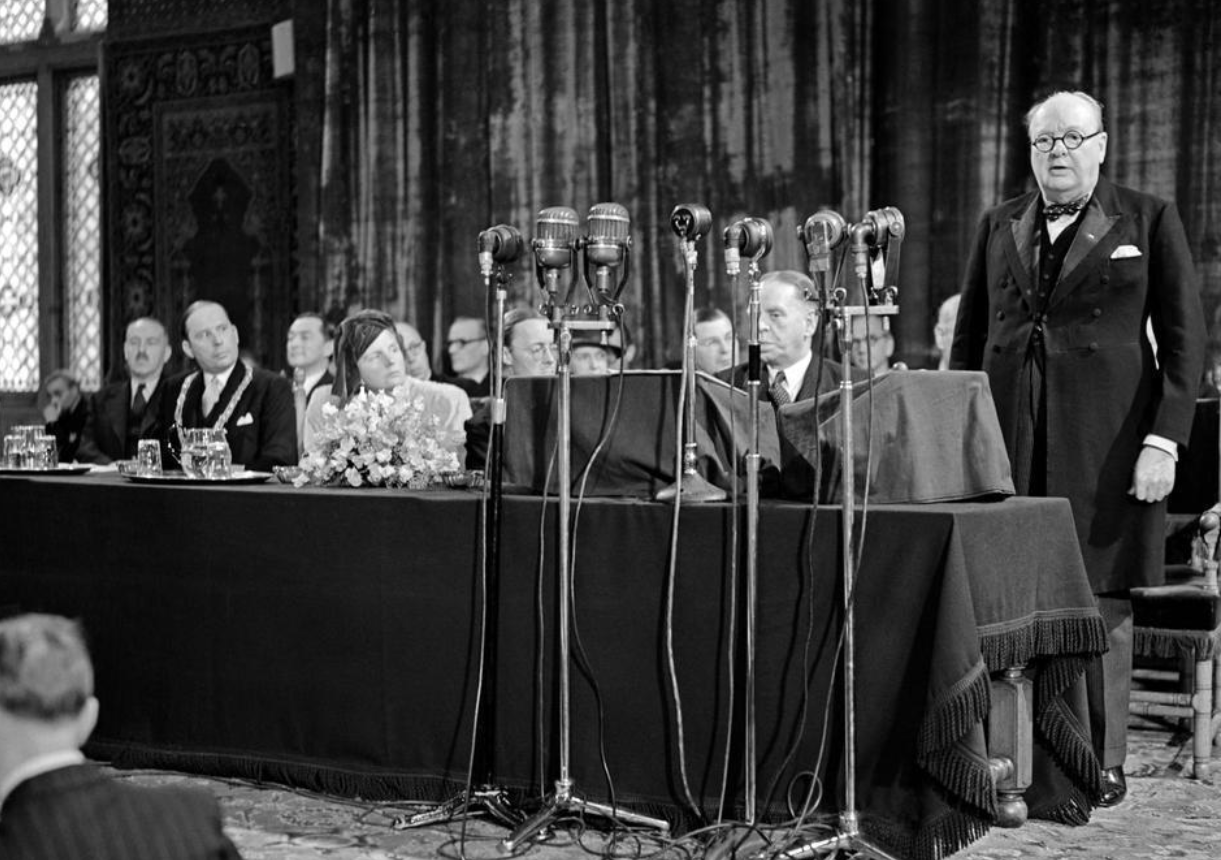
Koos Raucamp / Anefo CC0
Not two years later, in 1948, the Organisation for European Economic Cooperation (OEEC) was established with the intention to coordinate the distribution of American economic aid provided by the US’s Marshall Plan. In the context of unifying Europe in the name of peace, the Council of Europe was established in 1949, consisting of Heads of State and Heads of Government of its 10 founding members - Belgium, Denmark, France, Luxembourg, Ireland, Italy, the Netherlands, Norway, Sweden and the UK. It was based on the Statute of the Council of Europe, signed on May 5th 1949, in London (also known as the Treaty of London). Its core purpose was to promote human rights, parliamentary democracy, and the rule of law across the old continent. While it still remains a separate organisation from the European Union, the Council of Europe played a pivotal role in laying the foundations for European cooperation by promoting shared democratic values and encouraging dialogue between European states as an institutional commitment, not merely a diplomatic choice.
The European Coal and Steel Community
In 1951, on the proposal of the French Foreign Minister Robert Schuman to place French and West German coal and steel production under a common authority, six countries signed the Treaty of Paris, establishing the European Coal and Steel Community (ECSC). France, West Germany, Italy, Belgium, the Netherlands and Luxembourg became its founding members, with participation open to other European countries. The treaty entered into force one year later, with its main goal being to control the general production of steel and coal - two main raw materials needed for arms production. By placing these strategic resources, often weaponised in times of political turmoil and grievances between European nations, European governments hoped to make another war in Western Europe not only politically undesirable, but practically difficult to execute.
For the first time, six European countries agreed to place important aspects of their economic activity under a common supranational institution, marking the modest beginning of the EU project by making European integration inseparable from a common institutional foundation.
Why Treaties Became the Building Blocks of European Integration
In contrast to a state founded through a single constitutional “episode,” European integration emerged gradually through international treaties voluntarily negotiated and ratified by participating states, in accordance with their own constitutional requirements. Unlike traditional international cooperation, the European Communities introduced supranational institutions, capable of exercising powers conferred upon them by the Member States.
In this sense, European countries agreed to exercise certain powers collectively and jointly, rather than exclusively at the national level. By ‘giving away’ part of their sovereignty, they effectively reaffirmed their (for some) newly gained autonomy. The treaties on which the EU is based became both the legal foundation and the driving force of European integration, establishing common institutions, defining their powers, and determining the obligations of participating countries. Each major treaty encompassed a further stage of integration, whether by expanding cooperation into new policy areas or reforming and adapting existing institutions. Thus, the EU did not emerge from a single constitutional outset, but expanded and developed gradually through successive treaties, political compromises, and institutional reforms.
The Treaties of Rome - The Foundation of European Integration
Following the establishment of the European Coal and Steel Community in 1951, the six founding countries began exploring further integration. On March 25th 1957, Belgium, France, West Germany, Italy, Luxembourg and the Netherlands signed the Treaties of Rome, establishing the European Economic Community (EEC) and the European Atomic Energy Community (Euratom). The EEC aimed to create a common market by gradually removing trade barriers and introducing the foundations of free movement of goods, persons, services and capital. On the other hand, Euratom focused on cooperation in the peaceful development of nuclear energy. While primarily economic in nature, the Treaties of Rome laid the foundations for the European Union we know today.
The Maastricht Treaty of 1992 - The Birth of the European Union
The Maastricht Treaty, also known as the Treaty on European Union, was established in Maastricht on February 7th 1992, signed by twelve European countries in the presence of the then President of the European Parliament, Egon Klepsch.
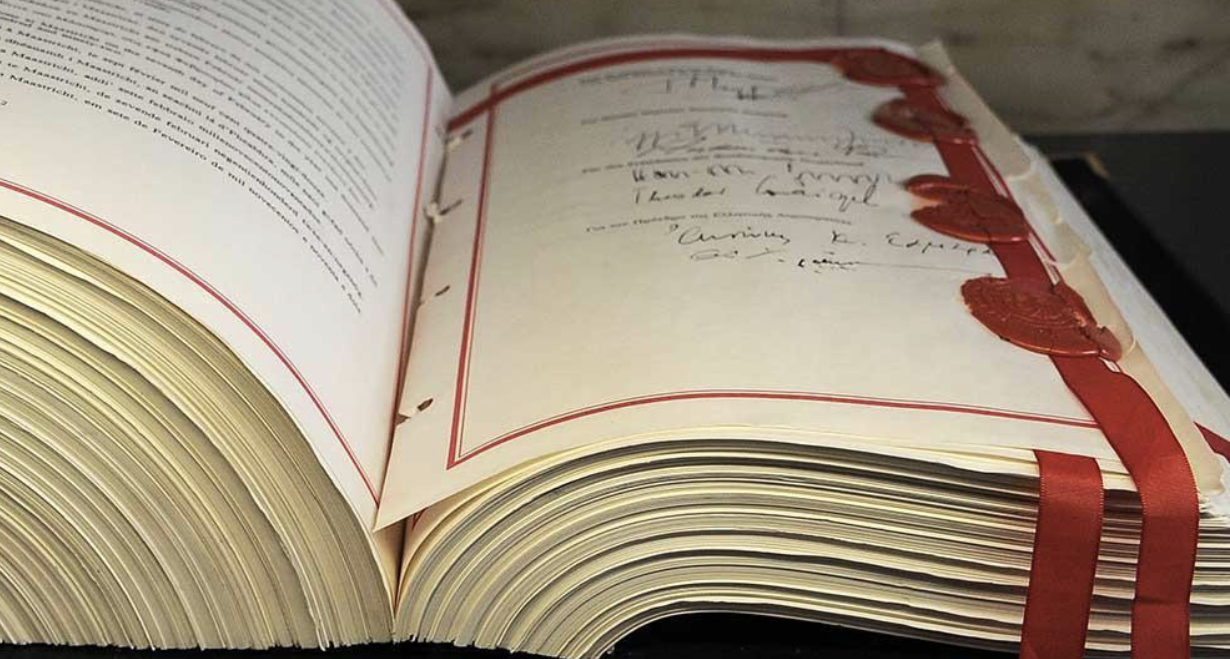
EUR-Lex / Wikimedia Commons
Under the Maastricht Treaty, the European Union was formally built on three pillars, expanding the scope of European cooperation beyond merely economic integration. The treaty also gave the European Parliament more power in making laws and overseeing other EU institutions. Moreover, the introduction of the co-decision procedure allowed Parliament to have a greater say in adopting European legislation. The European Parliament also gained the right to ask the European Commission to propose new laws. Additionally, the European Commission as a whole now needed Parliament's approval before taking office, and Parliament became responsible for appointing the European Ombudsman, who investigates complaints about poor administration by EU institutions.
Three Pillars, One Union
The Maastricht Treaty organised the EU around three main pillars, reflecting different aspects of EU integration: European Communities, Common Foreign and Security Policy and Justice and Home Affairs. The first pillar, perhaps the most commonly known, comprised the already existing European Communities, including the European Community (formerly the EEC), Euratom and the ECSC. It mainly covered economic integration, the common market, and numerous common policies, including legally binding Community law.
The second pillar introduced the Common Foreign and Security Policy (CFSP), providing a framework for coordinating Member States’ foreign and security policies, aiming at promoting common values like peace and security, while preserving national control by leaving decision-making predominantly intergovernmental.
Lastly, the third pillar, Justice and Home Affairs (JHA), introduced closer cooperation in areas like asylum, immigration, and judicial cooperation. It relied primarily on intergovernmental decision-making and intended to address cross-border challenges that individual states could not effectively manage alone.
Although the three-pillar system would eventually be abolished by the Treaty of Lisbon, its legacy lies in special rules and foreign security policies the EU still follows today.
The Road to the Euro
Among the Maastricht Treaty's most significant achievements was laying the foundations for the Economic and Monetary Union (EMU) framework, paving the way for the introduction of a single European currency. The main objective was to strengthen economic integration by coordinating Member States' economic policies and eliminating exchange rate fluctuations between participating countries. Additionally, the Treaty also established certain economic convergence criteria that countries had to meet before adopting the euro, encompassing stable inflation, public finances, exchange-rate stability, and interest rates. Furthermore, it laid down the framework for establishing the European Central Bank (ECB), responsible for managing the common monetary policy.

Daniel Lobo, CC BY 2.0.
On January 1st 1999, the euro was officially introduced for electronic payments and accounting purposes, followed by banknotes and coins which entered into circulation in 2002. Although not every single EU Member State has adopted the euro, it remains one of the most tangible and recognisable achievements of European integration. Fundamentally, it marked a pivotal moment in EU history as it formally made what had once been an ambitious political objective a part of everyday economic life in the Union.
EU Citizenship
Perhaps one of the most far-reaching changes introduced by the Maastricht Treaty was the establishment of European Union citizenship. For the first time, citizens of Member States were not only nationals of their own countries, but also citizens of the European Union and thereby acquiring rights that extended beyond national frontiers. Crucially, the EU citizenship did not replace national citizenship, but rather introduced additional rights that complemented it and which individuals could exercise across the Union.
These rights included the right to move and reside in other Member States, as well as the right to vote and stand as candidates in municipal and European Parliament elections in their country of residence, even if they were not nationals of that country. Additionally, EU citizens gained the right to petition the European Parliament and seek assistance from the European Ombudsman. With these changes, European integration went beyond economic cooperation and began directly influencing the everyday lives of its citizens, undeniably reformulating the character of European integration.
The Treaty of Lisbon - Shaping the EU as We Know It Today
By the beginning of the twenty-first century, the EU faced an increasingly complex change in the face of accommodating its institutions for new members of the Union. Following the EU's largest enlargement in 2004, its institutions required further reform for the growing membership. After the proposed European Constitution was ultimately rejected in French and Dutch referendums in 2005, European leaders negotiated a new agreement.
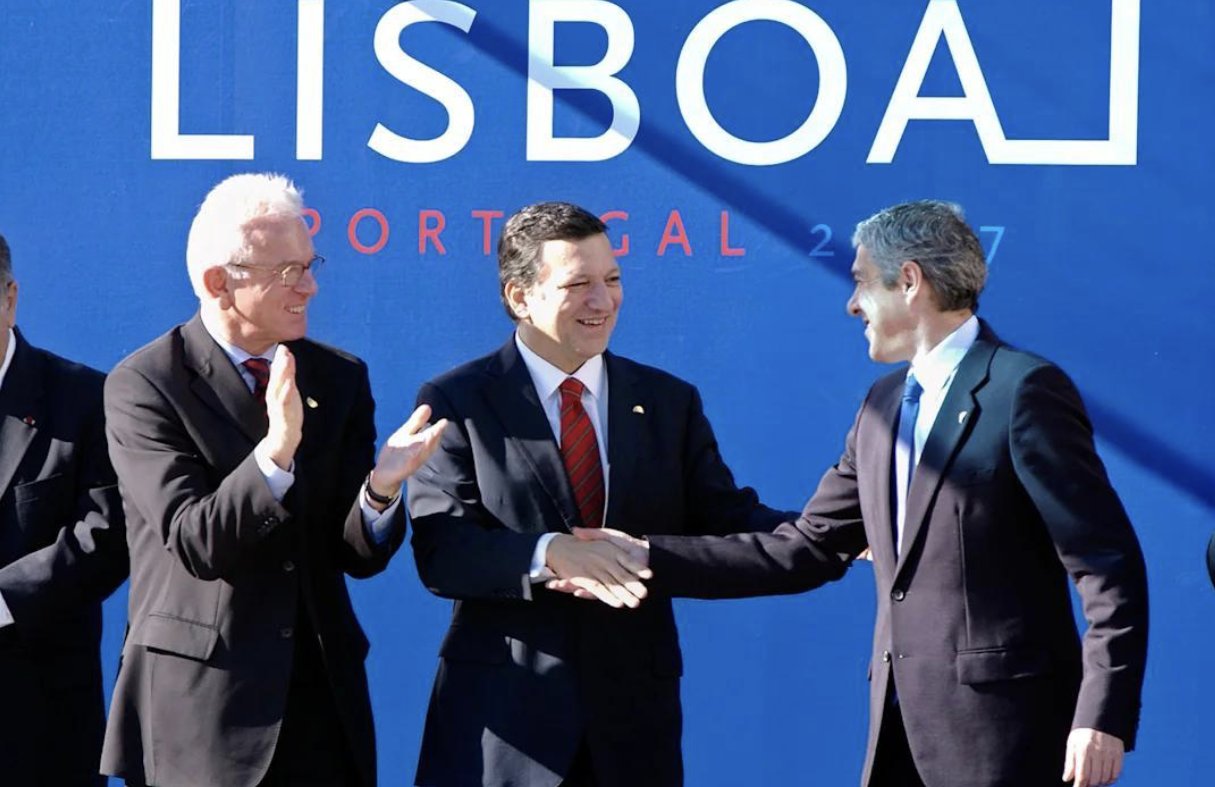
Manuel Correia / Wikimedia Commons.
Signed on December 13th 2007, the Treaty of Lisbon was the result of this arduous process, entering into force on December 1st 2009. Rather than creating an entirely new constitutional framework, it reformed the existing treaties and substantially reshaped how the EU operates. Mainly, it abolished the three-pillar structure, strengthened the European Parliament's legislative powers, and made the Charter of Fundamental Rights legally binding and, legally, on an equal footing with the treaties.
Perhaps one of its most historically significant provisions was Article 50 TEU, establishing an explicit procedure for withdrawing from the Union, with its historic significance becoming clear when it was later invoked by the United Kingdom during Brexit.
Ultimately, theTreaty of Lisbon went beyond modernising the EU framework, directly shaping much of the EU's present institutional framework, although debates about national sovereignty and European integration persist to this day.
An Ever-Closer Union, yet an Unfinished One
From the Treaty of Paris to the Treaties of Rome, through the avenues of Maastricht and Lisbon, the history of European integration is one of gradual transformation, rather than inevitable progression. Each treaty emerged as a pivotal chapter from the particular challenges of its time and socio-political context.
To be continued…
From the Treaty of Paris to the Treaties of Rome, through the avenues of Maastricht and Lisbon, the history of European integration is one of gradual transformation, rather than inevitable progression. Each treaty emerged as a response to the particular challenges of its time, gradually shaping the Union's institutions, competences and relationship with its citizens. What once began as an attempt to secure peace through economic cooperation has since developed into a much broader political and legal project. Nevertheless, questions concerning sovereignty, democracy and further integration remain unanswered. After all, European integration is not merely a chapter of history, but an ongoing process.
