

Artificial Intelligence and the future of work: What students need to know
By Aurora Dagnino, reading time: 3 minutes
We are in 2026 and nowadays it is basically impossible to count how many people use AI in their daily tasks or to study. Indeed, not only students use AI, but also employers, leading to a change in the job market.
This raises many doubts for us students, who are currently looking for a job or planning to do it in the future. For example: will generative AI replace my job, or improve it? What has been the impact on the labor market so far?
Artificial intelligence is modifying the labour market in a deep but often misunderstood way. It is not simply “taking jobs”; instead, it is changing what people do at work, which skills matter, and who is beneficial for the economy.
For instance, after the release of ChatGPT in 2022, job postings for roles involving repetitive tasks fell by 13%. At the same time, demand for jobs requiring analytical, technical, or creative skills, which can be strengthened by AI, increased by 20%.
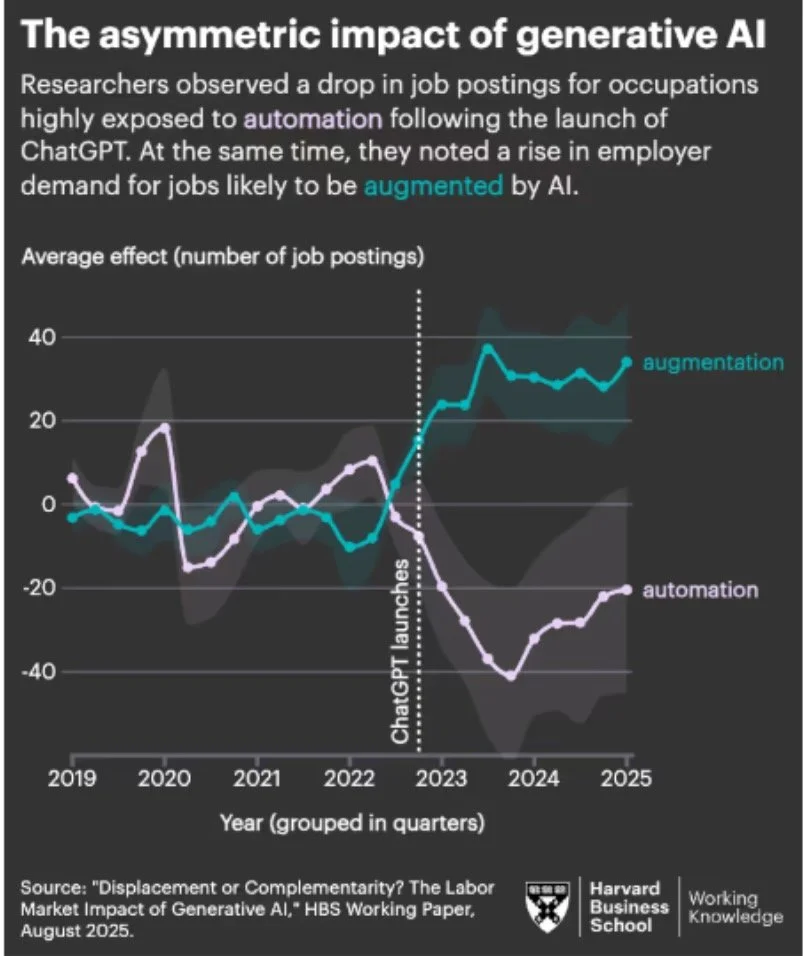
It must also be said that AI mostly affects tasks, not entire jobs. Many jobs are made up of different activities, and AI is good at handling routine, repetitive ones. For example, a worker may spend less time on basic tasks such as handling scheduling and processing data; but more time on thinking, planning, or solving problems.
Artificial intelligence is changing different sectors in different ways, depending on the type of work involved. Two clear examples of this are retail and healthcare, where AI is transforming jobs but in very different directions.
In the retail sector, AI is mainly used to automate routine tasks and improve online services. For instance, AI can suggest products to customers, and answer basic questions through chatbots. Due to this, some traditional roles, such as cashiers or in-store assistants, are becoming less important; while there is growing demand for roles in online sales, digital marketing, and customer experience. In this way, retail is moving away from physical, routine work toward more digital and service-based roles.
In healthcare, the impact of AI is quite different. Instead of replacing workers, AI is mostly used to support them. For example, AI can analyze medical data, help doctors detect diseases, and assist in making diagnoses. This reduces the time spent on paperwork and data analysis, allowing healthcare professionals to focus more on patients. Doctors and nurses are still essential because their work requires human judgment, communication, and care, things that AI cannot at all replace.
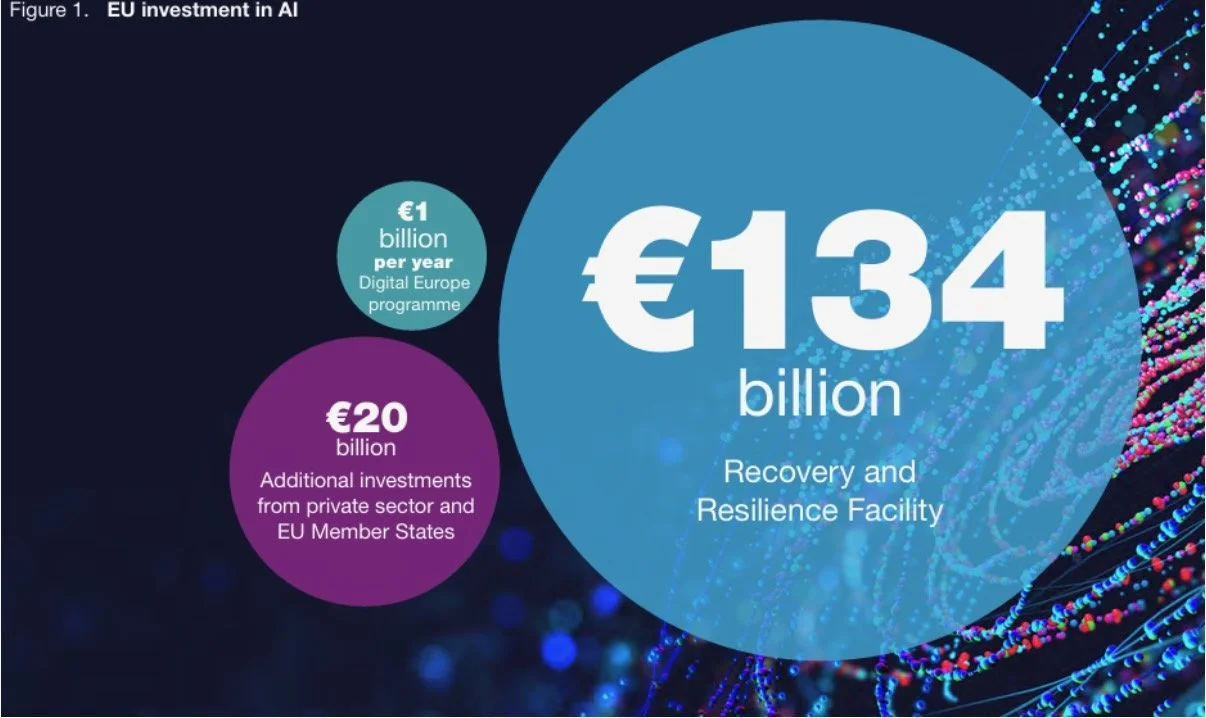
The European Union has recognized and acknowledged the growing presence of AI in every aspect of life, thus it has invested a huge quantity of money to support the development of trustworthy AI, culminating in the adoption of the European AI office.
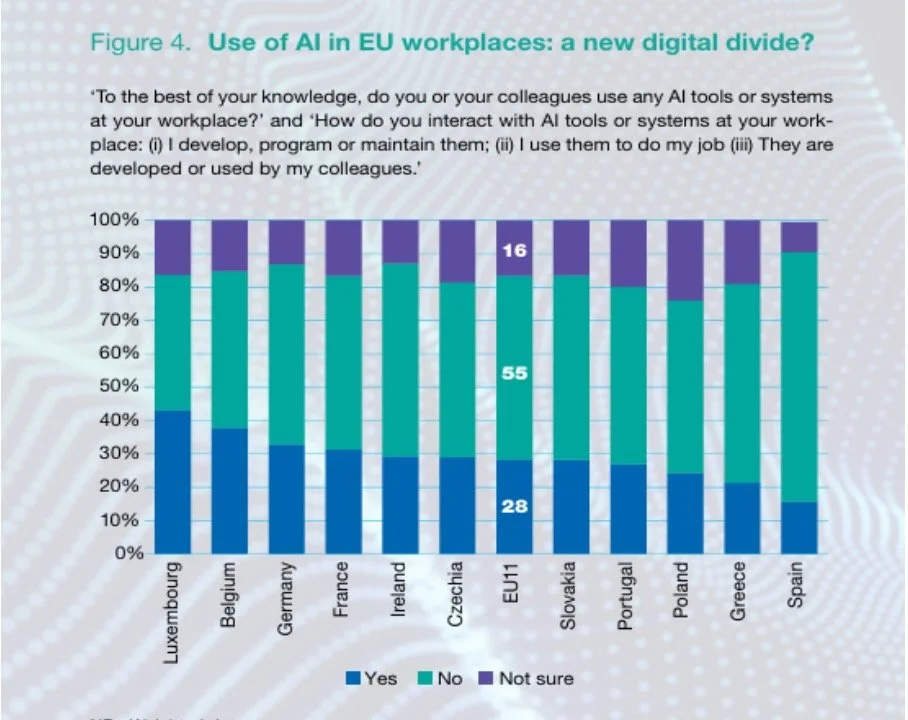
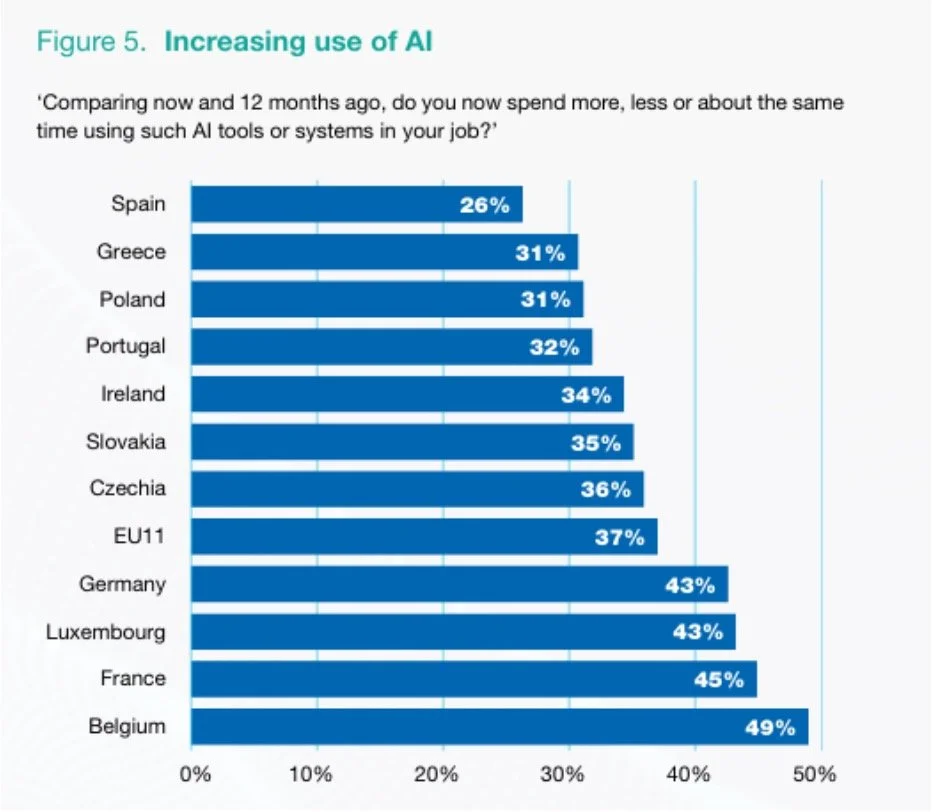
More than 1 in 4 (28%) adult European workers reported that an AI tool or system is used in their workplace, by themselves or by colleagues. It is interesting to point out that AI use is more common in some western European countries (Belgium, Germany, France, Luxembourg) than it is in southern European countries (Greece, Spain, Portugal).
Having said this, what can we do to increase our ability to navigate the current work scenario dominated by AI technologies?
Be curious
The first step is exploring what’s available and experimenting with it. AI is already part of our daily routines, consider when you use a voice assistant, interact with a smart speaker, or rely on live chat while shopping online. So, why not explore and get familiar with some of these AI tools that have been created and are freely accessible?
Understanding What’s Happening Behind the Scenes
It may help understand how employers are using AI. When you click “submit,” your resume goes into an Applicant Tracking System (ATS) that scans for keywords and qualifications. Up to 75% of resumes don’t make it past this initial screening. If this sounds discomforting, bear in mind that AI is being used to enhance efficiency, but human judgment still dominates final hiring decisions. Only 8% of companies use AI throughout the entire process.
Boost your skills
There are lots of virtual learning platforms out there offering short courses for beginners, some of them are also free. Some examples are can be found on Coursera, Udemy, LinkedIn and Elements of AI.
Strengthen your human skills
There are certain abilities that employers highly value that AI cannot reproduce, skills like problem-solving, communication, emotional intelligence, and leadership. To stay competitive, it’s important to keep improving these strengths in a world where AI excels at handling the technical side.
Look for intersections between your interests and AI.
Think about how technology can enhance what you already enjoy or want to pursue. Whether you’re interested in art, business, healthcare, or law, there are growing opportunities to apply AI in meaningful ways. For example, if you want to work as a lawyer, AI tools can help with legal research, contract analysis, and case preparation, making your work more efficient.
In conclusion, artificial intelligence is not replacing jobs, but changing how work is done and what skills really matter. For students, this creates both uncertainty and new opportunities.
What really stayed with me is something one of my professors said: AI is a tool. It can make intelligent people even smarter, but it can also make unintelligent people more unintelligent.
By staying curious, improving both technical and human skills, and understanding how AI is actually used, students can take advantage of these changes instead of fearing them.