

Preparing the Public Sector for the FutureInterview with Florian Stupp, co-founder of Public Makers
Written by Anneke Pelzer, Reading time 7 minutes
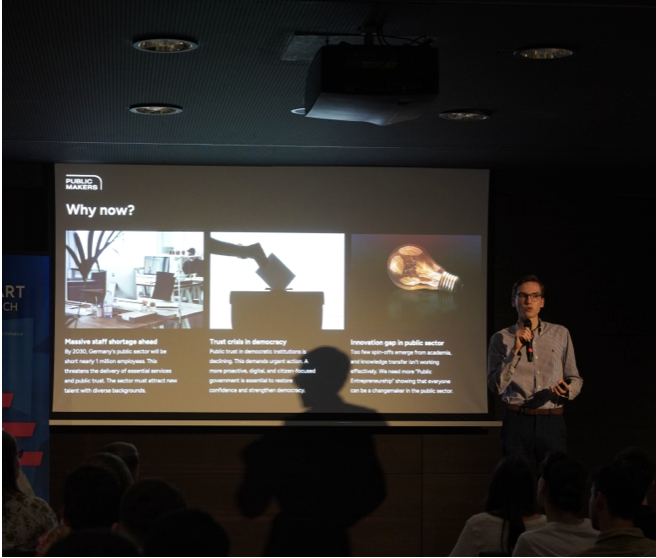
Interviewee Florian Stupp, credits: Public Makers
Europe’s public sectors face many challenges: democratic backsliding and declining trust in governments, aging societies entail a crisis in social security systems, and economical pressure intensifies. In Germany, Florian Stupp and Yannic Plumpe founded the NGO Public Makers with the vision to tackle these problems. By engaging young people in public change they want to foster innovations to strengthen the German public sector. Whether through hosting so-called Hackathons, Bootcamps, or Micro Masterclasses: Public Makers aims to inspire students to transfer their knowledge into valuable solutions. I had the chance to speak with Florian about Public Makers and the vision they have for future-proof public sectors. Florian is currently studying Information Engineering at the Technical University of Munich. He recently received the Young Leaders in GovTech Award by Handelsblatt for his dedication to engage young people in the public sector.
Can you start by introducing yourself? Who are you and what do you do?
I am Florian, and I am the co-founder of Public Makers. With Public Makers we aim to turn young people into „public makers“. This comes from the realization that the public sector does not work for us as young people. That means that we don’t have the options to participate, co-design, or co-create the public sector. Our problems are not seen, and therefore, our goal is to connect young people and students with the public sector so that we can have a contribution in this field.
I think that’s really interesting. Do you have any examples for problems that you see specifically that you want to tackle with Public Makers?
The Public Sector is facing multiple challenges, which we want to tackle with Public Makers. First of all, the demographic change which is going on in Germany, and other European countries. By 2030, we will have a severe shortage of 1 million employees in the German public sector, so the capability to act will be reduced. We also lack the technical capabilities. In Germany we are still talking about fax machines and from a digital side, we are not as far as we wish to be. A third one is the lack of innovation and the ability to look into the future. We are more concerned about the status quo, but not what our life will look like in the next 10 years and what the government and administration can contribute. Those are the broad issues. Looking at students, we have a more optimistic perspective: we as a younger generation are quite interested in digital opportunities and how can we implement digital technologies in the public sector. We can, for example, tackle this issue with “Hackathons“ or co-creation formats to build digital prototypes with, and for, the public sector.
I mean, we are one of the first generations of students that can use AI, which changes quite a lot. That also leads to my next question: what brought you to the idea of founding Public Makers? Was there any key situation or was it just like a general problem that you came across again and again?
I founded Public Makers together with Yannic (Plumpe, editor’s note). We were both motivated to do something to create public value. We both had some experience when it came to the political
field, but also a background in tech, and were both wondering how to combine these two topics. We did not want to become active just for the sake of doing something, but wondering how we can create impact translating between those two fields. This lead us to the topic of public administration and innovation in this field. Yannic brought experience in the public sector, and we saw that something was going on. But nobody really looked at our generation. The change was only about the people who are currently in the public sector, but not about what the sector could look like, which other groups of people could be involved. Since we will be the next generation in the state, we believe that it is important to also look at us, so that we can contribute and build the solutions we need.
credits: Public Makers
Would you say there was one way to get in the position to found Public Makers? Because, of course, this is a big step. How did you get there?
The kind of journey of how we got there also resembles the idea we have at Public Makers. It is not about building the perfect solution or directly coming up as an expert that knows how everything works. Given the scale of challenges our state faces, no one has a perfect solution. It would be an illusion to think one has the perfect solution. So when we started Public Makers, we were really building one step at a time. We started with the first bootcamp to validate the idea of connecting young people with the public sector. Then we saw that, indeed, there was an interest, and started recruiting our team from the bootcamp. We then built more formats while cooperating with other student initiatives, but also cooperating with ministries and other governmental bodies. This is the philosophy which we follow at Public Makers when it comes the products we execute. Nobody has to come to us and be the perfect public entrepreneur or already be a public maker. For us, it is more about seeing problems and having the motivation to actually tackle them.
As you said, you don’t start with the perfect product. Which challenges have you faced? How did you overcome them?
There were many challenges we faced. It is inherent to the process of building something new that challenges will arise along the way. One core challenge was how to structure an organization, or how to set up everything internally. But also externally: working with the public sector is sometimes slow, and sometimes challenging, but even from that we profit. It is great to see how many allies we can find within the public sector who share the motivation of changing something. We are not alone in driving the transformation of the German public sector toward more innovative and digital solutions. Whether it is the Data Innovation Lab of the Federal Foreign Office, TUM.ai, START Munich or GovTech Germany: there are initiatives going on. Having the people behind these initiatives as allies really helped us to overcome some of the challenges of a slow public sector. It is about seeking people who have the same ideas.
I saw that you get a lot of support, for example from the Technical University of Munich (TUM) Campus Heilbronn or START Munich, which supports student entrepreneurs. How does that help you to reach your goals?
It helps us a lot because what we can bring in is the perspective of young people. We are, as an organization, not the most esteemed experts when it comes to entrepreneurship. We are not the best data scientists, we are not the best computer scientists. But what we really focus on is building the bridge between different disciplines. So, for example, with START Munich we built the START Public Makers lab. We worked together with municipalities who provided us with real cases, and we brought in the expertise from the public sector, while START Munich brought in their expertise in entrepreneurship and building digital solutions. Together we created the value. But we also got support from the TUM Campus Heilbronn, and the TUM Think Thank. It is great to have diverse partners from academia, public sector, and entrepreneurship on our side: bringing the perspectives together, we can draw the bigger picture of public sector innovation.
You already talked a little bit about this, but you also have a team coming from a very diverse background. How does that help you to shape Public Makers?
Our diverse team helps a lot, and is a driver of new ideas. Looking at the public sector, this looks different: we see a lot of lawyers, and people from administrative backgrounds. But at the same time, we see a shift in the paradigm. We need people who also understand code and not only law. We need people who are able to envision what a digital identity can look like. It is necessary to have people who cannot only implement future policies in law, but also in code. By bringing together all these perspectives we can bridge these gaps, so that we are not working against each other, but working together on a solution. Only with this interdisciplinary approach can we really tackle the challenges we face.
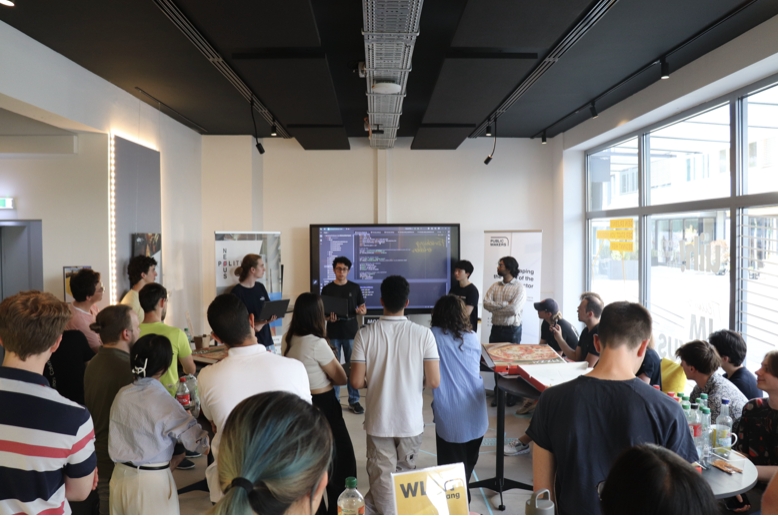
PoliTech Hackathon Pitches, credits: Public Makers
Looking at your website being formulated in English, I guess that you are also targeting an international audience. Why do you think we should also then work together with different countries?
There are multiple reasons. First of all, we can learn from each other. If we look at Estonia, or at the Scandinavian countries we can learn how to successfully implement a digital administration. We do not have to reinvent everything from scratch, but we can build up on these solutions. The first aspect is learning from each other and employing knowledge that already exists. Secondly, since we are in the same field, we share a common idea and understanding within the European Union, we often face challenges together. If we are talking about the digital administration, governmental technology interoperability between European countries is very important. What we achieved in the economic sector we should now also seek to achieve in public administration. If you move to another country, your data should be easily transferable. Interoperability should be a core asset of the public administrations of the countries of the European Union. When we talk about public administration and creating public value, we should use the European spirit on the idea of working together.
I totally agree with you! That is also something, when we look at Brussels, that, for example, the European Commission could probably target a little bit more in the future. I think it is very interesting that you especially target such a young audience. In a lot of situations, especially young people are overlooked or it gets underestimated what they can bring to the table. Obviously the team of Public Makers is still quite young. What value do you see specifically in what young people can bring to the conversation?
We are still at the beginning of our careers, and we have a long path ahead of us in our state, but we are also the ones who can shape it. We have the chance to create and contribute to the innovative state which we want to live in. As the young generation, we are not as influenced by the paradigms of public administration. We have the opportunity to not consider our administration slow, and paper based. We have the chance to think in a new way. We grew up with digital technologies. We look at it from a different angle. This is what we can bring to the table.
If you had one vision for the future, what would you like to see changing?
Coming from the background of Public Makers, I would love to see close ties between young people and administration that creates public value. We should not only listen to young people, but give them the possibilities to co-create the state the next generation envisions. We will not always be young, but there will be a young generation after us. For example with closer collaborations between universities and administrations we can create the state with the next generation. Close ties between the state and young people create this public value.
I think a lot of our readers can probably relate to the feeling of being overlooked and not knowing how they can translate their ideas into reality. As you want to engage more young people in the public sector, I would like to hear more about how you want to do that. Do you have any steps planned for the future that you want to take?
In the near future we are looking forward to expanding our team. The next recruiting takes place in April. We are now mostly based in Berlin, Munich, and Heilbronn. Our goal is to be more present all over Germany, having in-person formats and convince more young people to engage in the public sector to create public value through Public Makers. We believe, as you mentioned, that we are the generation with ideas and the will to create solution. Quite often we lack the avenues where we can take on this role and take action, which is what we want to offer.
Do you also see yourself expanding all over the European Union in your vision for the future, or even worldwide?
Looking at the future, yes. But over the next year we are focusing on building a core structure. We are still quite young as we founded Public Makers in summer 2024. For now we want to build our base in Germany, but we definitely want to look ahead. I believe that the Europe Union is a great project, where we can all work together and use the ideas that we have to learn from each other. But that is the long-term vision.
As the public sector is also quite wide, do you see one specific field that in your eyes needs the most attention?
It is hard to say that there is only one specific field. What gets covered in the media a lot and what we talk about often are definitely the issues in the digital public sector and digital administration. But a digital administration will not solve all our problems. So there is not a single field, we have to look at all fields to create public value. Using digital resources can happen when founding a company or startup, which then contributes to the public sector. There are multiple paths when creating public value. I am quite curious about what will come up in the future.
You touched upon this a little bit: what tips do you have for ambitious young people? How can they transfer their motivation and ideas into reality?
Public Makers would be one starting point to explore projects. We founded Public Makers by trying and exploring how our ideas could work. We started small. We did not have a whole strategy sketched out. But in the beginning we had an idea, we were exploring what worked and what did not. From there we continued with the next steps, and that is also how we started growing. We translated our ideas into action. We chose the name Public Makers with the “maker spirit“, which is probably more anchored in the computer science field, but it refers to our spirit as well: build the things you envision and turn them into reality. This is something we can only profit off. If in the end it turns out to be a failure, then we can still learn from that. So my advice would be to start making.
I totally agree! You can probably conclude it in try, fail, try again, and then see where it goes from there. Do you have anything that you want to give our readers on their way for the future?
Be courageous, and have a vision when looking into the future. Only if we contribute we have the opportunity to change the system. Even if it is small in the beginning, in the end we will shape the system. Then we have to have the courage to envision what our world can really look like. If it is about strengthening our democracy, every step we can take is worth it.
I think this is a very good note to end the interview on. Thank you so much for your time! We are excited what Public Makers is going to create in the future.