

The Benefits of a European Union & Australian Free Trade Agreement
Juliane Trabandt; 3 minutes reading time
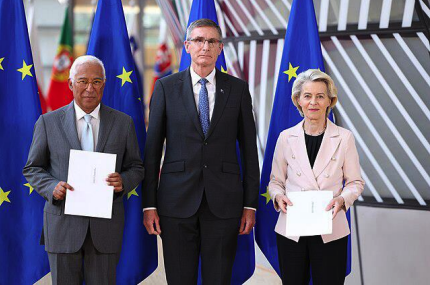
Ambassador Angus Campbell, Head of the Mission of Australia to the European Union - 2025.
5 years ago, if you’d asked me what I thought of a potential EU-AU free trade agreement, I would have said that in its infant form, it was a spit in the face of our agriculturalists, viticulturists, and other producers of our European primary industries. When talks broke down in 2023, it was over concerns that Australian producers would be wrongfully using the Geographical Indications for Traditional Regional Specialties, which protect the names of products with specific origins tied to a region. Could you imagine a Champagne coming from the outback, Mozzarella coming from Sydney, or Schwarzwälder Schinken coming from Brisbane? This would make not only my Mutti weep.
Now talks have gained momentum again, and the Australian government has seemed to have softened on the need to call their products by European names. Now that our ham and champagne are safe, we can focus on the benefits that a free trade with this faraway continent could offer.
Australia has a great amount of minerals that we don’t have but hold such importance in our rapidly changing environment. Australia produces 49% of lithium, 9% of manganese, 24% of zircon. These minerals are going to power the future of green manufacturing of batteries, solar panels, and computer chips. Furthermore, with minerals coming from a democratic and friendly state, we can ensure that they meet not only our high manufacturing standards but also our humanitarian standards. Deepening our ties with Australia in a free trade agreement could ensure that the economic engines in Germany, France, and the Netherlands, which create the majority of our heavy industry, could have a steady, reliable supply chain.
Then comes the obvious perks of any trade deal: The mutual benefits to both economies through strengthening and diversifying trade between the two trading partners would be manifold. For example, opening trade for our automotive industry in Australia might just help the already struggling sector. Last year, Australia was the ninth biggest importer of automobiles in the world, as Australia has no indigenous auto industry anymore and solely relies on imports. Currently, the EU is economically constrained by tariffs, duties, and a Luxury Car tax of 33%. Lifting these is just one of the most obvious benefits of the Free Trade Agreement.
Beyond the previously mentioned economic benefits, strengthening ties with a regional power such as Australia during unstable times is an incredibly important security measure. As we start to pivot away from the US, we are beginning to wake from an 80-year-long malaise and truly realise that we need to reposition ourselves as strong middle powers working together in a world of great powers. It is high time that the EU acts like the potential economic superpower it is. Diversifying the reach of our single market will cushion the effects of wars and economic shocks. If only the EU had diversified its energy imports before Russia invaded Ukraine, our power bills would not risen so high. Whilst it does seem impractical to import LNG to the EU from Australia, it has become a costly reality – and we are collectively paying for the supply chain which has not been previously developed.
Lastly, introducing longer reciprocal working visas between the EU and Australia would allow for greater amounts of skilled workers to feed our developing and modernising European industry. Most EU nations already have a working holiday visa agreement with Australia, so no arguments can be made that Australians will flock to the continent and over-saturate the job market and lower our wages. Migration in the other direction would also be easier and allow for Europeans to live in a continent that does not have freezing winters but does have eternal sunshine and thousands of beautiful beaches. In the coming weeks – or months – we expect to see this trade deal completed. When the ink dries, we can begin to reap the benefits. As citizens of the European Union, we should gladly welcome this.