

Abortion in the EU: Is the Union doing anything? Can it?
By: Aurora Dagnino
Reading time: 3 minutes

How abortion is regulated in Europe differs from one state to another. For example, in states like Malta and Poland, abortion is strictly limited to cases where the life of the woman is in danger or where there are malformations of the fetus.
On the other hand, how voluntary termination of pregnancy is regulated in France should be a source of inspiration for other states. In 2024, France amended its constitution to introduce a right related to abortion. While the amendment does not explicitly grant a “right to abortion”, instead stating that the law determines the conditions under which a woman’s guaranteed freedom to have recourse to a voluntary interruption of pregnancy is exercised, it still carries significant symbolic weight.
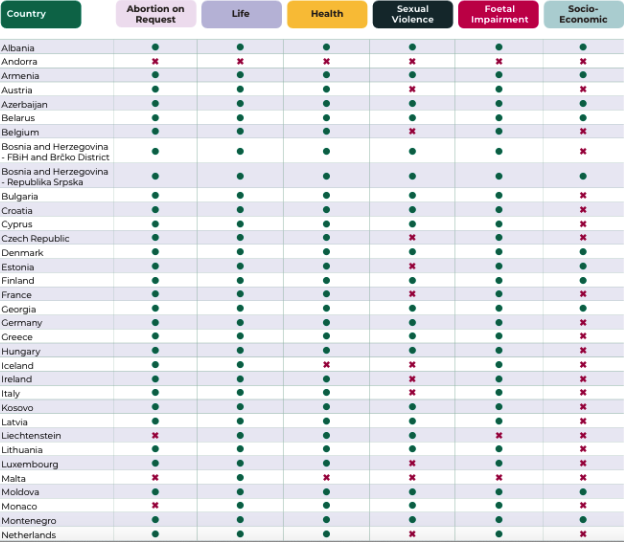
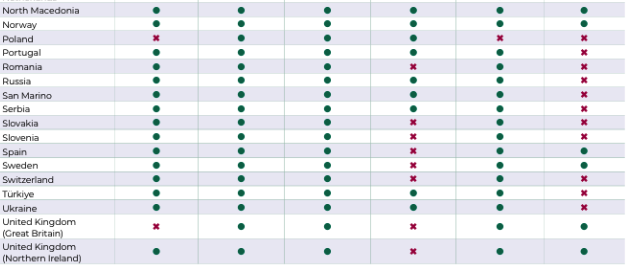
source: Europe-Abortion-Laws-2025-1.pdf
In this fragmented scenario, what is the European Union (EU) doing?
First of all, it must be noted that the French episode has triggered some reactions at the EU level. Indeed, a month after the right to abortion was introduced in the French constitution, the European parliament adopted a resolution calling for the introduction of the right to safe abortion in the Charter of Fundamental Rights of the EU.
Nonetheless, while this resolution hasn’t changed anything yet in practice, since a treaty amendment procedure is necessary to modify the Charter, something else has happened.
In December 2025, the European Parliament adopted by 358 votes to 202, with 79 abstentions, a resolution on the European citizens’ initiative called ‘My Voice, My Choice: For Safe and Accessible Abortion’.
The European citizens’ initiative (ECI) is a tool for EU citizens to ask the Commission to propose new legislation. If one million signatures are collected, the Commission must, within six months of the ECI’s validation, explain which actions it is planning to take in response.
“My Voice My Choice” is a citizens’ movement calling on the EU to ensure safe and accessible abortion; specifically the initiative is asking for the establishment of a funding mechanism for cross-border abortion access.
A couple of weeks ago, a step was taken by the European Commission towards the realization of the ECI.
The European Commission confirmed MS can use an EU social fund to provide access to safe and legal abortion for women who are barred from doing so in their home country.
Member states (MS) can use the European Social Fund Plus (ESF+), which contributes to social, education, employment and healthcare policies, voluntarily and in accordance with their domestic laws to provide this support.
This decision has sparked several and contrasting reactions among MS and politicians.
Some welcomed the decision of the Commission with enthusiasm, defining it as a victory for European women and a real progress towards the realization of women’s rights.
On the other hand, there are also politicians who are a bit more critical and consider the Commission’s action as a palliative measure, not actually responding to the ECI’s request of establishing a separate and dedicated fund.
The Italian anti-abortion association “Pro Vita & Famiglia” (Pro Life and Family) criticized the use of ESF+ money to finance reproductive healthcare. “We ask the Italian government not to use this money to promote abortions”, said spokesperson Maria Rachele Ruiu.
Speaking of Italy, there is little doubt that the government will not use these funds to promote voluntary interruption of pregnancy for women from other countries. Instead, the opposite situation is more likely to occur: Italian women going to another MS, employing these funds, to undergo the procedure.
As a matter of fact, Italy is one of the countries with the highest rate of conscientious objectors, as in some regions 90% of gynaecologists working in public hospitals are conscientious objectors, basically rendering abortion inaccessible and forcing women to travel to another region.
For this reason, I believe that for some of them it would be more advantageous to directly travel to another country where they are sure they will receive a more suitable service.
The fact that abortion is still limited in some MS raises the question of what more can the EU do to protect the women’s right and choice to terminate pregnancy.
In this regard, we must bear in mind that, according to art 168 TFEU, the EU can act to complement and coordinate MS’ public health efforts, but the organization, management, and delivery of healthcare services remain primarily the responsibility of each MS.
However, let’s be honest: would it be the first time the European Union has expanded its competence when convenient to do so?