

By: Charlotte Trouwers
Reading time: 5,5 minutes
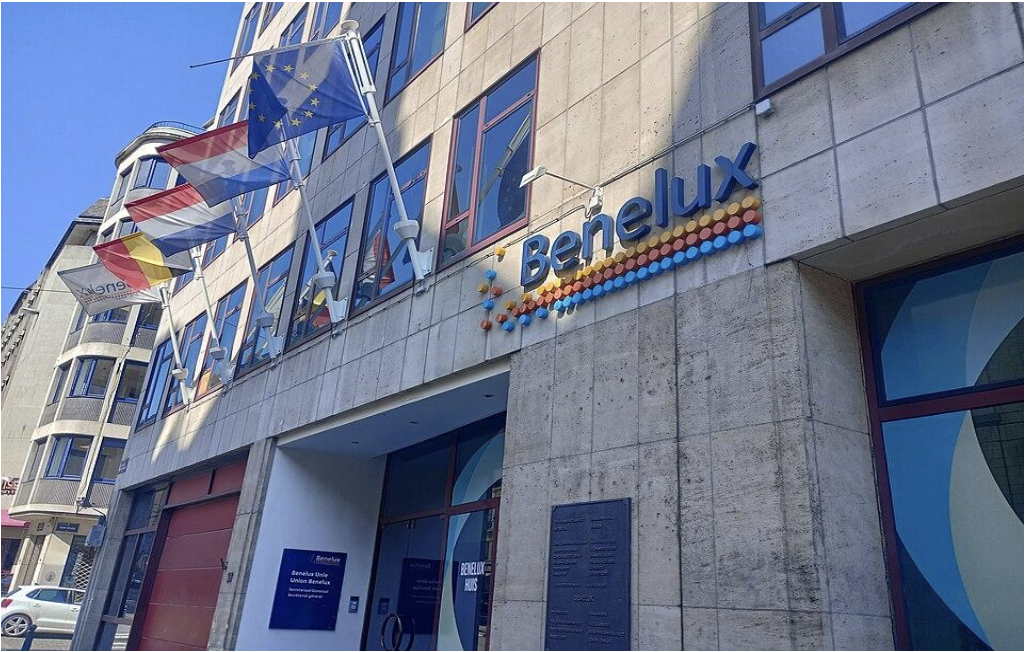
Mastrocom, CC BY-SA 4.0, via Wikimedia Commons
Upon the Benelux summit of November 10th 2026, UM students and officials were invited to attend a conference with all three prime ministers of the Benelux. The aim was to showcase the Benelux’ role as the core of the European Union, a laboratory where all policies can be tested on a smaller scale union, rather than immediately to the 27 member states the EU has. But why choose the Benelux out of all the Regional Unions? How could three small countries with relatively short histories constitute a “laboratory” for the EU?
First, this article will outline what the Benelux is, its origins, geography and aims. Next, it will explore the role of the Benelux in European Integration and why it specifically is considered to be such an important element, finishing off with what is in store for the future of the Benelux.
The history of the Benelux
It all started in 1943 during WWII, when Belgium, Luxembourg and the Netherlands decided to sign a monetary agreement with the aim of creating a transactional framework and strengthening economic ties among the three. On September 5th 1944, a customs agreement was created aiming at the formalisation of an Economic Union for an open internal market once the occupation was over. This agreement was not welcomed as warmly as was hoped and Belgian farmers were anxious that Dutch agricultural products would fill up the country. However, the war had ravaged the Benelux region, leaving people worried for what was to come. This led the governments to use an integrated internal market in hopes of achieving prosperity.
Four years later, this agreement was implemented and extended in order to remove import duties on internal trade in the Union and set a common tariff for third countries.
The Benelux Treaty which established the Benelux Economic Union was signed and was implemented in 1960. 25 years later the Schengen Agreement came into force, with the aim of gradually abolishing border control in shared borders between the Benelux Economic Union, the German Federal Republic as well as the French Republic. This agreement was signed in the very heart of Schengen, a Luxembourgish City, and it is now a widely recognised document that has since then expanded through the European Continent.
Upon the start of the 21st century, the Benelux collaboration continued to strengthen as the three countries set up a new cross-border policing convention allowing for better communication for police cooperation on all sides of the borders enabling joint patrols, checks, observation and pursuit. Something that is still very much in use to this day, as the Benelux Prime Ministers put forward during the Summit; the Treaty was renewed in 2021, permitting ever closer collaboration. Among those cooperations, in the 2010s numerous agreements came, permitting cross-border and inter-territorial cooperation, as well as road transport inspections, higher education degree recognition. Throughout these policies, the Benelux also included Westphalia in Germany and France for further collaboration.
The Benelux is an entity in itself, it has three pillars clearly stated by the Secretary General of the Benelux, Ariadne Petridis: “Residence and security, Economy and competitiveness and lastly Sustainability”. It is made up of five central institutions: the first being the Committee of the Ministers. It is the highest executive power in the Benelux Union, and is made up of at least one representative per country at the level of minister. They are some of the key actors in directing the priorities for cooperation in the Region.
Secondly, there is the Benelux Council, in which the senior officials from relevant ministries prepare dossiers for the ministers.
The Secretariat-General can propose and monitor the use of legal instruments, like decrees, recommendations and treaties.
An important role is taken on by the Benelux Parliament, composed of 49 members sent by parliaments of all 3 countries. Its members inform and give advice to this town native governments on issues related to the Benelux
Finally, there is the Benelux Court of Justice, which serves as a very important pillar in the uniformity of the policy interpretation across all three countries. In fact, national Courts of Justice must refer to this particular institution regarding questions of interpretation. Magistrates from all three nations mainly go from the courts of appeals and courts of superior justice, depending on the case.
The Benelux as a driving force in European integration
As previously explained, the Benelux has been important in the making of the European Union; however, it is not the sole regional union. In fact, many of them exist and they are commonly referred to as BURGs, Bottom-Up Regional Groups. They are separate from the EU on an institutional level and can best be described as the level between national authority and EU authority. At present, many of them exist although the Benelux usually is considered as the first one. The Bridge network describes BURGs as a form of international cooperation fitting in 5 different criteria. It must be institutionalised, currently active, only have EU members, be institutionally separate from the EU and be made of geographically close states. These unions largely aim at either: integration, cooperation, policy coordinating and resistance cells. Most BURGs range from 2 to 12 member states, meaning that the Benelux is a rather small regional union; but what exactly constitutes its uniqueness?
Many BURGs were created in recent years with the Russian threat looming over Europe, they are not a political-economic union like the Benelux and often do not meet on a regular basis. In addition, different BURGs supervise different things, from many different types of policies to only one sectoral policy.
It is important to note that as previously mentioned, the Benelux is highly institutionalised and was the first type of European Integration even before the postwar era. It also showcases the “peace via trade” of it all, illustrating the ECSC and the EEC as institutions inspired by the Benelux, installing trade systems to achieve peace. In fact, the EU Treaty (Article 350) clearly states that the Benelux is the only region that has the right to set up cooperations beyond the EU’s actions. This proves that even officially, the Benelux is recognised as a laboratory for the EU. This is something which was reiterated by the prime ministers during the Benelux Summit, specifically that testing policies on a small scale union such as this one helps assess their effectiveness on a much bigger scale.
The Benelux Summit, what’s in store for the union ?
The Prime ministers appeared to be very proud of the Benelux Union putting forward its market and police cooperation. But, as mentioned previously, many more things are in order under the Dutch presidency. The Benelux prides itself with their automatic recognition of degree, fight against social fraud, and traffic inspections which are unique to only being used within the Benelux.
During the Benelux Summit, the spectators had the honour of listening to experts who work for the institutions such as the Secretary General as well as the Prime Ministers of all three countries of the Union.
Bart De Wever, the Belgian prime minister, was especially vocal about the idea of the Benelux as the European Union’s core and how it being the core had been the plan since the beginning. Naturally, Luc Frieden, Luxembourg's prime minister and Rob Jetten, the Dutch prime minister, were in agreement.
Their main argument was that democratic agreement, especially between 27 member states of the European Union, takes a lot of time. As I understood from hearing their talk, they argue that trying out in a smaller regional union would indeed help the bigger institutions measure the effectiveness of certain policies.
On the Benelux website, the same three Prime Ministers have participated in a short video outing the clear aims of their term. The degree recognition was once again mentioned, adding that the Benelux benefits from a great job market with its cross-border workers. This has proven to be true, and the percentage is quite high, amounting to 37% of the EU’s total cross-border workers (in 2021). Next came the security measures and crime fighting, which is an important aspect for the Prime Ministers. They explained that information regarding these issues could be communicated with ease even beyond borders.
The stressed priorities of the Benelux, reiterated by Mrs. Petridis during the Summit, were Prosperity and Security. The main aim currently would be to have a faster and deeper market integration, and to remain as a competitive entity for the good of the people and the economy. Rob Jetten recalls article 350 of the TFEU, stressing that with the treaty’s clause anything can be possible and that the Benelux is the perfect breeding-ground for new EU policies.