

By: Lana Simončič
Reading time: 7 min
Why Serbia’s October election matters for the long climb toward membership, and will a horizontal movement survive the weight of real power?
AI-generated image created with OpenAI (ChatGPT), 2026.
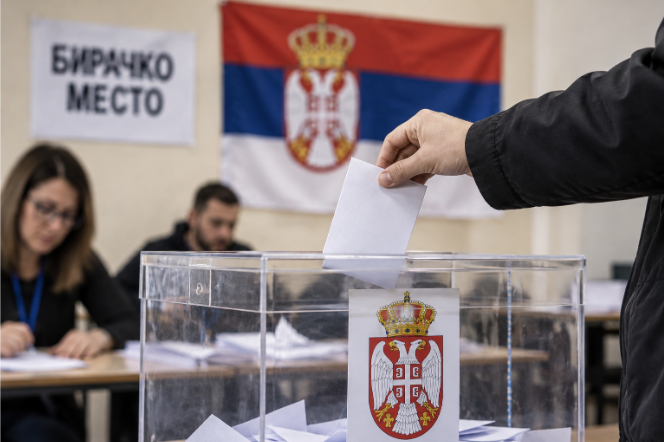
25th of October marks the end of an era in Serbia. A political, historical and societal turning point. A student-led opposition movement won the parliamentary elections and put an end to the 14-year grip of Aleksandar Vučić’s political machine, something no other opposition party had managed in over a decade.
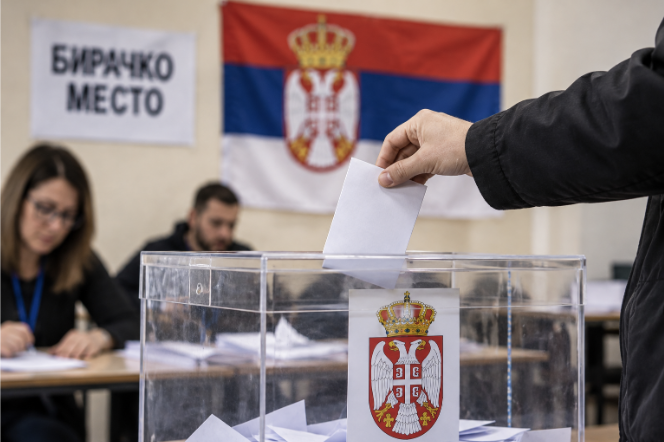
The significance of the result is more than just a change of parliamentary seats; it is an entrenched political force losing its dominance. The Student List won 140 seats, 14 more than the 126 required for a parliamentary majority. It did so without a traditional “leader” and media support, crashing a deeply rooted stereotype that a government with control over the media and state institutions cannot be beaten in the elections. Moreover, the elections had the highest voter turnout – close to 70%, recorded in the past 30 years in Serbia.
What began as a small student-led protest against the government grew into a mass movement that mobilized citizens across all Serbia and drew support from across Europe and the world, and in a historic first, it evolved into a political force that defeated the country’s most powerful political party and ultimately took on the responsibility of leading the country. But how did Serbia even get to this point?
AI-generated image created with OpenAI (ChatGPT), 2026.
Everything started back in 2012 when the Serbian Progressive Party (SNS) - Vučić’s party came to power. Vučić served successively as deputy prime minister (2012-2014), prime minister (2014-2017) and, from 2017, president. Over these years, public frustration grew, as well as multiple concerns regarding media freedom, political pressure on opposition groups, institutional independence, democracy, and especially corruption.
Press freedom has been in decline during these years; most media were controlled either directly by the state or at least by pro-SNS figures. Threats and even acts of violence were common against independent journalists, and perpetrators were rarely found guilty. Serbia fell on every major international index after the SNS took power in 2012. Democratic backsliding reached a point where, according to Freedom House, Serbia was downgraded from a “democracy” to a “hybrid regime”, meaning that independent democratic institutions exist, but coexist with authoritarian practices.
Corruption is another major problem for democracy in Serbia. According to the corruption Perceptions Index 2025, Serbia’s result was the worst in two decades: it scored 33 out of 100 and ranked 116th of 182 countries, the lowest in the Western Balkans for the first time. For years, corruption was just an abstract index score in international reports, however that changed in November 2024, when Novi Sad tragedy exposed how corruption and misuse of public funds can have deadly consequences.
The collapse of a newly renovated concrete canopy in Novi Sad railway station killed 14 people on the spot, and 2 more later due to severe injuries. Suspicion quickly fell on how the reconstruction was funded and carried out. Critics pointed to non-transparent contracts and private interests and asked whether public money that should have gone into safe, solid construction was lost to corrupt practices or diverted elsewhere – into “private pockets”. For many, the question was stark: ordinary people have paid with their lives for the gains of a few government officials?
Within days thousands of protesters took to the streets to demand accountability and liability of the ones responsible for the deaths. At first these looked like ordinary protests, however, they turned out to be just the opposite of that. What began as a “classic” protest, developed into blockade of educational institutions, traffic and by March 2025, spread across all cities and towns in Serbia, and gained recognition and support from all over Europe. By late spring 2025, the movement formally demanded snap parliamentary elections and announced that it would form its own political alternative. Enormous demonstrations and pressure continued until Vučić called snap parliamentary elections in September 2026. That election on October 25th then brought the end to the 2-year protest wave, with the Student List defeating the SNS (39.2%) with 52.7% of the vote (140–141 seats in the 250-member parliament) and Vučić conceding defeat.
But why does the EU care so much who wins in Serbia?
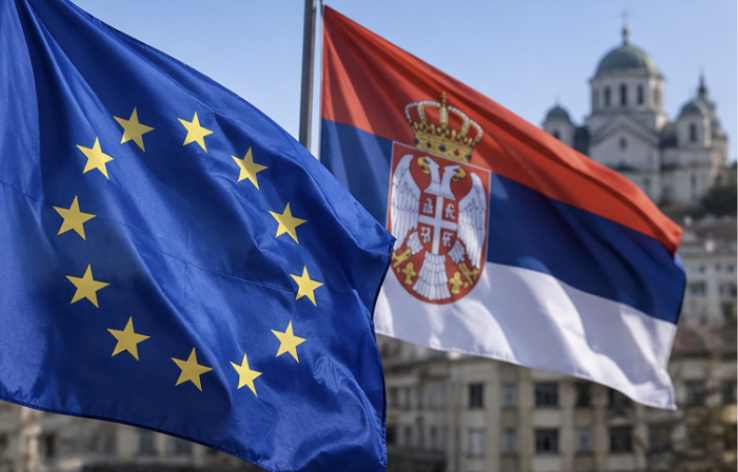
The EU’s interest in Serbia’s politics is roughly based on three factors. Geopolitical, geographical, and economic. Firstly, geopolitical. The EU is interested in who governs Serbia, as Serbia's political future could influence whether it moves closer to the EU or to other powers such as Russia or China. Serbia is traditionally caught between competing East and West influences, although it is an EU Candidate, it maintains strong political, historical and economic ties with Russia and growing relations with China. For Brussels, Serbia's political transition represents a crucial opportunity to ensure that future leadership respects democratic values, and accelerates its journey toward European integration, while at the same time prevents further Russian and Chinese influence in Serbia and Western Balkans in general.
Secondly, Serbia’s geographical position makes it an important country for European security as well as regional stability. Located in the heart of the Western Balkans and sharing borders with both EU Member States and candidate countries, Serbia acts as one of the most influential countries in the region. It has significant political and economic influence over its neighbors because it makes up half of the GDP and population of the Western Balkans. Ergo, its domestic political direction directly impacts its neighbors, so Brussels views a stable, cooperative administration in Belgrade as essential for maintaining peace and predictability across the entire Balkan region. Moreover, good neighborly ties and post-war reconciliation are officially required by the EU as part of the EU membership application process. However, these relationships were strained under Vučić's leadership.
And thirdly, the EU also has a strong economic interest in Serbia's elections due to the close economic relationship between the two. The EU is Serbia's largest trading and investment partner. In 2025, the EU accounted for 58.2% of Serbia's total trade in goods, and the EU Member States accounted for 72.2% of foreign direct investment inflows into Serbia. Consequently, the EU’s interest in a stable, democratic and predictable Serbian government that maintains economic cooperation, protects European investments and continues moving steadily towards the EU integration is reasonable.
Taken together, these factors show that Serbia's 2026 elections are much more than a domestic political milestone. They serve as a defining test that will shape the EU's economic security, democratic values, and geopolitical standing in the Western Balkans for years to come.
AI-generated image created with OpenAI (ChatGPT), 2026.
Does a more EU-aligned government automatically bring Serbia closer to accession?
Although Serbia was recognized as a potential EU candidate in 2003, granted official candidate status in 2012, and began accession talks the following year, the last negotiations cluster was opened in 2021. Consequently, negotiations have been stalled for roughly 5 years, largely due to democratic backsliding and Belgrade’s failure to align with the EU’s Common Foreign and Security Policy (CFSP) regarding Russia.
The Student List, born out of mass student protests that created a broader movement, places strengthening the rule of law and combating corruption at the center of its political and economic program. These priorities align closely with two of the most demanding areas in negotiations on EU accession: reforms tackling the ‘judiciary and fundamental rights’ and ‘justice, freedom and security’. Beyond the rule of law, the Student List views the EU as economically essential and emphasizes the need for new partnerships with the EU. The Student List may be in an excellent position to further its objective of fostering good neighborly ties given its widespread popularity in the area.
The Central European Free Trade Agreement (CEFTA), which offers a framework for regional economic integration and aids in preparing participating economies for EU membership, is specifically highlighted in its program. All this demonstrates that the new political alternative definitely brings great potential, which was also recognized by the Enlargement Commissioner Marta Kos who said, two days after the elections, that the students had been calling for democracy, the rule of law, free media, and the battle against corruption, which is exactly what the EU requires of Serbia. The students just adopted simpler language: everyone should be treated equally by the law, public leaders should be held accountable, and institutions should carry out their duties. Still, domestic anti-corruption and democracy pledges are only half of Brussels’ equation: will a movement built around internal accountability be willing, or politically able, to make hard concessions on Kosovo normalization and EU sanctions against Russia?
In any case, it is important to remember that the next administration will take over an EU accession process that has been essentially stalled for years. Serbia's credibility as a candidate country has been weakened by worries about judicial independence, media freedom, corruption, and the operation of democratic institutions. Victory over the incumbent government does not resolve the country’s institutional weaknesses. The immediate priority, and challenge, is therefore to translate the electoral mandate into credible institutional reforms.
A change of government can restart the conversation with Brussels, but only stronger institutions can turn that conversation into membership.