

Trump Meets Xi : Arm-wrestling or Friendship?
By: Anneke Pelzer, Reading time: 3 min
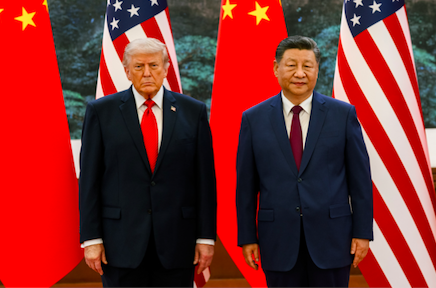
The White House, Public domain, via Wikimedia Commons
It’s 10 am at the Great Hall of People in Beijing, where Donald Trump gets welcomed by a large military spectacle and flag-waving children. Xi Jinping greets the American President warmly, and it almost seems like their countries’ relationship has not been defined by rivalry and hostility for nearly a decade.
When the Cold War ended, and the United States’ (US) dominance was nearly uncontested, the US tried to integrate China into its creation of a liberal international order. Most notably, China joined the World Trade Organization in 2001. However, when Trump served his first presidential term, US policy towards China transformed drastically. A first trade war broke out in 2018, when Trump significantly increased tariffs and other trade barriers on Chinese products. This line of action continued through the Biden administration and well into Trump’s second term. After another escalation in the Sino-US trade war in 2025, the Supreme Court declared those tariffs as unlawful, forcing the Trump administration to reconsider its strategy.
Beijing 2026
Trump’s second visit to China from May 14th to 15th in 2026 feels very different from his first one in 2017. Whereas the meeting back then was followed by a trade war, the signs today rather point towards friendship. At least, this is how Donald Trump portrays Sino-US relations: “It’s an honour to be your friend”, he said to Xi.
However, several issues still create tension between the two countries. China is the biggest buyer of Iranian oil and has a significant interest in the Strait of Hormuz being reopened. The instability in the Middle East could trigger a global recession, potentially decreasing demand for Chinese products. Furthermore, technology, supply chains, and trade were expected to be core issues discussed in the meeting, but little information has been announced about agreements on these topics. Taiwan stood at the centre of attention as well, as the US has reiterated its commitment to support Taiwan in recent days. After the meeting had already begun on Friday, China released a statement underlining that the US must "exercise extra caution in handling the Taiwan question".
The meeting was wrapped up on May 15th without any deals or policies being announced. However, both sides underlined the success achieved in their talks multiple times. “We’ve settled a lot of different problems that other people wouldn’t have been able to solve,” Trump stated. According to Chinese state media, Xi described the meeting as “historic”.
Cooperation or Competition?
While Trump highlights the country’s friendly relations, Chinese statements point towards dominance. "The world has come to a new crossroads. Can China and the US overcome the Thucydides trap and create a new paradigm of relations? Can we meet global challenges together and provide more stability for the world? Can we, in the interest of our world, of our two peoples, and the future of humanity, build a brighter future for our bilateral relations?" Xi Jinping asked.
Interestingly, Xi points out the Thucydides trap, a term coined by American social scientist Graham Allison, that describes a tendency towards war when an emerging power threatens to replace an existing great power as regional or international hegemon. It can only be speculated whether China wants to imply that it sees itself as the next dominating power, which would be in line with other recent Chinese statements.
What does this mean for Europe?
Against the backdrop of Trump’s aggressive “America First” policy, the US has recently violated multiple democratic and liberal principles. Attacking both Venezuela and Iran, as well as threatening Greenland, amounts to conflicts with the democratic values of sovereignty and territorial integrity. As mentioned before, the US also distanced itself from committed support for Taiwan recently. Instead, Trump is looking to the authoritarian regime of China for support and cooperation, as his visit to Beijing underlined.
Trump’s line of action, in combination with Chinese signs of intending further growth towards international dominance, should be a sign of worry for democracies and Europe. The US President even suggested a G2 forum including both the US and China to target global problems. Especially for the European Union, which is currently scrambling to preserve the international weight of its voice, this could potentially pose a future challenge.
Chrystia Freeland, a Canadian politician and journalist currently working as an advisor on economic development of Ukraine, summed up the situation on Politico’s Brussels Playbook Podcast on 15th May. “Where I think the real problem is, what we need right now is a collective front of the democracies when it comes to China, a collective position. (…) Apart from the EU, for every other country in the world, it is very challenging to stand up to China. (…) This is very hard to do without the United States being part of that effort and without the United States being ready to support its partners. If the US doesn’t come back firmly onto the side (…) of the democracies, all of us will be poorer and weaker.”