

While Europe closes its borders to migrants, Spain opens a door
By Aurora Dagnino, reading time: 5 minutes
Migration has been for almost a decade, after the refugee crisis in 2015-2016, a very hot topic, and now it is even hotter than ever. In fact, in less than a month, after a transition period of two years, the New Pact on Migration and Asylum will be applicable.
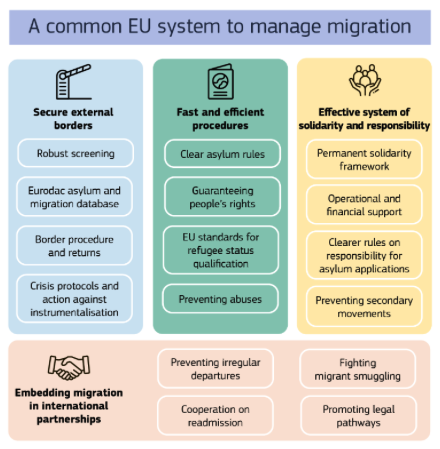
The New Pact is a very complex package composed of different pieces of legislation such as the Asylum Procedure Regulation, the Screening Regulation, and so on. Its complexity is the result of a long negotiating process due to Member States' different stances on migration issues. For example, countries in the South of Europe such as Italy and Greece have been constantly trying to ask for support and relocation of migrants, while countries in the North of Europe are very reluctant when it comes to cooperation measures.
In general, the pact reflects the will of Member States (MS) to contain and prevent illegal migration. A big part of the Pact is designed so that as many people as possible are dealt with at the edge of the European Union (EU), or even before they arrive, rather than inside it. The logic is straightforward: the deeper someone gets into the EU system, the harder it is legally to remove them. It is exactly for this reason that the Spanish plan has caught attention and criticism; in a EU whose aim is keeping migrants outside, Spain is going in the opposite direction.
But what exactly is Spain doing?
Any foreign national who can prove five months of continuous residence in Spain before 31 December 2025, and who has no serious criminal record, can apply to one-year residence-and-work authorisation. The permit suspends ongoing administrative expulsion procedures and it is renewable. Holders immediately receive a work authorization and access to the public health system.
It is worth noting that this is not the first time Spain has taken this path; the country has carried out regularisation programmes repeatedly, in 1986, 1991, 1996, 2000 and 2001. Most notably, in 2005 the Zapatero government regularised approximately 700,000 people in one of the largest such programmes in European history, a move that drew similar criticism at the time.
One could wonder, why is Spain doing this? First of all, Spain has an ageing population and serious labour shortages in sectors like agriculture, hospitality, construction, etc. These undocumented migrants were already doing that work, just informally, meaning with no social security contributions, lower wages, and more exploitation. Bringing them into the formal economy is expected to generate over €1 billion a year in new social security revenue, and help sustain Spain's welfare system.
Moreover, it is important to highlight that those people were already in the country but with no legal status. Migration is surely something you can control, but not something you can stop. Escaping and trying to look for a better standard of life is the nature of human beings. Most of us are migrants, fleeing their country to study in the Netherlands and secure a better job.
In the Prehistory, humans were migrating to other territories in search of food, better climate, and better conditions.
What Spain is doing is simply trying to integrate those people in the country. Without a legal status, migrants linger in a legal limbo where they cannot work or contribute to the system. Giving them the possibility to work, to pay taxes and participate in the Spanish economy, is not only having a morally positive impact on them, but has various advantages in the long run.
Poverty and low levels of education go hand in hand with high crime rates. We can see this in many countries across Europe, and saying that migration is not a problem in those countries is like negating the obvious, and I say this as an Italian. With that said, I do not mean that migrants are the source of every problem we have, or that they are the only ones committing crimes. However, studies show that the most dangerous neighbourhoods in European cities are often associated with mass immigration and are predominantly inhabited by first- or second-generation immigrants. The reason is surely not that "migrants are bad", it is all a chain of different factors accumulating.
Consider, for example, the situation of someone who arrives in Italy through a sea rescue operation. They are not granted asylum, and an expulsion decision is issued against them, yet they do not wish to return to their country of origin due to the difficult conditions they were living in and the episodes of persecution they experienced. If they remain in Italy without legal status or documentation, the only employment they can realistically access is low-paid, informal work that others are unwilling to take on, in agriculture, construction, or cleaning. Without a contract, they have no legal entitlement to paid leave, no social contributions, and no protections of any kind. As a result, they work seven days a week simply to get by, and are rarely present at home with their children.
This means they cannot provide them with a proper education or meaningful support during their upbringing. On top of that, the only housing they can afford tends to be located in neighbourhoods already affected by crime and drug-related problems. Their children grow up surrounded by that environment, with limited economic prospects and little real way out. It is hardly surprising, then, that many of them end up drawn into exactly the kind of criminal activity, drug dealing included, that surrounded them from an early age. Not because they are inherently prone to it, but because the system left them with almost no other options.
This is the cycle that poor migration management creates, and I believe that proper integration from the beginning could have prevented this outcome. For this reason, I strongly support Sanchez’s move.

Nonetheless, the plan has not been welcomed by opposition parties in Spain. The center-right Popular Party said the new immigration policy would overwhelm public services. The PP went so far as to ask the European Commission to examine whether the plan complies with EU migration law, escalating the domestic debate to the European level.
Furthermore, a spokeswoman for Vox, Spain’s far-right party, said it “attacks our identity”. Sanchez's idea has also triggered reactions at the EU level. The European Commission has strong reservations about the Spanish government's plan, worried it would conflict with current EU policy.
However, the EU also clarified the legal limits of the scheme. An EU spokesperson noted that the Spanish permit does not authorise travel or work within the wider EU, only within Spain. If a permit holder is found in an irregular situation in another MS, they must return to Spain.
Only time will tell whether Spain’s policy will produce positive long-term results. So far, a total of 42,790 people have already submitted online applications to begin the regularisation process.
Spain’s move surely represents a different approach to migration management, one focused more on integration than exclusion, and it remains to be seen whether other Member States will eventually take inspiration from it.