

Latvia’s Elections and Baltic Identity in the Shadow of the War in Ukraine
By: Lavinia Tacke
Reading time: 3 minutes
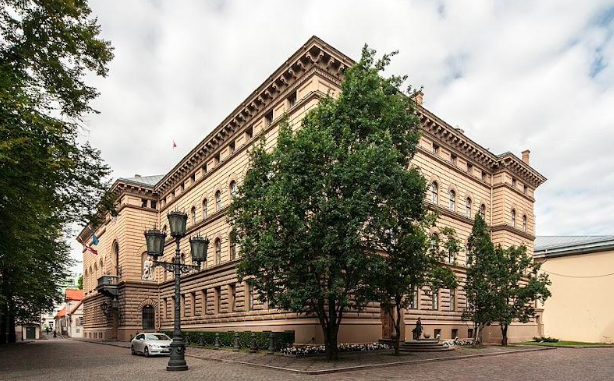
The Latvian parliamentary building, source: Ralf Roletschek, CC BY-SA 3.0 AT <https://creativecommons.org/licenses/by-sa/3.0/at/deed.en>, via Wikimedia Commons
As tensions between Russia and the EU run high, the Baltic country Latvia, formerly part of the Soviet Union, recommitted to the European Union. On Sunday, October 3rd, Latvia held its federal election. According to Latvian law, the new parliament, called Saeima, will convene on the first Tuesday of November for its first sitting.
The prime minister Kulberg’s centre-right party “United List” won the elections with 35 percent of the votes, a record result for the party. The United List party is known for their pro-European and pro-Ukrainian stance, wherefore the party’s success might have led to some relief in the EU-Bubble. Second was the right-wing populist party Latvia First (LPV). The LPV-Party which is affiliated with the Patriots of Europe in the European Parliament, has faced criticism in the past, when party leader Šlesers said after the Russian invasion in Ukraine that trade relations with Russia could be restored in the future. With 11.7 percent of the votes, the “Sovereign Power” party runs third. This right-wing populist party advocates for the Russian minority in the country and is known for being pro-Russian. What becomes clear from the political differences of the parties is that Latvia’s position between fear of Russia as a threat and cultural ties remains tense. In addition, it should be highlighted that the voting turnout for this election was at a historic low of 51.5 percent. Experts reason this with public dissatisfaction and the economic situation of the Baltic country. What the new government will change or not change will be decided soon, so it is definitely worth to stay tuned and to keep an eye an Latvia.
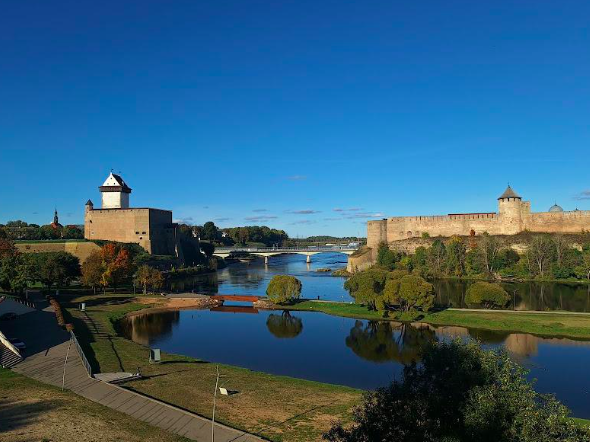
The Russian-Estonian border in Narva, Estonia (Estonia on the left, Russia on the right)
Source: private picture taken by the author
How did the invasion of Ukraine affect the Baltic States?
Due to their Soviet history, the Baltics have an interesting position in times of Russian aggression. The Baltic countries, especially Latvia and Estonia, have large Russian-speaking populations wherefore the influence of the Russian language is very noticeable in daily life and even in political debates. Because of the large Russian-speaking community in Latvia, there was also Russian content on the public broadcasters. Recently, however, the Latvian parliament has passed new rules limiting the Russian content on broadcasters, only allowing it in emergencies. Shortly after, the Russian president Vladimir Putin accused the Baltics of violating Russian speakers' rights on their grounds. In September, he claimed: “We are not preparing for any military action against Europe. We have no such plans.” However, he explained Russia would already have a planned approach on how to deal with the accused violations of Russian speakers' rights in the Baltics. “We respond on humanitarian grounds and within the framework of international law”, Putin continued without clarifying the “humanitarian grounds”.
Politically, the Russian invasion of Ukraine and the fear it caused in the Baltics of Russian aggression have strengthened Baltic cooperation even further. The three countries work closely together, for example, in the Baltic Council of Ministers, a forum for intergovernmental cooperation founded in 1994. In the format of the Baltic Council of Ministers the different ministers of the three Baltic states, Estonia, Latvia, and Lithuania, gather at least once a year to discuss common interests such as regional security and defense as well as cross-border connectivity.
The current tensions showcase that the EU accession of the Baltics was not solely an economic decision but also confirmation of their independence. When the Baltics joined the EU as part of the “Big-Bang” accession round of 2004, one of their core interests was to secure their security and independence of Russia. As previously discussed, the Russian influence in Estonia, Latvia, and Lithuania remains noticeable due to their long history as part of the Soviet Union. However, the elections in Latvia show that Latvia (and the Baltics) remain committed to the EU and European values, even amid tension with Russia, and especially because of it.