

First Serbia, now Kosovo… Has Glorifying War Criminals Become the Standard in the Western Balkans?
By: Pia Ajdarovič
Reading time: 7 minutes
After the death of ‘the Butcher of Bosnia’, Ratko Mladić, a Serbian war criminal responsible for the atrocities in Srebrenica, Europe has seen it all: a glorified war criminal, buried with honours and people, including politicians, mourning his death like one would the death of a saint. But has it?
On September 16, Hashim Thaçi, the former president of Kosovo, was sentenced to 25 years in prison after being found guilty of war crimes. The Kosovo Specialist Chambers (KSC) in The Hague found him guilty of four counts of war crimes, including murder, torture, cruel treatment, and arbitrary detention.
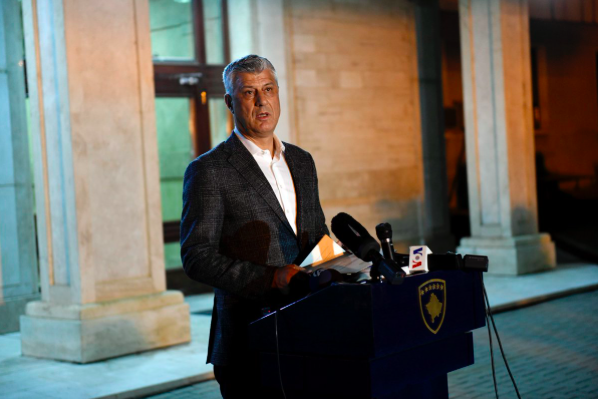
Former President of Kosovo, Hashim Thaçi, in 2020. source: 11VSH, CC BY-SA 4.0 <https://creativecommons.org/licenses/by-sa/4.0>, via Wikimedia Commons
The road to the Kosovo War
After Slovenia’s independence from former Yugoslavia in 1991, the war was far from over. Following the genocide of Srebrenica in 1995 that took thousands of lives, another conflict, among many that followed, sparked in 1998. It was fought between The Federal Republic of Yugoslavia – led by the Serbian security forces – and the Kosovo Liberation Army (KLA), an ethnic Albanian armed movement seeking liberation from Serbia.
The conflict’s roots go back deep into the history of the Balkan peninsula. Under the 1974 Constitution of the former Socialist Federal Republic of Yugoslavia, Kosovo (a predominantly ethnic-Albanian territory) was officially part of Serbia, but had extensive autonomy. That changed when Serbian leader Slobodan Milošević dramatically reduced that autonomy and strengthened Belgrade’s direct control in 1989, which consequently sparked strong resistance among the Kosovo Albanians. During the 1990s, Kosovo’s political leaders initially pursued a largely non-violent resistance. However, by the mid 1990s, the Kosovo Liberation Army emerged and began with armed attacks against the Serbian-led Yugoslav authorities. Their goal remained the same: seek separation from Serbia and become an independent, sovereign state.
By early 1998, occasional attacks and fights developed into an open armed conflict, and the Kosovo War began. The KLA attacked Yugoslav police, security forces, and other military and national objects. In response, the Yugoslav forces launched increasingly large operations against the KLA, targeting their resources and leaders. According to NATO’s records, 1500 Kosovo Albanians were killed, and approximately 400 000 were forced from their homes during 1998. The KLA’s retaliatory attacks were no less cruel. Casualties on the Serbian side were in the thousands.
By the end of 1998, major international organisations like the UN and NATO became increasingly involved. The UN Security Council adopted multiple resolutions, including‘Resolution 1199 ’, which called for a ceasefire by both sides. A temporary agreement in October that same year did reduce the violence, but fighting unfortunately resumed.
International intervention and the end of the war
In February and March 1999, both sides met in Rambouillet, France, for international mediation. The proposed agreement would have granted Kosovo extensive autonomy and self-government, while formally remaining within Yugoslavia for the time being, backed by a NATO-led military presence to prevent further conflict and casualties. While the Kosovo delegation eventually agreed to the proposal, the Serbian side rejected it.
On March 24th that same year, Operation Allied Force began, during which NATO forces retaliated against the Yugoslav/Serbian army. The bombing campaign lasted 78 days in total, its objective being to stop violence and repression in Kosovo and to enable refugees to return. Although a crucial moment in the war, the operation also sparked major legal controversy in international law because NATO forces used force without explicit authorisation from the UN Security Council.
The conflict effectively ended after Yugoslavia agreed to withdraw its military and police force from Kosovo, and on June 10th 1999, ‘Resolution 1244’ was adopted by the UN Security Council. While this is important for Kosovo’s legal status, it remains a topic of debate in international and, especially, European law.
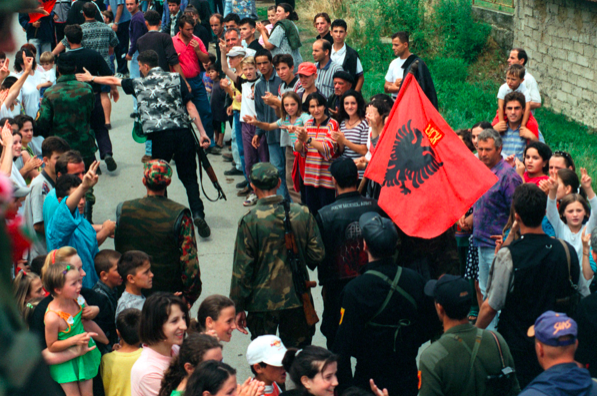
Members of the local KLA, Kosovo Liberation Army, march through the streets of Koretin in 1994
Source: National Archives at College Park - Still Pictures, Public domain, via Wikimedia Commons
Thaçi’s role during the war
Before the open war, Thaçi was part of the underground Kosovo Albanian movement, and by 1998, he was a member of the KLA General Staff and headed its political department. He became the KLA’s international political face and even earned the nickname “The Snake” (‘gjarpëri’), given by his enemies for evading Serbian security forces and slipping across the border unescorted. Former US President Joe Biden, on the other hand, called him ‘The Washington of Kosovo’, reflecting his status as a leader and so-called founding father of Kosovo that he enjoyed amongst his supporters. So, what is it then: a hero of war or a war criminal?
During the war, the KLA had the task of not only fighting Yugoslav forces, but also proving to the US and European governments that it could represent the country on the international stage. Thaçi led the Kosovo Albanian delegation during the Rambouillet peace negotiations in France after being a prominent figure in the party. Signing the agreement made him internationally prominent. He had gone from being a relatively little-known guerrilla political figure to negotiating directly with major Western powers. In 2008, he served as Prime Minister of Kosovo and served a presidential term from 2016 to 2020. As PM, he became the central figure in Kosovo’s declaration of independence, declared on February 17th 2008.
Between the years of 1998 and 1999, according to the KSC Trial Panel, the KLA targeted not only Serbian soldiers, but also people they regarded as opponents or collaborators, including civilians. The victim pool encompassed Kosovo Albanians associated with rival political parties or military groups, such as the Democratic League of Kosovo (LDK). Some members of ethnic minorities, particularly Orthodox Serbs and Roma, fell victim to KLA’s actions. The KSC later found that, with limited exceptions, there was no evidence that the victims had actually committed crimes or posed a security threat.
The verdict and the question of accountability
September 16th 2026 brought his story almost to an end. He was tried before the KSC in The Hague, alongside three former KLA figures. The indictment was confirmed in 2020, in November of that year he was transferred to The Hague, and three years later the trial began. During the trial, 134 witnesses testified and 156 participated in total. The Court convicted him of four war crimes in the context of the Kosovo War, including murder and torture. He received a 25-year imprisonment sentence, with credit for time spent in detention from 2020.
The judges found that there was a common criminal purpose to target people perceived as opponents of the KLA, including Serbian and Roma populations. The vast majority of the victims were civilians. Interestingly enough, while he was convicted for war crimes, he was acquitted of six crimes against humanity. The judges concluded that the prosecution had not proved, beyond reasonable doubt, the element of widespread or systematic attacks directed against a civilian population, which is necessary in order to conclude a crime against humanity. It is important to note that the Trial Panel judgment (first-instance conviction) and appellate proceedings are now being organised. The deadline for notices of appeal has been extended to November 27th of this year, meaning the judgement remains subject to appeal.
Kosovo’s reaction to the conviction
The reaction in Kosovo to the conviction was overwhelmingly negative among Kosovo Albanians. For many, the verdict did not simply constitute a judgment against Thaçi personally, but was something that challenged the historical narrative of the KLA and the 1998–1999 liberation struggle. Thousands of people gathered in Pristina's main square to watch the judgment live on large screens. Many carried Kosovo, Albanian, and KLA flags. When the Court announced the decision, the crowd reportedly became silent. The anger then became more confrontational. Some demonstrators moved toward the headquarters of EULEX, the EU's rule-of-law mission. There were attempts to damage parts of the perimeter, stone-throwing and clashes with riot police, although the broader demonstrations were largely peaceful. Students joined demonstrations under the slogan “Not In My Name”, objecting in particular to the Court’s judgement being pronounced “in the name of the people of Kosovo.” KLA veterans' organisations also became heavily involved.
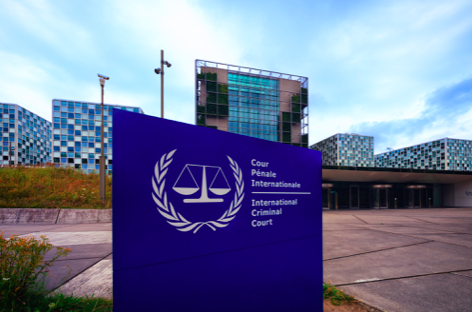
The International Criminal Court in The Hague. source: Tony Webster, CC BY 2.0 <https://creativecommons.org/licenses/by/2.0>, via Wikimedia Commons
By October 1st, thousands again filled central Pristina in what AP described as the largest nationwide protest against the convictions to date. Demonstrations had taken place across Kosovo in the intervening period. Acting President Albulena Haxhiu described the verdict as deeply shocking for Kosovo, placing it in the context of the violence and mass displacement Kosovo Albanians suffered at the hands of Serbian/Yugoslav forces during the war. Even more strikingly, on 28 September the Kosovo parliament unanimously condemned the convictions: all 99 lawmakers present supported a declaration criticising the judgments and calling for action to defend the legacy of Kosovo's independence struggle.
National heroes and the legacy of war crimes
The reaction to Thaçi’s conviction therefore raises a question that reaches far beyond Kosovo itself. The history of the Western Balkans has produced national heroes whose names have become inseparable from war, independence, and collective identity. But when loyalty to that history turns into an unwillingness to confront crimes committed in its name, remembrance can easily become glorification. Serbia’s experience with convicted war criminals has already shown how difficult it can be to separate the idea of defending a nation from defending the individuals who claimed to fight for it. Kosovo now faces a similar challenge.
Recognising the crimes committed by members of the KLA does not erase the suffering of Kosovo Albanians, nor does it invalidate their struggle for freedom; just as acknowledging that struggle cannot erase the suffering of those who became victims of the KLA. Perhaps the real test for the Western Balkans is therefore not whom it chooses to call a hero, but whether it is prepared to accept that a national hero can also be held accountable.
If war crimes become excusable whenever the person convicted of them fought on “our” side, then the uncomfortable question posed by Thaçi’s case remains: has glorifying war criminals become the new standard in the Western Balkans?