

The right to protest, the right to learn: Who loses when Europe protests?
By: Charlotte Trouwers
Reading time: 7 minutes
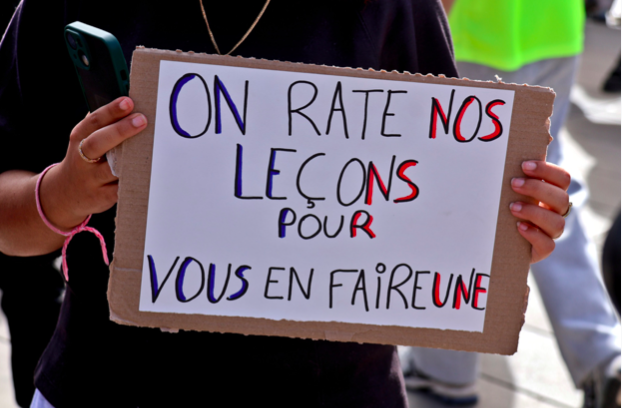
Protests in Paris with a sign saying: “We’re missing our lessons to give you one”. Picture source: FreCha, CC BY-SA 4.0, via Wikimedia Commons
Wake up at 6am, get dressed, eat breakfast, block schools, protest. This has been a typical morning routine for some high school students since September 21st when French and French speaking Belgian teenagers started their “blocus”.
The term “blocus” refers to the blocking of high schools and certain universities by students. In France, the teenagers are motivated by the disregard of the French educational system. The students are protesting for less students per class, balanced timetables, more teachers, better conditions of school buildings, a lack of school aids such as social helpers as well as “Parcoursup”, the web page by the French Ministry of Education used to coordinate the admissions to French universities and higher education institutions.
A Euro-wide protest
The movement launched in France has been spreading to different European countries, where people are also growing tired of governments disregarding living situations. Other youths such as those from Italy, Germany, Greece, Albania and the Iberian peninsula (only speaking of Europe), have started protesting in the streets, complaining about the poor crisis management of governments.
October 17th is a key date in this “historical” mobilisation. In France, the “yellow-vests” and farmers joined the protest. In Belgium, the strike movement started back in April of 2026 with both teachers and students protesting the “Arizona” government’s budget for education. It features a lack of equality of opportunity among students and teachers. In Italy, students as well as truckers are also going on strike. People need better living conditions like better working conditions in schools, opportunities, less expensive basic needs such as housing, gas and food. In Spain and Portugal, people protested in the streets going as far as camping in them to express their dissatisfaction with the cost of housing. In Germany, teenagers are rising up against budget cuts in education, rising living costs as well as plans for military service. In Albania, students demand that the state should lower tuition fees, invest more in education and acknowledge corruption in the education system. In Greece, university students as well as teachers have been planning actions about expensive housing and the need for better living conditions. Overall, Europeans are not happy with the current situation, they are revolting to hopefully get change, and be heard by their governments. People are tired of living in austerity.
The right to protest
“Protesting is a constitutional and necessary right” says the SNALC president in an interview about the blockades on national French channel “France 2”. Students are also defending their right to protest against what they qualify as “authoritarian” measures used to repress the revolts. Amnesty International has published an article reminding the French government of what international laws say about the right to protest compared to what is put in place. After the damage caused by the October 17th riots, it has been a duty to contain and even forbid demonstrations in French cities, similarly in Belgium and Italy.
In previous demonstrations, police officers have organized what is called a “kettle” which consists of blocking people in a certain area during a protest creating a feeling of suffocation. Police officers have also been throwing tear gas at the masses as well as dispersion grenades which have caused a teenager to lose his hand during a protest in Lens. In Liege in Belgium, the mayor had forbidden any group of more than 3 people in the streets, an attempt at preventing any riots that might have occurred. In Italy, Meloni has deployed the army against protestors justifying her measures as “freeing” the cities being held hostage by the demonstrators, not to mention the drone surveillance and constant monitoring of the demonstrations.
It would be wrong to say that protestors are doing no wrong, as many damages have been caused by the riots and especially vandals have been discrediting what students are defending. In fact, many of the student unions and students being interviewed about the revolts state that they dissociate themselves from the people who break. Although in various debates and discussions about the riots and the violence born out of demonstrations; some students call the violence legitimate and part of a revolution. Quoting a student: “The vandals are legitimate from the moment that she [French speaking Belgium minister of education] plays deaf”. Another student stated “We have to shock them” whilst discussing the correct way to protest and make their voices heard (Tarmac). These violent actions such as breaking storefronts as well as setting buildings, bins and diverse objects on fire have in part been legitimised by protesting students explaining a legitimate anger against the system.
Different categories of vandals have been analyzed by the Guardian with European correspondent John Henley. He notes that most of the protests happened very peacefully with between 500 000 and 800 000 people in the streets of France. The correspondent explains that rioters and looters came to the cities late into the night and were faced with an unprepared police force therefore making space for vandalism galore. Organized groups have been running through the streets of big cities whether it be in Italy, France or even Belgium, breaking storefronts and stealing various objects. Videos are circulating where it is possible to see buildings being burned down like in Limoges, damages done by the Black Blocks, a politically motivated group that attacks institutions.
The widespread violence has indeed led to political discourse between left and right-wing parties. President Macron warned about the possible instrumentalization of students by the radical left due to their representatives participating in demonstrations. The far-right has been pushing a narrative that immigrants have been damaging the country that they are trying to integrate, playing into their populist politics to try and get more votes, especially with elections coming up soon. In addition, the cost of repair for all of the damage has been estimated to multiple million euros in France alone.
This points to the fact that part of the tax funds will have to go towards the repair of public spaces, making people unhappy. The insurance companies in France were certainly not prepared for such damage and shop owners, whether big or small, are worried about how expensive the repairs may be. Adding to this uncertainty, there are discussions about introducing laws to make protestors pay for the damages done during the riots. It is not a new debate but the process of discussion has been accelerated due to the vandalism taking place during demonstrations. Even peaceful protestors would have to pay for the material damages done. The main issue does not lie within the students protesting but rather in the damage that, sometimes even they, call part of the revolution.
The right to learn
The term “student” implies the term of striving for a diploma, a career, a goal which in turn entails work, showing up, and learning. This is something that is sometimes rendered impossible by the protests. How fair is it to block schools when certain students would like to attend their classes, or even need to attend classes?
As a student myself I can imagine how frustrating it must be to be blocked out of university being therefore unable to attend a class. Although I will add nuance to this argument as certain college professors, or high school teachers have been helping students catch-up with their work. Some 30 000 students are unable to attend class due to the material damages caused by the “Blocus” making it impossible to re-open the high schools, security gates and fire alarms were damaged meaning that a lot of schools were unable to open before the start of the fall holidays (Le Figaro). Homeschooling is a troubling option as these classes can be rendered impossible by WiFi complications, students’ short attention span and lack of interaction. Some teachers are therefore sending out PDFs to their students to ensure the continuity of schools.
Certain students are not willing to partake in the blockades because of school work, security issues or even political disagreement. There is a sense of injustice for them because they want to learn, and a whole month without school can bring issues. Final year students are falling behind, and Parcoursup, the platform managing admissions to French universities that students are criticising with the protests, will still take into account the lack of grades from one of the first months of school.
High schools are not the only institutions affected, but in France universities have been blocked by their own students. Various reactions have come from the solidarity offered to high school students showcased by university students of for example “Sciences Po” and “Sorbonne”, both Parisian universities. Professors, however, are not abandoning their students and have arranged for online classes leading to certain images of students on their laptops in the middle of the “Blocus”; “I agree with the movement but exam season is arriving”. On the other hand, students are angered at the blockades making it impossible to attend class, a student explained her frustration due to her going through an hour of commute all for nothing. Whilst the right-wing trade union “UNI” scolds what they think is a minority of students holding the others “hostage” from going to class.
It should be noted that blocking a school is illegal in France, as it takes away people’s free will of attending school. In addition, absence due to the blockades may not always constitute a valid excuse. It is mostly up to individual institutions to regulate the way they register absences and how that might affect a student’s scholarship. For example in high school, a student could get suspended for 15 days of unjustified or repeated absence. Overall students, whether they are at university or high school, must attend classes and do not have the right to go on strike.
News outlets such as the BBC and the Guardian have been talking about the violence and carrying of the protests as typical French culture, expressing a certain violent nature in the French people showcased during football games. A lack of public support has been indeed observed especially when it comes to the damages done to shops which is where most of the public draws a line. Drawing back to the image at the beginning of the article reading “We are skipping our lessons to give you one” constitutes a key element in the protest and what teenagers are defending. Protests are a historical reality of Europe, the violence and damages that come with it as well. Looking back on our own past, the European culture of revolution is definitely something we can go back to and use to legitimize the current acts of violence.