

The disappearance of the Social Democratic Party
By Saul Gunning
Reading Time: 3min
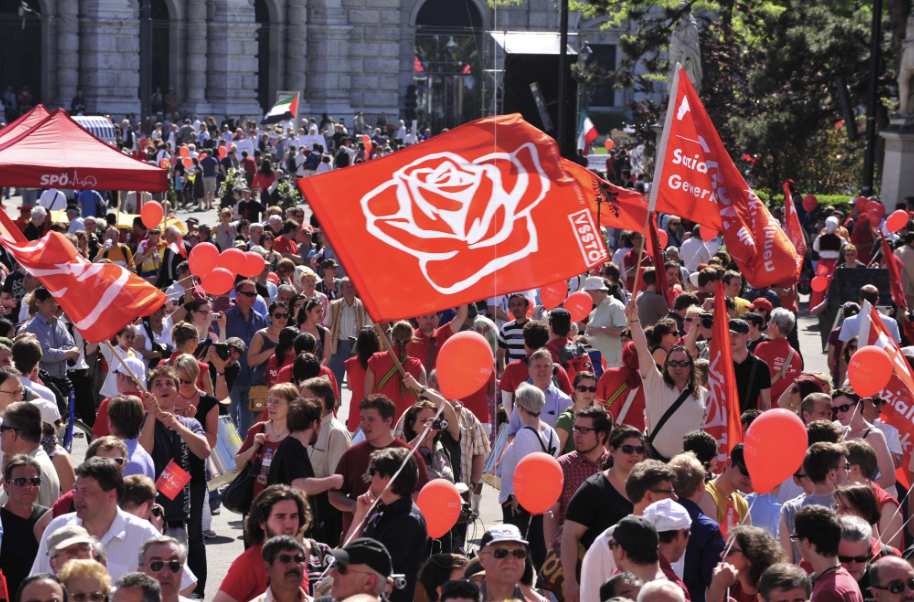
The 21st century has claimed its first casualty in the Netherlands, but will it be the last?
On the 26th of March, the merger of Groenlinks (Green-Left) and the PvdA (The Labour Party), which had provisionally been known as Groenlinks-PvdA unveiled its long-awaited new name at a party congress in Halfweg: the union of the Netherlands’ largest two parties of the left will now be known as ‘Progressief Nederland’.
Of the many casualties of the decline of Social Democratic parties in Europe, the PvdA was by far the worst hit. Reduced from a pillar of the Dutch political sphere, polling first or second at every election from its foundation in 1947 until 2017 (except for 2002), by 2021, it could no longer command 6% of the vote. As a result of the disastrous 2021 election, at which the three parties of the left, the SP, Groenlinks and PvdA received a combined 17% of the vote, the less radical two agreed to form an electoral alliance and contest the next election jointly. Since then, the fusion process has been tortuously slow, with the party congress votes and membership referenda required to assent to each new step towards integration all being held at a leisurely pace. Just two weeks before the new name was announced, municipal councillors ran under their old party banners at the local elections, causing the left to cannibalise itself in important urban municipalities. The new party of former UK Labour Party leader Jeremy Corbyn also had a tumultuous and protracted beginning. Your Party, which was founded last year, was derided for the indecision and internal chaos that defined that party’s founding, including taking almost five months just to decide upon a name, but when ‘Progressief Nederland’ becomes official on the 13th of June, it will have been over three years since the merger was first announced - Your Party’s timetable appears a veritable sprint in comparison.
Social democratic parties across Europe have had a poor decade. The Parti socialiste has faded from the second power in French politics to a junior confidence and supply partner in Macron’s centrist coalition, while in Germany, the SPD under Olaf Scholz received its worst electoral result since the 19th century last year. Spain and Denmark have been the exceptions to this rule, with particularly the latter’s Mette Frederiksen celebrated by ‘Third Way’ inclined politicians as a model for Social Democrats across Europe to emulate for electoral success. Yet Metter Frederiksen has proved to be no exception at all, although it appears she will survive as Prime Minister after the Danish general election on Tuesday, her Socialdemokratiet party achieved its worst result since 1903. The significance of the completion of the Groenlinks and PvdA merger in the Netherlands is to make de jure what has already been true de facto since 2023; a Western European country no longer has a social democratic party for the first time since the death of Francisco Franco. The fact the inaugural leader of ‘Progressief Nederland’, Jesse Klaver, also happens to have been leader of Groenlinks since 2015, that the majority of the new parties membership has been inherited from the smaller party and that the new party’s policies on climate and foreign affairs owe far more to Groenlinks than the PvdA has given the merger more of the character of a reverse-takeover and prominent Social Democrats, including ex-ministers have resigned in protest.
The British Labour Party has hardly flouted this trend, polling at ~19% for most of the past half year, hitting a record low of 16% at the beginning of March and in a recent YouGov poll even finishing fourth place behind both the Conservative and Green Party. Nevertheless, it seems unlikely that Labour will be eclipsed by the Greens, as they did the Liberal party a century before, as more recent polling has the Greens sliding back to third place, behind Labour. But were the new political landscape inaugurated in Gorton and Denton in February to survive until 2028, with neither party able to unite the left behind them and facing mutual electoral oblivion standing alone, Labour and the Greens may decide to put aside their differences to keep Nigel Farage from Downing Street. A Green-Labour electoral alliance may seem unlikely now, but a leadership change after the recent municipal elections and the raw electoral calculus of staying in power might make a British ‘Progressief Nederland’ irresistible to both parties; it only remains to be seen who will be devouring who.