

The ICE Phenomenon: Fear, Power and Control in Modern America
Written by: Margaux Baudry, Reading time: 4 min
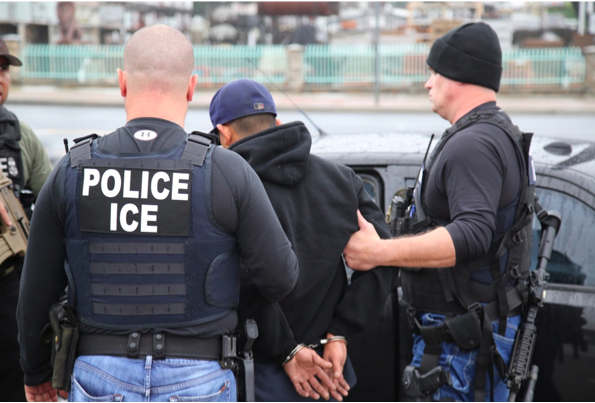
Image Credit: NYCLU
More than 65,000 “alien” immigrants are currently detained in immigration jails across the United States. A historic record, which we can thank Trump’s administration for. Since the beginning of Trump’s second term, in February 2025, the Immigration and Customs Enforcement (ICE) Agency has been synonymous with fear for many people of color in the US.
Some now sleep with their passports beside them, carry their birth certificates wherever they go, avoid public gatherings, and, in extreme cases, choose not to leave their homes at all. The question looms large: What exactly is ICE, and how did it become such a force of intimidation?
The Birth of ICE
ICE was created in the aftermath of the 9/11 terrorist attacks in an attempt to reinforce the USA’s internal security. Under President George W. Bush, the Homeland Security Act of 2002 established the Department of Homeland Security (DHS) in 2003, and with it, ICE. Its mission was clear: protect the US from internal threats and enforce immigration laws. Due to the growing fear at the time, ICE was given a very wide range of power.
A New Era of Enforcement
In 2025, ICE’s power is felt more strongly than ever… Under Trump’s revived anti-immigration agenda, massive operations took place in major cities such as Los Angeles, Chicago, and Charlotte.
During the government shutdown from October 1st to November 12th, 2025, ICE arrested and detained 54,000 people, while it deported 56,000 more. The DHS claimed that ICE arrested the “worst of the worst”, yet 21,000 people without criminal records were arrested and/or detained! A number which surpasses the number arrested with any form of criminal charge.
Crucially, being undocumented is not a criminal offense in the US; it’s a civil infraction. Yet ICE’s dragnet approach has swept up people with legal status, permanent residents, and even US citizens.
The agency’s rapid expansion, fueled by $170 billion in federal funding over four years, has turned ICE into the most funded law enforcement agency in US history. With new recruits drawn from local police and federal agencies, concerns about training, accountability, and oversight are rising.
The Rise of Violence
Beyond the impressive numbers of people arrested and detained lies a darker truth: violence within ICE operations and detention centers. Reports from Human Rights Watch reveal widespread violations: agents are pressuring detainees into “voluntary departure,” depriving them of food and water, tying them up, or preventing them from contacting family or legal counsel.
This September, a Mexican immigrant was fatally shot in Chicago. Should immigrating to have a better life, cost one’s life?
The September killing of a Mexican immigrant in Chicago sparked national outrage. For many, it symbolizes the chilling question at the heart of America’s immigration debate: Should seeking a better life cost someone their life?
In September, the Supreme Court legalized racial profiling, allowing agents to arrest or detain people based on skin color, language, or employment.
In an alarming development, the US Supreme Court recently legalized racial profiling, allowing agents to detain individuals based on skin color, language, or perceived nationality. In legitimizing discrimination, it is ensured that ICE is talked about and feared by immigrants, so they’ll self-deport. Indeed, ICE knows it cannot deport 11 million people…
The Obama Years vs. The Trump Machine
Former acting ICE director John Sandweg, in an interview with Politico Magazine, lamented that the agency’s original goal, “arresting the worst first”, has vanished.
Under President Obama, ICE focused primarily on individuals with criminal backgrounds through targeted operations. Today, enforcement looks very different: broad area sweeps, mass arrests, and indiscriminate detentions. Leaked emails even reveal directives for agents to arrest “collaterals”, anyone present during an operation, regardless of legal status or warrant.
Low-wage workplaces such as car washes and Home Depot parking lots have become frequent raid sites. As Sandweg dryly observed, “Your really serious criminal threats don’t do shifts at the local car wash for minimum wage.”
He also noted the growing politicization of ICE, where agents face pressure to boost arrest numbers, sometimes at the cost of dignity and due process. This environment of fear has led to violence in both directions, toward detainees and even toward ICE agents themselves. In response, the agency has controversially allowed agents to wear masks to conceal their identities during operations.
The Final Twist
If ICE’s domestic chaos weren’t enough, Trump’s foreign plan adds a surreal twist. Back in June 2025, he called on U.S. allies to “help out” — by taking in migrants who weren’t even their citizens.
Kosovo agreed to “temporarily” host 50 deportees, El Salvador received 200 Venezuelans accused of gang ties (now locked in its mega-prison), and Costa Rica and Panama somehow became drop-off points for Asians and Africans.
In short, America’s immigration policy has gone global, and foreign aid might have become foreign trade.