

Make Armies Young Again? The Struggle of Europe’s Armies to Attract Young Servants
Written by: Anneke Pelzer, Reading time: 4 min
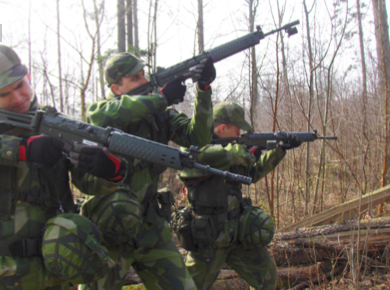
Image Credit: Osquar, CC BY-SA 3.0 <http://creativecommons.org/licenses/by-sa/3.0/>, via Wikimedia Commons
Countries abolished their mandatory military conscriptions, like Sweden in 2010 and Germany in 2011, when peace and security in Europe were still largely taken for granted. Over the past decade, starting with Russia’s annexation of Crimea in 2014 leading up to today’s ongoing Russia’s invasion of Ukraine, armies have become more important again. War feels closer to Europe’s capitals now, urging leaders to think about ways to step up their defense.
With the change in Europe’s security climate, Sweden already made a U-Turn in 2014 when Russia annexed Crimea. What started with 4000 servants a year, is now aiming for 10000 a year. Their system is a role model to many European countries that want to restructure their military services, such as the Netherlands and Germany.
The Swedish selection process is based on a questionnaire in which all 18 year old men and women need to give insights relating to their health, education, criminal record, and motivation. Based on this information, around 110,000 teenagers are invited for a mandatory screening that consists of mental and physical exams every year. Those found to be best suited need to serve 15 months in the military, no matter if they would rather pursue something else. “Conscription is a basic prerequisite for the armed forces' continued growth,” Swedish Defense Minister Pål Jonson explained.
The Netherlands is trying to reform their defense system as well and is now sending out letters encouraging 18 year olds to join. 17 year olds can now fill out a survey, which might become compulsory as well. Striving for 200000 soldiers by 2030, the Netherlands too is reacting to the threat coming from Russia.
Germany’s government seems to agree with Sweden and the Netherlands and just passed a law reforming voluntary military conscription. Accordingly, starting in 2026, all 18 year olds will receive a questionnaire that will be mandatory to fill out for men. All those who send back their questionnaire will be called in for a test inspired by the Swedish model, starting in 2027. However, if not enough people sign up voluntarily so that the goals would be met, the new policy includes the possibility of a so-called „compulsory military service“, which would make conscription mandatory again. Germans have the basic right to refuse it, and numbers show a record-high of applications since 2011. Even though no law has been passed so far that actually puts the reform in place or makes the service mandatory again, until October of this year, 3034 applications for refusal have been received so far.
The new law currently causes a great public debate in Germany, with young people feeling overlooked by politicians. “It is paradoxical and wrong to believe that we need lots of young people now, but that we don't need to involve them. That doesn't work; you can't make good laws that way. You have to bring young people to the table,” criticized Federal Student Representative Quentin Gärtner. After the law was passed on December 5th, students went on strikes in major German cities. The common feeling of being unheard and questioning the necessity of risking their own lives in possible wars unites them. In a recent interview with chancellor Friedrich Merz, a student asked „Why should I fight for this country, if this country does not give me the feeling of fighting for me?“. Questioning rising train prices and the German pension reform mainly affecting younger generations that feel disadvantaged, the video went viral.
Merz replied he served his, back then mandatory, conscription out of conviction to give back to society, voicing his hopes that the youth as well will come to the conclusion of finding protection of Germany worth it.
But German teens are not alone in their defensive stance towards military conscriptions: in the Netherlands, surveys show that half of the teenagers eligible for military service would try to avoid it. More than half of the Dutch population supports the revival of conscriptions, but younger people, especially, are not so sure about it.
That leaves both the Netherlands and Germany with a problem: will the youth be listened to? In the end, it’s their lives that politicians decide over, and going over their heads poses the danger of risking young people’s trust in governments.