

Don’t Feed the Pig: Bulgaria’s 2026 Eurozone Budget Uprisings Explained
Written by: Nikola Kirkov, Reading time: 7 min
This week, the European Union awoke to yet another episode of civil unrest in one of its Member States. Just 31 days before its planned entry into the eurozone, Bulgaria has plunged into an unprecedented political situation. On Wednesday, thousands of citizens gathered on the emblematic Independence Square in Bulgaria’s capital, Sofia, rallying around a giant pink piggy bank. The majority of the slogans on the protestors’ banner also featured the animal, a symbol of the ruling elite within the Eastern European country, which has long been accused of robbing Bulgaria of its money, features, and transparency. Following the large-scale protests, the government withdrew the 2026 budget, which had been scheduled to replace the lev with the euro officially. Now consultations are starting from scratch.

The crowd of thousands protesting against the 2026 Budget on Sofia’s Independence Square on November 27, 2025 // Source: Radio Free Europe
The 2026 uprisings
On Thursday, Bulgaria’s minority government was pressured into withdrawing its highly controversial 2026 draft budget, following escalating street protests against the envisioned steep tax hikes, including higher social security contributions and a doubled dividend tax. The proposed budget triggered one of the largest demonstrations Sofia has seen in recent years. Reports of up to 70,000 protesters occupying the so-called Triangle of Power, demanding transparency, rejecting the planned record government spending of 46% of GDP, and condemned what they viewed as an attempt to push through a punitive, anti-business fiscal plan. Tens of thousands of citizens blocked traffic in the heart of the capital. They effectively besieged the buildings of the Presidency, Parliament, and the Council of Ministers for hours, preventing MPs from the ruling majority from leaving before midnight and prompting clashes between protesters and police.
Uniformed officers used pepper spray after National Security Service vehicles were attacked, resulting in injuries among both demonstrators and law enforcement, as confirmed by emergency services. The protests, planned by the biggest opposition party in the country, “We Continue the Change - Democratic Bulgaria” (PP-DB), joined by employer, labour, and worker organisations such as the Association of Industrial Capital in Bulgaria (AICB), escalated when the budget committee approved the controversial tax increases, intensifying confrontations.
Two cars belonging to the National Security Service (NSO) were attacked by demonstrators, with uniformed officers using pepper spray in the second incident. Furthermore, the turmoil included attempts to overturn police buses, throwing firecrackers and bottles, and chants along the lines of ‘Mafia out’ and ‘Boyko = thug,’ referring to the leader of the ruling centre-right GERB. GERB is the country’s main political party and is the driving force behind the current government, despite a solid track record of corruption and allegations of embezzlement of EU funds. Alongside the slogans against Borisov, the protestors’ choice of the ‘pig’ theme was not random. Slogans featuring the animal were deliberately aimed at Delyan Peevski, leader of the DPS-New Beginning party and widely regarded as a symbol of oligarchic power and corruption in Bulgaria. Peevski is a sanctioned oligarch, a former media mogul and a long-time politician who remains in power despite numerous attempts to oust him from the Bulgarian political scene.
By invoking words such as ‘Mafia out!’ and ‘Don't feed the pig with your money’, protesters signalled their anger at what they see as state capture: control of institutions, legislation, and public finance by those tied to the bipartite ruling elite. The chants underscored that many of the demonstrators view the proposed 2026 budget not merely as economic mismanagement, but as part of a broader system of oligarch-backed interests.
The political storm was fuelled by coalition infighting after committee members pushed through social security rises despite the employers’ and opposition objections, culminating in mass demonstrations demanding accountability, an end to corruption, and the rejection of Budget 2026. The demonstration comes as the Balkan country prepares to officially enter the eurozone at the very beginning of next year, on January 1.
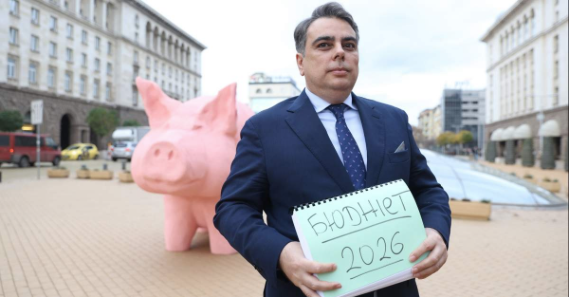
Assen Vassilev, former Minister of Finance and co-founder of ‘We Continue the Change’, in front of the infamous piggy bank, symbol of recent civil uprisings // Source: BTA
Bulgaria’s Budget 2026 Proposal
The protests reflect deep public alarm over the draft 2026 budget’s unprecedented economic implications, particularly higher social security contributions, frozen social benefits for vulnerable groups such as children with disabilities, and the doubling of the dividend tax. Moreover, the 2026 budget sets a record for government spending, reaching nearly 46% of GDP, financed largely through increased taxation and a surge in public debt. Despite fierce opposition and criticism from businesses, trade unions, and economists warning of severe economic risks, the budget was still expected to pass due to the ruling coalition’s parliamentary majority. The contested measures include salary hikes across the security sector, the state administration, and judiciary, increases to both minimum and maximum insured incomes, and external debt projected to reach 37.6 billion euros (31% of GDP).
The ruling coalition, comprising the centre-right GERB, the pro-Russian Bulgarian Socialist Party (BSP) and the nationalist There’s Such a People (INT), with the support of Peevski’s DPS-New Beginning, has downplayed the significance of the rallies. On the other hand, Democratic Bulgaria MP Ivaylo Mirchev labelled the budget a ‘war on the middle class’, prompting GERB leader Borissov to impudently dismiss the protests, noting that he hadn’t even considered speaking to the protesters as Real Madrid was playing that night.
Opposition leader and former minister of finance, Assen Vassilev, warned that the increased pension contributions would force every Bulgarian citizen to pay an additional 300 euros, accusing the committee of ignoring citizens, businesses, and all opposition proposals. The large-screen broadcast outside parliament on Thursday, organised by PP-DB, allowed thousands to follow the heated session in real time, after the meeting was abruptly convened ahead of schedule to be passed more quickly and against procedure, precluding opposition proposals and triggering public outrage.
On November 27, it was announced that Borisov had told the prime minister and finance minister to retract the 2026 budget, bringing the process back to the drawing board. This decision underscores the unprecedented nature of the crisis, noting that never before has a draft budget been withdrawn so late in the legislative process.
Meanwhile, the European Commission has warned that the draft budget risks breaching EU fiscal rules, expanding the shadow economy, and fueling inflation due to heavy reliance on tax hikes and rising debt. Prime Minister Zhelyazkov pledged to revise the budget to address its ‘defects’, ensuring compatibility with the coalition’s goals and eurozone requirements.
Borisov falsely accused PP-DB, without evidence, of attempting to derail eurozone accession, insisting Bulgaria will join on January 1. PP-DB has long been viewed as Bulgaria’s key defender against Euroscepticism and Russian interference in the Member State’s domestic politics, and therefore a strong proponent of the country’s accession to the eurozone. These key aspects of the party have led to its support coming mostly from young, liberal-leaning people in the last couple of elections.
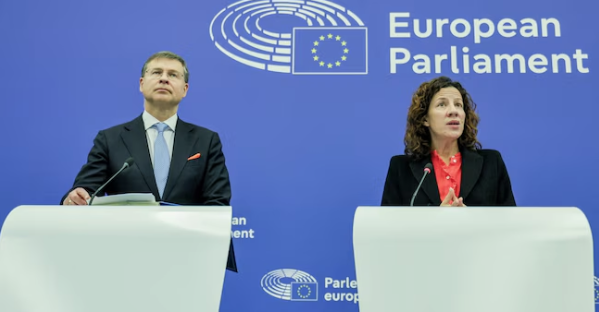
The European Commission adopted the autumn package for the European Semester for 2026 on Tuesday in Strasbourg. EPA/RONALD WITTEK
Bulgaria’s deepening democratic crisis
Bulgaria’s 2026 budget crisis has not occurred in a vacuum. It has unfolded against a broader breakdown of political trust, ignited by longstanding corruption concerns, and the re-emergence of oligarchic influence at the governmental level. The protests in front of the parliament building this past week echo the infamous events of July 2013: a key moment in Bulgaria’s modern history, when, during massive and continuous civil protests, MPs besieged over the appointment of Delyan Peevski as head of State Agency for National Security were evacuated under police protection in a white bus that was almost turned over by demonstrators – a litmus test revealing how deeply embedded public anger toward the ruling class remains. Alongside the reappearance of the infamous white bus this week, the historical spectre resurfaced shockingly close to a new scandal: the unprecedented adoption of a sweeping Lukoil bill in just 26 seconds by the parliamentary energy committee, without debate, opposition presence, or scrutiny, granting the government’s ‘special administrator’ near-unchecked control over Bulgaria’s largest refinery. The lightning-fast vote, defended by GERB, BSP, ITN, and Peevski-aligned DPS–New Beginning as necessary to comply with upcoming sanctions, was condemned by PP-DB, Revival, and economists as an act of de facto nationalisation and a dangerous concentration of power.
This chain of controversies reinforced fears that the ruling coalition is drifting back toward the state-capture model associated with Borisov’s earlier governments, in which corruption, political repression, and media influence were pervasive. Opposition leaders argue that the rapid Lukoil takeover and the contested budget are two sides of the same crisis: the resurgence of a political elite that prioritises opaque deals, special-interest networks, and institutional control over democratic legitimacy and stability.
Many Bulgarians interpreted these developments as symptomatic of a deeper democratic erosion, heightened by the fact that Bulgaria has undergone seven elections in three years, with the possibility of an eighth looming as coalition negotiations repeatedly collapse. The resurgence of Peevski’s political power within the ruling coalition has intensified concerns, as the tycoon remains sanctioned by both the US and UK for corruption and influence-peddling. The instability of the current GERB-BSP-ITN-DPS coalition is also owed to the contradictions it embodies, particularly balancing pro-Western rhetoric with tacit concessions to pro-Russian actors and Eurosceptic forces.
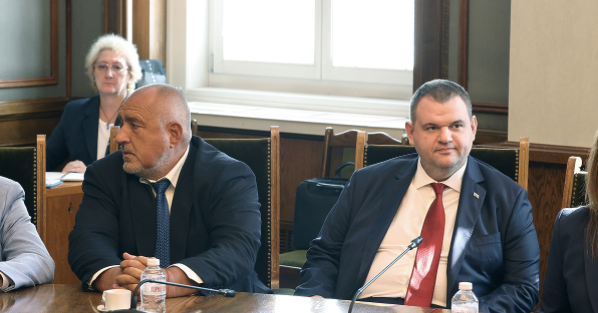
Boyko Borisov, leader of GERB and infamous for corruption schemes and erosion of transparency, next to US and UK-sanctioned oligarch Delyan Peevski, leader of DPS-New Beginning. // Source: Club Z
The protests that have been occurring in the heart of Independence Square in the past day thus expose a deeper national anxiety: the possibility of Bulgaria drifting back toward a model of governance dominated by corruption, impunity, and oligarchical elites. The budget demonstrations emerge not merely as a rejection of unpopular taxes, but as a decisive public stand against a political order perceived as sliding back into entrenched unaccountable power, putting Bulgaria’s eurozone trajectory and its democratic future in jeopardy.