

The Transatlantic Ripple: How U.S. Politics is shaping Europe
By Tricia Pelser, Estimated reading time: 4 minutes
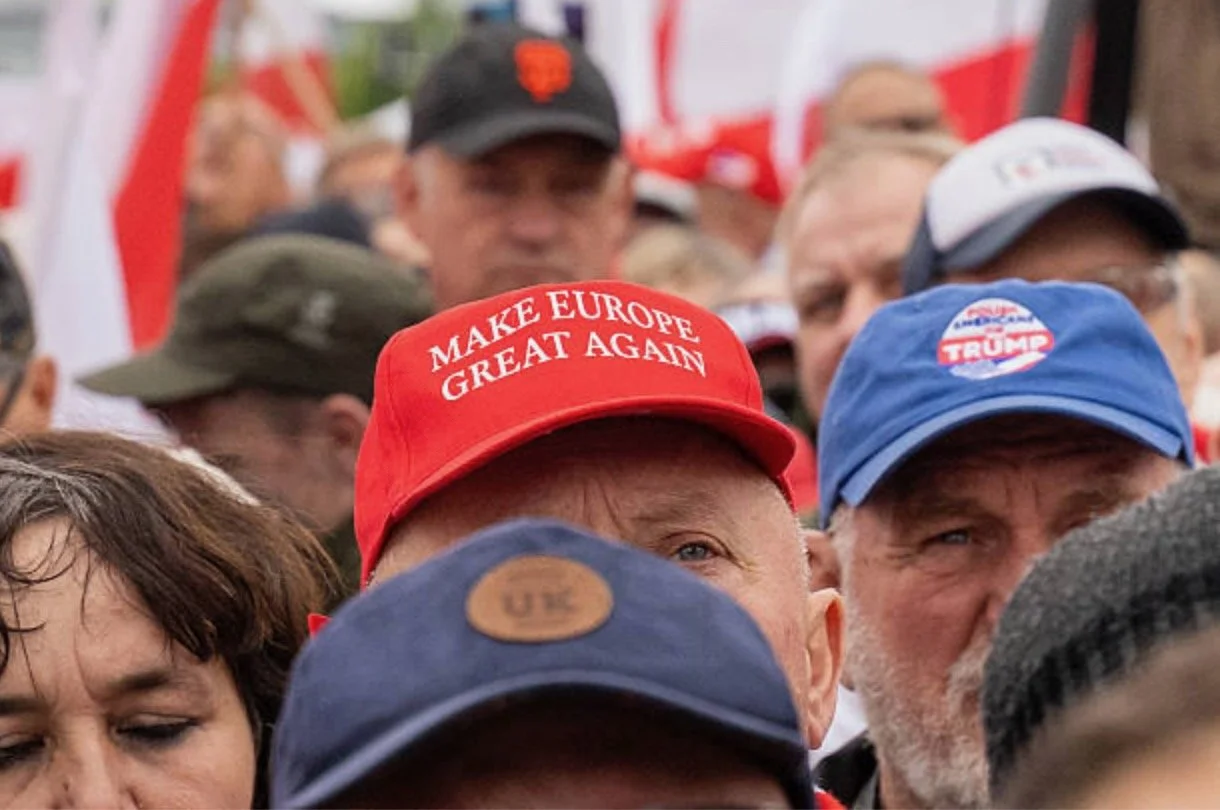
SOPA Images/ gettyimages.nl
The United States is widely regarded as one of the most influential nations in the world. Its dominant economic strength, military power, and cultural reach extend far beyond its borders and actively work to shape global trends. However, few movements have generated as much international political resonance as the rise of the “Make America Great Again” (MAGA) movement. Emerging from American conservatism, MAGA has not only transformed American politics, but some view it as leading certain European movements to seemingly mirror its political rhetoric, strategy, and ideology. As right-wing movements have begun and continue to gain traction, the parallels between their messaging and MAGA’s core themes have become increasingly apparent. The growing visibility of these similarities raises important questions about the extent to which American political movements are shaping the evolving political landscape of Europe.
Following the emergence of Donald Trump’s 2016 campaign slogan “Make America Great Again” came the “Make Europe Great Again” (MEGA) strategy. While this campaign is not technically accredited, it somehow remains in limbo between rhetoric and official status. MEGA, from the American perspective, entails a highly debated U.S.-backed initiative that aims to completely shift European power dynamics by encouraging nations such as Austria, Italy, Hungary, and Poland to “work more with the U.S. with the goal of pulling them away from the European Union”, as stated in the official 33-page National Security Strategy (NSS) document. However, from a European perspective, it merely extends to a rising nationalist movement that aims to restore what are considered traditional European values. Often backed by conservative and populist figures across Europe, such as Hungarian Prime Minister Viktor Orbán and Marine Le Pen’s National Rally. These two figures, alongside Spain’s Vox party, have organised events under the “Make Europe Great Again” banner. The movement has received attention from US-based conservative organisations such as The Heritage Foundation, which has been actively working to “Make Europe Great Again” to counter progressive policies in Europe.
Whilst the aforementioned countries may initially seem like a random grouping of European states, looking closely at the political situation in each reveals why they have somewhat been singled out by the U.S. Ranging from electoral gains to holding government power, Austria, Italy, Hungary, and Poland alike have all experienced a significant rise in far-right political influence. Although these are not the only European countries that have faced a rise of the right, what makes them valuable choices for the U.S. is their mutual focus on stricter immigration policies and their challenges to European Union norms. This aligns directly with the American government's viewpoint as outlined in the NSS. The document specifically outlines that they will “reward and encourage the region’s government, political parties and movements broadly aligned with our principles and strategy”, which is evidently unfolding in front of our eyes.
As a quarter of Polish people already support a theoretical “Polexit”, and Italy’s "Italexit" party had previously proposed the possibility of a similar withdrawal from the EU, some view the ideology of MEGA as potentially causing a broader rise in Euroscepticism and possibly threatening the unity of the EU. The United States’ perspective on Europe further adds to this rising tension. In an interview with Politico, Trump spoke harshly of “decaying” European nations, which, according to him, are “destroying” their countries by the immigration policies of “politically correct leaders”. These comments not only reinforce the nationalist narratives within Europe but also lean towards an attempt to potentially pull apart the EU. These comments are widely regarded by many European politicians as an open affront, interpreting them as encouragement for Eurosceptic movements that seek to weaken the EU from within. These developments have risked intensifying ideological divisions among member states while further destabilising the already fragile U.S- European partnership.
In recent years, Europe has slowly watched one of its closest alliances completely transform. Europe’s relationship with the U.S. has transitioned from a close, security-guaranteed alliance to a more transactional, strained partnership, with a number of citizens beginning to view the nation as an enemy. This disdain is mutual, however, as Trump has outwardly expressed his disregard for the EU and belief that it was founded with the intention to “screw the United States”. Because of this, some argue that, for MAGA, supporting the EU is not only a low priority but is actively resented and resisted, despite the United States' recognition of transatlanticism as being in its national interest. The mere existence of the National Security Strategy has clearly shown Europe exactly how the U.S. administration regards it, and it is now impossible to pretend otherwise.
It has become increasingly clear that the political aftershocks of MAGA are no longer confined to the United States. As its rhetoric and strategy echo across Europe, Euroscepticism is deepening, and an alliance that once defined Western unity is now highly strained. What was once a shared transatlantic vision is now increasingly fractured and has raised a pressing question: Can Europe withstand America’s political influence without being pulled apart by it?