

An Introduction to the Digital Market Act : Welcome to the Future
By: Gabriel Panza
Reading time: 3 minutes

© Pexel Free Stock Photos
The Digital Field
In the past few decades, digital platforms have emerged, giving businesses access to platform-based business models. These platforms have transformed the digital economy by bringing users from all over the world together to interact and enabling them to offer services at lower transaction costs. This has led to major firms dominating, with Alphabet, Amazon, Apple, Meta, and Microsoft often referred to as “the Big 5” for their time. Since then, other major firms have expanded their influence over their industries.
One would think that the evolution of digital platforms would introduce new business models; however, this is not the case. In fact, digital platforms have optimized traditional forms by expanding business models to facilitate global interactions more easily. However, the EU has been cautious not to allow these major companies, such as the Big 5, to use these business models to dominate their industries. Naturally, this led to the adoption of the Digital Market Act.
The Digital Market Act
The Digital Market Act (DMA) was introduced in 2022 as a regulatory tool that identified large digital platforms as “gatekeepers” and imposed obligations to ensure fairness and contestability in digital spaces. These obligations include technical elements such as data access controls, interoperability requirements, and behavioral restrictions designed to prevent unfair competitive advantages. The Commission serves as the organ responsible for enforcing the DMA by designating the gatekeeper label. In fact, a joint team in the Directorates-General for Competition and the Communications Networks, Content and Technology department is responsible for the DMA’s implementation and enforcement.
The DMA is especially important regarding its implications for competition law, as it aims to reduce market dominance. The Google Shopping case (2024) is a revolutionary case that exemplifies this goal. This case concerned the use of self-preferencing techniques by a dominant search engine, in which the commission found that Google abused its dominance in its search service to prioritize its own shopping services while demoting rivals. This case influenced how the DMA is viewed politically, with the enforcement of pro-competition measures being in the spotlight!
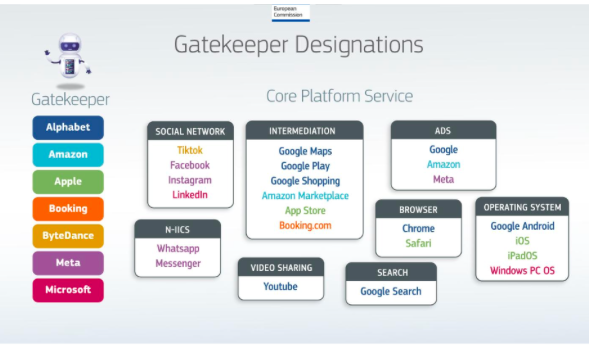
There are criteria for assessment to be considered a gatekeeper. First, the platform must be considered to have an impact on the EU internal market, especially if it has earned more than €7.5 billion annually with its core platform service. Secondly, the platform should be an important gateway for business users, with 45 million monthly active users as a threshold metric. A platform is considered entrenched and has a durable position if it has satisfied the first two criteria for three consecutive years.
What can you expect as an EU citizen?
So, the key question arises: so, what? What do these obligations for gatekeepers even mean for us as EU citizens? The DMA has implications for consumers in the digital market by expanding their choices, offering fairer services, and limiting gatekeepers' ability to lock users into favoring their gatekeeper products.
Consumer choices are expanding as Articles such as Article 6(4) obligate gatekeepers to allow consumers to install preferred apps directly from the web. This allows third-party companies to have directly downloadable alternative app stores and other apps. Moreover, Article 6(5) regulates self-preferencing obligations by prohibiting the use of ranking systems that favor gatekeeper platforms. What does this mean for us? It means consumers have unbiased search results, streamlined access to alternative platforms, more control over personal data, and seamless data portability.
Overall, the future of digital markets is leaning towards greater regulation of dominating platforms, fairness for businesses, and more rights for consumers. Although the DMA is still in its early stages, it has great potential to reshape the digital landscape by promoting competition, limiting abuse of dominance, and creating a fair online market.