

How an Irish mother is reshaping Europe’s fight against online abuse
By Tricia Pelser
Reading time: 5 minutes
European Parliament / https://multimedia.europarl.europa.eu/
In 2018, Jackie Fox lost her daughter, Nicole, at the age of 21 when she died by suicide after years of abuse, both in person and especially online. Jackie then began to campaign for justice for Nicole, also known as Coco. However, due to Ireland’s outdated laws, this proved to be increasingly difficult. At the time, the existing harassment laws were written before social media became widespread, and therefore, it was difficult to apply traditional laws to digital behaviour. However, after years of sustained campaigning, public advocacy, and pressure on lawmakers, Ireland adopted the Harassment, Harmful Communications and Related Offences Act 2020, widely known as Coco’s law. What began as a fight for justice in Ireland has since raised a wider question: could Ireland’s approach influence how Europe responds to online abuse?
Coco’s Law created two new offences that criminalise the non-consensual distribution of intimate images. Under this Act, it is an offence to distribute or publish intimate images of a person without consent and with the intent to cause harm, as well as to take, distribute, or publish intimate images of a person without consent, even if there is no specific intent to cause harm. It also targets harmful communications, covering messages intended to cause serious emotional distress, whether they are online, through social media, or in other digital spaces. While the law marked an important development in Ireland, the issue it addresses is far from unique to Ireland. In fact, Coco’s Law represents a major step forward in protecting victims and holds a broader significance. It shows how national legal systems can adapt to technological change and serve as models for wider European discussions on online safety.
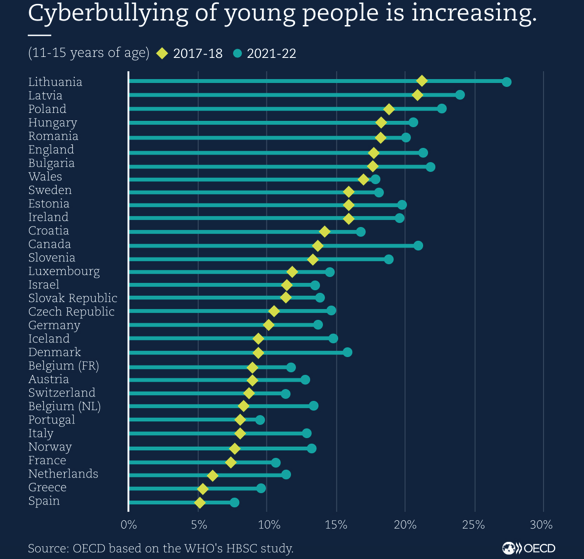
Online abuse is increasingly recognised as a cross-border problem within the European Union. As social media platforms enable communication to occur instantly across national boundaries, perpetrators and victims alike may be located in entirely different countries. This creates significant challenges for national legal systems, as harmful messages and images can spread rapidly beyond a single jurisdiction. According to a report by the Organisation for Economic Co-operation and Development (OECD), cyberbullying amongst children and teenagers is an increasing problem across Europe. In all 29 countries and regions surveyed, the rates of children reporting experiences of cyberbullying ranged from 7.5 percent in Spain to 21.5 percent in Lithuania, with an OECD average of 15.5 percent, a figure that largely reflects Europe.. Several countries, including Latvia, Poland, England, Hungary, Estonia, Ireland, Scotland, Slovenia, Sweden, Wales, Finland, and Denmark, reported rates above this average. These figures illustrate that online harassment is not limited to a small number of states, but rather represents a broader European challenge that continues to grow alongside the development of the digital age.
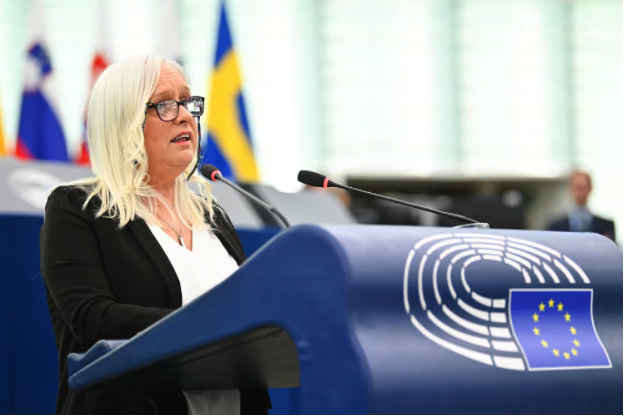
Through public advocacy and engagement with policymakers, Jackie Fox has helped bring the issue of cyber harassment into wider European discussions on digital safety. On International Women's Day, Jackie Fox took to the European Parliament to appeal that Coco’s Law be adopted at the European level. In her remarks, she highlighted the potential risks posed by the misuse of emerging digital technologies, including artificial intelligence, and stressed the need for stronger protections for people in online spaces. She warns of what they could produce, if misused, to the detriment of everyone. And she concludes: “We need so much to protect our adults and children”. Her intervention reflects growing concern among European policymakers about the scale and impact of digital abuse. The President of the Parliament, Roberta Metsola, stated after Jackie’s speech at the Parliament that “Coco’s law is now inspiring other Member States as a possible model for Europe”, and reaffirmed that “That is why this Parliament adopted the first-ever EU Directive on combating violence against women, with strong provisions against the worst forms of online abuse”.
The pleas made by Jackie Fox have directly influenced the recent Action Plan against Cyberbullying, released by the European Commission. The plan aims to protect the mental health of children and teenagers online in the EU by aligning national laws, namely through the rollout of an EU-wide app that enables victims of online bullying to easily seek help, and prevent cyberbullying by encouraging safer digital practices. The key point of the plan is to establish a standard definition of cyberbullying, which defines it as harmful, recurrent online behavior targeting young people, and urging Member States to adopt unified national anti-bullying strategies. The content of the plan presents a comprehensive vision for action that, if implemented effectively, has great potential to mitigate cyberbullying and its consequences.
Despite growing political attention, translating national initiatives such as Coco’s Law into a coherent European legal framework remains complex. Criminal law continues to fall largely within the competence of individual Member States, meaning that efforts to harmonise legislation on cyber harassment must balance respect for national legal traditions with the need for stronger cross-border protection. Furthermore, concerns about freedom of expression and the practical challenges of enforcing digital regulation across multiple jurisdictions continue to shape the debate. While EU action plans and policy initiatives represent important steps forward, their effectiveness will ultimately depend on the willingness of national governments to implement coordinated strategies and allocate sufficient resources to victim support and prevention measures.
Nevertheless, the campaign led by Jackie Fox demonstrates how individual advocacy can shape legal and political responses beyond national borders. What began as a deeply personal fight for justice following the death of Nicole Fox has evolved into a broader European conversation about how societies should respond to online abuse in an increasingly digitalised world. While the European Union may not adopt a direct equivalent of Coco’s Law, Ireland’s experience highlights the growing recognition that effective protection against cyber harassment requires both national innovation and European cooperation. In this sense, the story of Coco’s Law illustrates how activism can influence the future direction of digital policy across Europe.