

Ireland as Europe’s Mirror: What Ireland teaches the EU about historical justice (Copy)
By Tricia Pelser, reading time: 6 minutes
On April 24th, it is the 110th anniversary of the Easter Rising, and Ireland returns to the forefront of European history once again. The events of 1916 are widely commemorated in Ireland as a moment of national awakening and an assertion of political will against the rule of the United Kingdom. However, beyond commemoration, it raises a much more difficult question regarding not how Europe remembers injustice, but rather how it takes responsibility for it.
Debates over historical accountability have resurfaced with increasing urgency across the continent. Former colonial powers such as the Netherlands, Belgium, and France have been pushed to confront the legacies of empires abroad. Apologies have been issued, inquiries were convened, and the language of reparations has entered the public debate. However, these gestures remain carefully bound. They are directed outward and reinforce the notion that Europe’s most grave injustices can unfold outside the union. Contrarily, Ireland resists this framing. Its colonial history took place within Europe itself; moreover, under the authority of one (formerly) European power over a neighbouring one. This allows the past of Ireland to unsettle the boundaries that Europe has drawn around its past, and act somewhat as a bridge case.
By doing so, it reveals a deeper contradiction at the heart of the EU. The Union presents itself as a guardian of human dignity and promoter of rights, and although it looks forward with moral clarity, it remains hesitant when looking back. Ireland reveals a Europe that knows how to remember injustice, but is unsure how to take responsibility.
Historical Accountability within Europe
In recent years, Europe has not been silent in the face of its imperial past. In recent years, there has been a visible, albeit unequal, movement towards acknowledgment in which the Netherlands revisited its actions in Indonesia, Belgium confronted its rule in the Congo, and France continues to grapple with its legacy of Algeria. The combination of these efforts suggests an emerging awareness that history is not confined to archives, but rather persists to shape the political and moral landscapes nationwide long after empires have dissolved.
European accountability is largely framed as a response to overseas empires, and colonial violence is shaped to be understood as something external to Europe itself. Under this narrative, Europe is presented as the site of rights and development while injustices are displaced elsewhere. However, Ireland unsettles this distinction entirely. Its colonisation by the United Kingdom, a neighbouring country, disrupts the idea of moral distance within empires. Specifically, the Easter Rising illustrates how unresolved historical grievances, such as land dispossession and cultural suppression, can lead to political instability. These conditions were not inevitable but rather the result of governance.
From this perspective, Irish colonialism is not an exception but a challenge. It exposes the boundary in Europe between the injustices it is willing to confront and those which it prefers to leave undisturbed. In this way, Ireland exposes a deeper bias in the EU’s readiness to confront injustice, which is dependent on how close to home it lies.
The EU’s Missing Framework for Historical Justice
The European Union speaks fluently in the language of values. Human dignity, the rule of law, and reconciliation are the principles through which it defines itself. Notably, these commitments are primarily directed toward the present and have an intense emphasis on the future. When it comes to the past, the Union is increasingly less certain.
There is no coherent framework within the EU to address historical injustice at present. With no binding mechanisms for acknowledgment, no established procedures for reparations, and no engagement with the enduring effects of intergenerational trauma, history remains acknowledged in a political sense but institutionally unstructured. The consequences of this absence are illustrated in Ireland, as the recognition of their injustice first emerged through culture. Memory, literature, and political expression of their endured colonialism took place long before it found form in any legal or institutional frameworks.
While the EU effectively projects its values outwardly and is actively regulating present violations, it still seems to lack the ability to confront the historical inequalities within its own space. How effective is it really to promote human rights moving forward, but not apply those same principles retrospectively?
Ireland as a case study for Rights and Justice
The Great Famine in Ireland is often framed as a natural catastrophe and a tragic convergence of disease and dependency. However, this framing restricts much more than it reveals. The scale of suffering was not one of fate. Rather, it was shaped and intensified by the policy decisions that were taken under British governance. Considering the famine in these terms shifts it from the realm of tragedy to that of responsibility and raises questions that resonate beyond Ireland, such as the right to life, state obligations, and the limits of economic governance. Yet, while the EU has developed frameworks to respond to famine and humanitarian crises abroad, it doesn’t apply similar analytical tools to its own past. The result is a fragmentation between how Europe understands suffering elsewhere and how it interprets it within its borders.
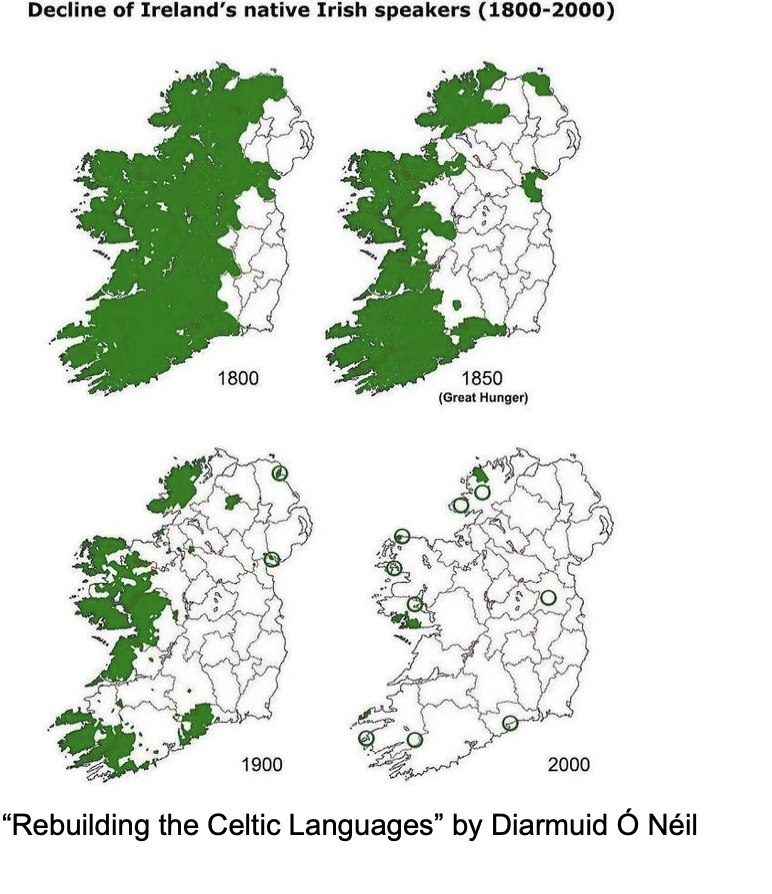
Furthermore, the decline of the Irish language under British rule was not a mere incident. It was entangled within the systems of power, education as well as economic survival. In this context, language was not only a means of communication but also a pinnacle of identity, and its erasure carried lasting consequences. This history echoes in contemporary European debates over minority languages, from Basque and Catalan to Sámi and Breton. The EU now positions itself as a defender of linguistic diversity, offering funding and institutional support. Yet such efforts remain oriented toward preservation, rather than acknowledgment. In 2022, Irish became an official and working EU language, but amidst this development, it was never acknowledged why exactly it took 50 years of EU membership for this to happen.
Ireland has never received any formal reparations for the injustices of colonisation. Instead, they emerged directly and altered material conditions such as land and politics. However, they were not framed as acts of accountability. This pattern reflects a broader European tendency. The Union favours forward-looking instruments such as development aid and investment rather than explicit engagements with historical responsibility. This approach addresses consequences, but leaves their origin largely unspoken, and the form of repair that occurs operates quietly and without acknowledgment.
Why this matters today
In modern conflicts, history is invoked in a way that obscures rather than clarifies. Violence is commonly attributed to “ancient tensions,” and divisions are cast as inevitable, subsequently dissolving responsibility into abstraction. The comfort of these narratives provides an explanation of the past without any implications. Irish history offers a different perspective, as it reveals that to depoliticise history is not just simplifying it, but it is removing accountability from those who shape it.
The emigration that followed the Great Famine occupies a central place in Irish and European memory alike. It is remembered with empathy and incorporated into narratives of resilience and survival, which is commemorated across generations. On the other hand, contemporary migration is framed completely differently. Those who are displaced by climate change or conflict are often met with skepticism rather than recognition, even within Ireland itself. This contrast reveals an even deeper asymmetry: Europe is capable of humanising suffering at a distance in time while actively struggling to extend the same recognition in the present. In this sense, Ireland becomes a reminder that the distinction between “then” and “now” is not always as stable as it initially appears.
Ireland does not stand apart from Europe’s history, but rather highlights it. By placing colonialism within Europe itself, it unsettles the boundaries that have structured discussions of responsibility since their origin. It reveals that amid the union’s efforts to remember injustice, there is still hesitance to confront it.
As the anniversary of the Easter Rising is marked once more in Ireland, the question that remains is not simply what is remembered, but what is acknowledged. After all, memory does not equate to responsibility. Ireland is evidence that the past does not fade when it is commemorated, but rather endures quietly where it has yet to be resolved.