

BREAKING: Orban has risen! Is Bulgaria the Next Trojan Horse within the EU?
By: Nikola Kirkov, reading time: 12 minutes
While Peter Magyar’s decisive victory in Hungary earlier this month sparked relief and a sense of triumphalism across the European Union, that optimism has now been called into question following Radev’s crushing win in Bulgaria. The political situation unfolding in Sofia might prove to be a litmus test for the Union’s future alignment, as Bulgaria stands on the brink of transforming itself from a reliable partner into a new and potentially dangerous Achilles’ heel of the EU.
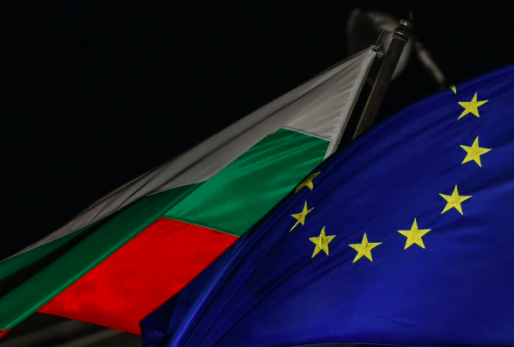
Artur Widak/NurPhoto via Getty Images
Bulgaria’s Deepening Political Crisis
On Sunday, April 19, Bulgarians went to the polls yet again, marking the eighth time the Eastern European nation has held elections in almost five years. Characterised by a persistent pattern of parliamentary deadlock, the electoral crisis in Bulgaria has evolved from an unexpected episode of political instability into a persistent feature of Bulgaria’s political reality. This era of institutional stagnation initially manifested itself with the 2020-2021 anti-corruption protests, which ostensibly marked the end of the long-dominant rule of the GERB party, an EPP-aligned centre-right formation synonymous with corruption scandals due to its long track record of political domination in the country.
Following the success of the nationwide protests in 2021, the EU member state turned to the ballot box with no clear path toward long-term solutions, as no political force was able to secure a parliamentary majority. Between 2021 and 2024 alone, the country held multiple parliamentary elections, highlighting declining trust in traditional parties and the urgent need for a profound reform of Bulgaria’s institutions. Although over the years of repeated elections, new political actors with reformist platforms emerged and faded on Bulgaria’s political scene, such as the ITN (“There is Such a People”) party, the country never successfully recovered from its episode of instability, as the election chain only led to short-lived formed governments which were ultimately brought down amid coalition tensions.
The systemic crisis progressively became a chronic diagnosis of the country, continuing into 2025, when the deeply unpopular GERB-led coalition government under Prime Minister Rosen Zhelyazkov collapsed amidst Bulgaria’s biggest protests in recent history. The large-scale uprisings, which effectively brought down the ruling government, were sparked by the controversial 2026 draft budget and Bulgarians’ growing dissatisfaction with the corruption within the country, which has infected all institutions. Subsequent attempts to form a successor government quickly failed due to the inability of major parties to secure sufficient parliamentary support.
In a dramatic yet unsurprising turn, former-President Rumen Radev announced his resignation in January 2026 with the intention of launching his own political platform and vowing to directly challenge the “mafia state”. Setting his sights on the Parliamentary institution, the former air force officer who served two consecutive terms in Bulgaria’s largely ceremonial role as head of state subsequently founded the Progressive Bulgaria party. While leading pre-election polls, Radev’s cryptic political agenda has been brought into question due to striking similarities to those of deeply EU-sceptic and pro-Russian figures such as Hungary’s former Prime Minister, Viktor Orban.
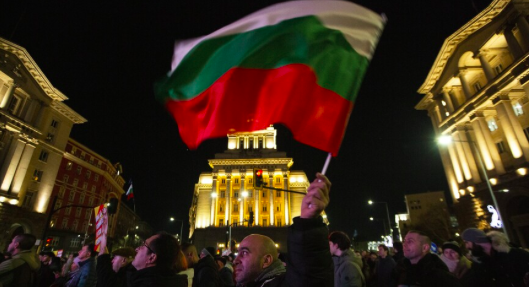
Bulgaria’s unprecedented anti-corruption protests in 2025 via Anadolu Ajansı © 2026
Radev’s “Progressive Bulgarian” Shift to Moscow
Emerging in early March 2026, Progressive Bulgaria’s early lead in pre-election polls effectively pushed the party into the media spotlight, due to the very cryptic nature of Radev’s new formation. Riding on the coattails of the historic anti-corruption protests, Radev has given his party the label of the biggest opposition to the GERB/DPS corruption model in an arguably opportunistic manner, seemingly trying to conceal the lack of a clear position on the political spectrum, a solid vision for future policies, and the true intentions of the ex-president’s new political venture. Despite the anti-corruption platform the party tries to push, Progressive Bulgaria appears to be an ambivalent political formation, as it is arguably largely built around Radev’s personal authority and dubious promises for reform.
Crucially, the reason why Radev has been gaining notoriety in both domestic and international media is due to the questionable and vague foreign policy orientation of both Progressive Bulgaria and Radev’s previous track record in the presidency. Despite Bulgaria’s traditionally pro-EU and pro-NATO stance, throughout his presidency, Radev repeatedly demonstrated concerning tendencies to align with Kremlin narratives regarding Ukraine. Most importantly, the ex-president has labelled Crimea as “Russian,” opposed military aid to Ukraine, described Ukrainian resistance as “doomed,” and prioritised cheap Russian oil over Brussels’s broad support for Ukraine. Moreover, Radev has a significant track record of advocating lifting sanctions on the Russian Federation as a gateway to renewed dialogue with the Kremlin, thereby threatening to shift Bulgaria away from its Euro-Atlantic alignment. Furthermore, Radev has also enjoyed considerable external support, with Russian political networks openly embracing his candidacy as evidence of growing dissent inside the EU, even labelling him the “new Orbán” in the Balkans.
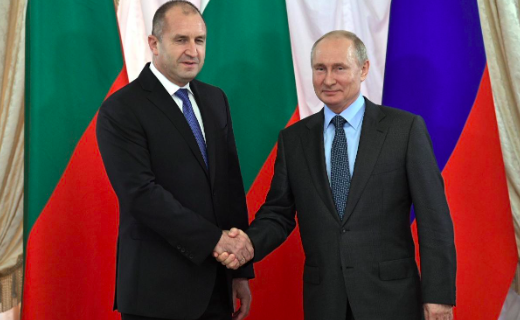
Meeting between Vladimir Putin and the ex-President of Bulgaria, Rumen Radev, via REUTERS
Radev’s positions have sent a shockwave throughout the EU, alarming policymakers across Europe, who view him as rhetorically aligned with Moscow on key policy areas in the Union. While some analysts describe his stance as “strategically ambivalent”, the party’s very apparent strategy to secure considerable political capital has undeniably focused on catering to pro-Russian constituencies, mainly through an overarching populist and Eurosceptic platform. Arguably, one of the clearest expressions of Radev’s Euroscepticism has been his attempts to challenge Bulgaria’s Eurozone accession while still in the Presidential office.
Concretely, the ex-president actively campaigned for a national referendum on adopting the Euro in 2025, an effort to directly delay or derail integration. Despite Radev’s campaigning, which saw joint efforts between him and the ultra-nationalist and pro-Russian Revival party, the initiative quickly collapsed and became legally impossible as the Constitutional Court ruled such a referendum inadmissible and unlawful, since such a referendum would inevitably contradict Bulgaria’s obligations under EU treaties and fall outside the competence of national plebiscites. Nonetheless, the verdict given by the Constitutional Court of Bulgaria failed to stop Radev from desperate last attempts to generate public support through the use of populist tactics, as exemplified by his 2026 New Year address to the nation, wherein he once again advocated for the unlawful Eurozone referendum, even though minutes later, Bulgaria officially adopted the Euro.
The Unprecedented 2026 Snap Elections
Bulgaria's 2026 snap elections cannot be viewed merely as an internal political matter within the country, mostly due to the sheer scale of Russian interference affecting the country before the vote. Sofia has been forced into the extraordinary position of requesting direct EU assistance to defend the integrity of its own vote, mostly by seeking coordinated monitoring of disinformation campaigns and intelligence sharing through the EU’s Rapid Alert System to suppress manipulation in real time. Undeniably, the sheer fact that the country sought such assistance from the EU exemplifies the fact that Bulgaria’s information space has effectively been left exposed, described as one of the most permissive environments in the Union for hostile manipulation.
With its previously proved expertise in foreign destabilisation as seen in Moldova, Moscow unleashed an industrial-scale propaganda effort: thousands of fabricated or distorted articles in Bulgarian each month, coordinated networks amplifying pro-Kremlin narratives, and digital ecosystems generating hundreds of millions of views, while relentlessly targeting public opinion. The content of the Russian disinformation campaign itself is as predictable as it is misleading and disturbing: persistent disingenuous attacks on the EU, fearmongering regarding Ukraine, and constant insinuations that Bulgarians must feel obligated to vote for those “wanting to save the country,” whose actual intentions remain loyal to Russia.
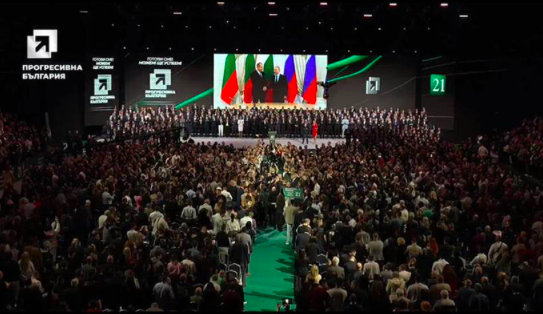
The official closing of Progressive Bulgaria's pre-election campaign on 16 April 2026 in Arena Sofia
After an intense pre-election campaign by Radev, marked by rallies of unprecedented scale and widely suspected, though still unproven, external backing from Moscow, the outcome of the parliamentary vote cast a concerning and long shadow over Sofia. Arguably, Russia’s broader efforts to secure a reliable partner who would destabilise the EU and promote the Kremlin’s interests through measures targeting any effort of the Union to aid Ukraine in the defence of its sovereignty and EU-aligned orientation, arguably, proved successful.
Radev’s Democratic Bulgaria party emerged victorious, securing a colossal triumph with nearly 45% against the backdrop of a roughly 49% voter turnout, according to exit polls, signalling a drastically lower electoral activity compared to the extraordinary turnout of nearly 80% in the recent Hungarian elections. “We Continue The Change-Democratic Bulgaria” ranked third with nearly 12.6%, while GERB and DPS experienced a substantial downfall to approximately 13.3% and 7%, respectively. In comparison, in the last parliament, GERB was the biggest formation with 26.3%, and DPS enjoyed a comfortable 11.5%. Moreover, the two parties, infamous for being deeply tied to state corruption, additionally suffered their lowest results since they began participating in parliamentary elections in 2009.
Due to the populist Euro-sceptic platform Radev ran on, other pro-Russian parties such as the ultra-nationalist Revival saw a significant drop in popularity, falling to 4.2% from the previous 13.3%, as a significant portion of their electorate switched to Radev’s Progressive Bulgaria instead. The same phenomenon extends over to fellow conservative formations whose political standing has been reduced to futility, such as BSP, MECH and “Greatness”, who failed to meet the electoral threshold. According to the Central Election Commission, Progressive Bulgaria is projected to be the biggest political party in the upcoming 52nd National Assembly, occupying a full majority with over 130 seats in Parliament.
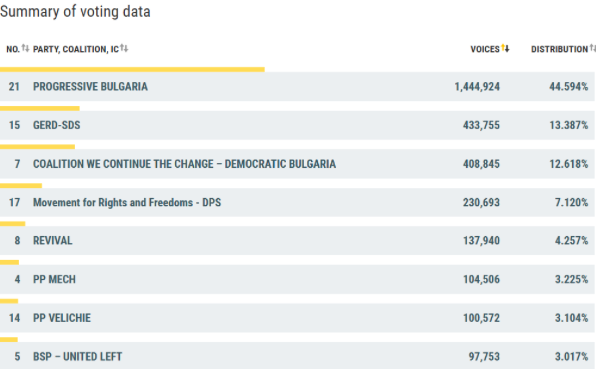
Data as of 15:00 on 20.04.2026, with 100.00% of SIC protocols processed in RECs
A return to the Orban era? What the future holds for Bulgaria
Upon closer inspection, one could reasonably infer from the outcome of the 2026 parliamentary election the following conclusion: the Bulgarians have had enough of the corruption-ridden GERB-DPS model of governance. Nonetheless, a deeply troublesome tendency continues to manifest itself in times of political crisis on Bulgaria’s political playing field –voters seem to always search for a new “heroic” actor to save the country’s stagnant state. This worrisome pathology of the Bulgarian voter has proven itself in time, owing to mobilisation based on populism and undemocratic impulses.
Rewinding to the 2021 elections, the recent at the time ITN (“There is Such a People”) party managed to achieve victory by running on an anti-corruption and soft euro-sceptic platform, which ultimately failed to demonstrate political depth and deliver significant change. This lack of substantial and actual reform led ITN to lose its parliamentary presence, generating merely 0.7% on Sunday. Similar to ITN, Progressive Bulgaria is far from an established party. If we analyse the current reality through the lens of previous historic precedence, Radev’s formation might prove incapable of governing in a parliamentary setting, since, unlike the Presidency, parliamentary power is not monopolised by one authority.
As Radev has managed to unequivocally secure the 121 seats needed for a full majority in Parliament, Bulgaria might finally put an end to its political deadlock and constant snap elections. With this result, Radev will be able to form an independent government without needing a coalition partner, which categorically rules out new early elections. Domestically, such a mandate would give Radev the authority to pursue his agenda of anti-corruption reforms, addressing a key voter demand after years of instability and need for institutional fixing, particularly in the area of the judiciary.
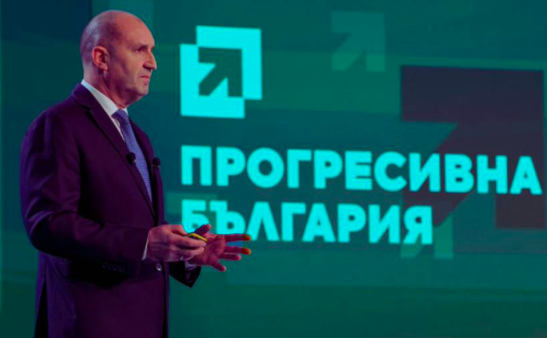
Rumen Radev at a Progressive Bulgaria rally, ahead of the 2026 Parliamentary elections. Via @facebook.com/PresidentRumenRadev
Nonetheless, given his record of scepticism toward EU sanctions on Russia and opposition to military support for Ukraine, his leadership could fundamentally alter Bulgaria’s stance within the EU, aligning it more closely with actors critical of Brussels’ current geopolitical posture. For the EU, this could translate into a new source of internal friction, particularly on issues requiring unanimity such as sanctions or military aid, echoing concerns that Bulgaria might emerge as a new Russian Trojan horse following Orban’s ignominious ousting in Hungary. While vowing not to paralyse EU decision-making and promising not to be as disruptive as previous outliers, Radev’s government in Sofia could nonetheless complicate the EU’s coherence, especially regarding its support for Ukraine and broader security strategy.
Related to concerns over the foreign position of the party, minutes after the initial exit polls at the end of the election day signalled a colossal victory for his party, Radev took the opportunity to address concerns regarding the future external policy of Bulgaria by expressing hopes that Russia will become a strategic partner of Bulgaria in the field of economy and security. This “pragmatic” attitude towards Moscow, which Radev has frequently employed in his statements, seemingly hinting at potentially aiming to secure cheaper Russian energy, echoes the very core of Orban’s past narratives, which translated to constant vetoes at the EU level.
It might be appropriate for us to issue a friendly reminder to our readers that the Russian Federation has consistently labelled Bulgaria as an “unfriendly nation” and has regularly been fantasising about occupying the Baltic nations and other Eastern European EU member states, alongside threatening to bomb every EU capital if necessary, including Sofia.