

33km That Could Strangle Europe
Implications of the Closure of the Strait of Hormuz on Europe
By: Anneke Pelzer
Reading time: 4:30 min
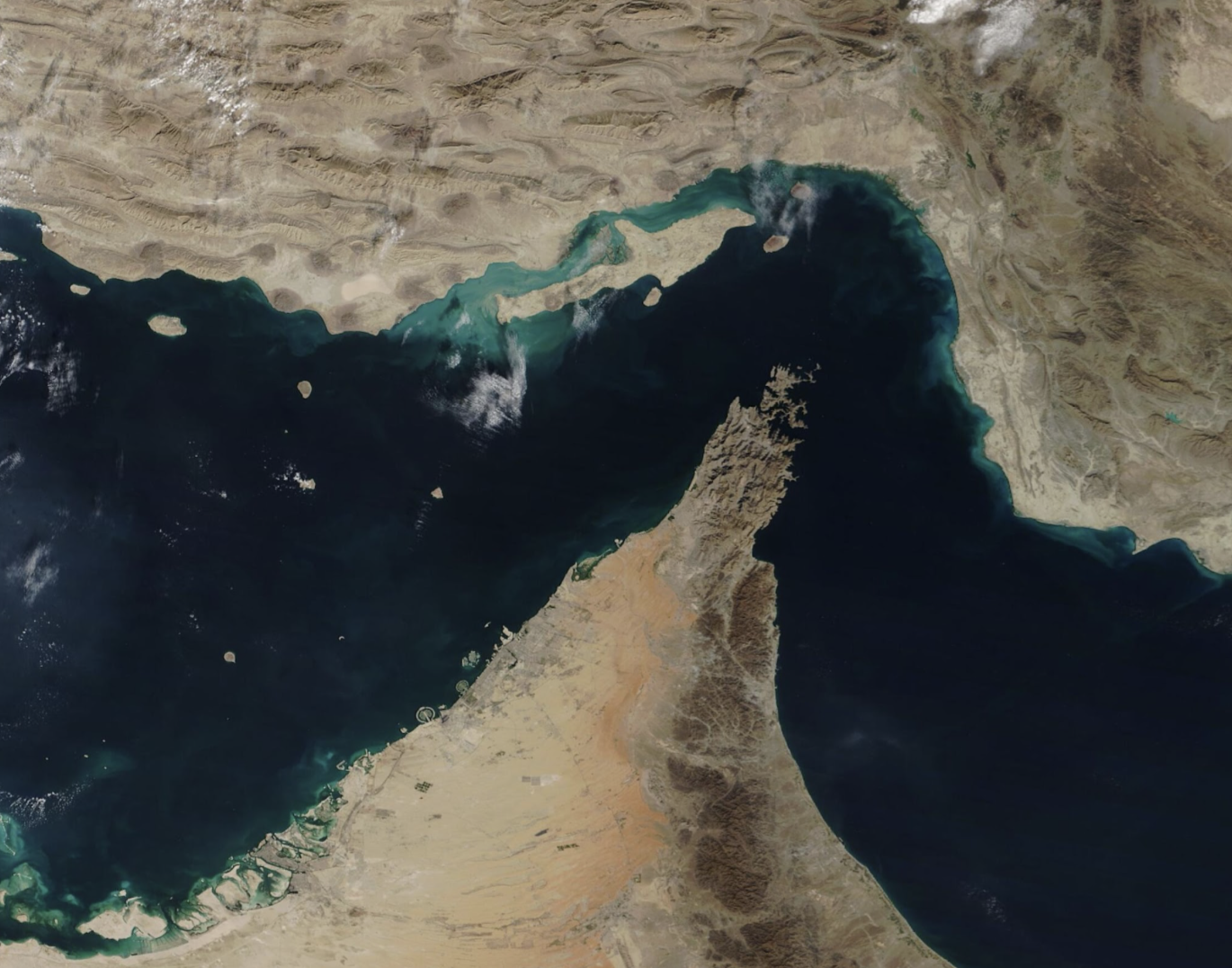
MODIS Land Rapid Response Team, NASA GSFC, Public domain, via Wikimedia Commons
What is 33km wide, 167km long, and has kept the global economy in a chokehold in the past two months?
The Strait of Hormuz dominated headlines around the globe since the US and Israel launched military strikes against Iran on February 28th. As a response, the Mullah regime closed the waterway between the Persian Gulf and the Gulf of Oman.
The strait is one of the world’s most important choke points. 33 percent of the world’s seaborne-traded crude oil, one-third of global seaborne trade in fertilizers, and 20 percent of global LNG gets shipped through the narrow point between Iran and Oman. Its importance for global trade routes renders it to the greatest geopolitical ace’s up Iran’s sleeve.
What happened?
In the past, the global economy’s dependence on the Strait of Hormuz made it a point of conflict between Iran and the US, when in 2019 Teheran shot down an American drone that, according to Iran, entered their airspace over the strait. The European-led Maritime Awareness in the Strait of Hormuz (EMASoH) mission, coming into force in February 2020, was set up as a reaction to incidents like this and aims at de-escalation. Dense traffic, in combination with both civilian and military vessels manoeuvring, create instability, making this crucial point in global trade routes dangerously unreliable. Today, only a fraction of the on average 130 ships per day can cross through this maritime bottleneck.
Oil prices spiralled after the US-Israeli attacks on Iran and peaked on 7th April at 113 US-dollars per barrel. Shipping oil takes a long time, since tankers move at the speed of bicycles. The last ships that were able to cross through the Strait of Hormuz before February 28th were expected to arrive in Europe and the US between the 10th and 15th April. Only then, the traditional supply would have finally stopped, creating great pressure on the US administration to resolve the situation.
After more than 6 weeks of blockade, the Strait of Hormuz recently opened again as an effect of the ceasefire agreed on16th April. However, access remains conditional and fragile, and risks of crossing are still high, while both Teheran and Washington maintain separate blockades. This creates uncertainty for both shippers and oil companies, which leaves oil prices at a higher level. Alternative shipping routes for oil to Europe, such as the one along the Cape of Good Hope, would take up to two weeks longer and significantly increase the shipping costs.
It doesn’t end with the gas bill
Even though the strait has reopened, economies still feel the effects. One explanation can be given by taking the Petrodollar system into consideration. After the US abolished the Bretton Woods system that tied the US-dollar to gold in 1971 because it threatened American liquidity, the Petrodollar system emerged as an alternative. Currencies are more stable if they are tied to a tangible resource such as gold or, in this case, oil. This also conveniently allows the dollar to remain the strongest currency by building the backbone for international trade.
In the Petrodollar system, the countries of the Gulf Cooperation Council (GCC) (Bahrain, Kuwait, Oma, Qatar, Saudi Arabia, United Arabian Emirates) agreed to sell their oil in dollars. Because these countries earn more money from that than they can spend domestically, they reinvest this money in stocks or US assets, which stabilizes the dollar. This is also called Petrodollar recycling. Today, when GCC countries can’t export the usual amounts of oil anymore, they are also missing the profits they could reinvest in US assets. This destabilizes the dollar, and therefore the global economy.
At the same time, limited oil supply gets associated with limited economic growth. This will pose an additional challenge to European states. The European Central Bank stated that the war in Iran has made the outlook for European economies “significantly more uncertain”. Higher oil prices are expected to entail raising prices across industries. This, in turn, can be suspected to limit the purchasing power of Europeans, further challenging European companies. At the same time, states are concerned with financing relief programs against the backdrop of rising oil prices. For example, Germany just released plans to spend 1.9 billion euros to relief fuel prices.
Who benefits from all of this?
While the developments in the Middle East pose yet another challenge to the European Union to deal with, one country is actually benefitting from this. As Russia faces a budget crisis, rising oil prices have come as support. The US (temporarily) lifted sanctions and tariffs that only allowed a limited export volume of Russia’s oil. In combination with higher demand and skyrocketing oil prices, this allows Russia to further finance its war in Ukraine. As a consequence, Russia has managed to raise its profits from selling oil by 100 percent in the first three weeks of the war in Iran.
Another way for Russia to generate financial leeway is by selling oil or military equipment to Iran. The Caspian Sea allows for direct transport of goods to Iran without the chance of blockade or foreign interference. As no western power border the Caspian Sea, it is nearly impossible for Europe or the US to stop this partnership from taking place.
Additionally, Ukraine is expected to experience less support from its allies. The US is using munition and other military resources, such as the Patriot system, to perform its attacks on Iran, rather than purposing them towards support of Ukrainian defence. Meanwhile, the European Union struggles to adapt to the new economic situation the Iranian war created. It can be suspected that, as a result, budgets will be even tighter, leaving fewer financial resources to support Ukraine with.
Where does this leave Europe?
Generally, European countries hold little power over what is going on in the Strait of Hormuz or how the US and Israel proceed. During ceasefire negotiations, Europeans did not participate and were only left to acknowledge the results. Considering the latest tensions in European-US relations, it can be questioned if President Trump will consider European requests for future strategies. However, a European-led coalition is being set up to reopen the Strait of Hormuz after the war ends. The coalition, of mainly NATO countries led by France and the UK, is being described as a “strictly defensive mission”. However, Europe’s voice remains underrepresented in this matter, even though it is already suffering the economic consequences.