

By: Peyo Bienabe
Reading time: 5 min
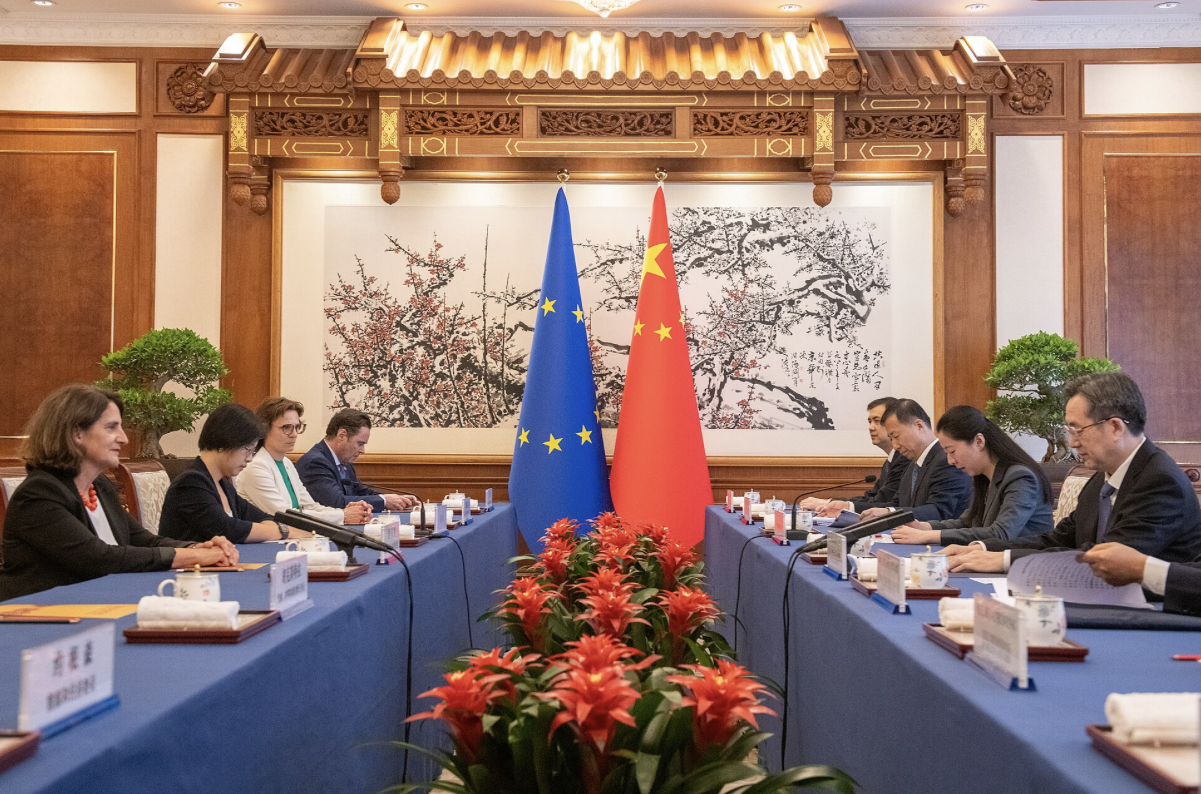
Visit of Teresa Ribera, Executive Vice-President of the European Commission, Wopke Hoekstra, Jessika Roswall and Dan Jørgensen, European Commissioners, to China source picture: © European Union, 2025
https://commons.wikimedia.org/wiki/File:Visit_of_Teresa_Ribera,_Executive_Vice-President_of_the_European_Commission,_Wopke_Hoekstra,_Jessika_Roswall_and_Dan_J%C3%B8rgensen,_European_Commissioners,_to_China_(P-067454-00-61).jpg
On 5 October 2026, French President Emmanuel Macron and German Chancellor Friedrich Merz addressed a joint letter to European Commission President Ursula von der Leyen, calling for stronger European trade-defence instruments. The letter was accompanied by a three pages long non-paper, intended to shape the EU's policy agenda, signalling a common Franco-German position ahead of the October European Council.
In their letter, the two leaders identify three main threats to European competitiveness:
The weaponisation of trade, whereby economic dependencies become instruments of geopolitical pressure. China's restrictions on rare-earth exports illustrate this vulnerability, given Europe's dependence on these materials for its automotive, technological and defence industries.
Systemic market distortions, particularly resulting from foreign state intervention. The heavily subsidised Chinese electric-vehicle industry offers a prominent example: a 2024 European Commission investigation identified government grants, tax advantages and preferential access to essential inputs, allowing Chinese manufacturers to compete under conditions that the Commission considered unfair.
Global macroeconomic imbalances, illustrated by the EU's €359.8 billion goods trade deficit with China in 2025, raising concerns about the sustainability of Europe's industrial competitiveness.
The letter also later denounces the asymmetry in international market access. European companies continue to face significant non-tariff barriers abroad, particularly regulatory and administrative restrictions in markets such as China. Meanwhile, imported products frequently fail to comply with EU regulations, notably concerning consumer safety. In 2024, products originating in China accounted for 40% of alerts registered through the EU's Safety Gate system. Macron and Merz further identify exchange-rate misalignments and undervaluation as additional sources of competitive disadvantage, since these can make foreign products artificially cheaper than European equivalents. Together, they argue, these pressures undermine Europe's industrial base, its capacity to innovate and its economic sovereignty, requiring stronger industrial policies and greater public and private investment.
Yet beyond these concerns, the letter raises a particularly interesting question: why is Germany, who was historically reluctant to embrace protectionist measures against China, now joining France in demanding stronger European trade defences?
Germany's changing position
For decades, Germany has been one of the principal beneficiaries of international trade liberalisation. Its export-oriented economy, particularly its automotive and machinery industries, has relied heavily on access to foreign markets. China, with its rapidly expanding economy and enormous consumer market, became a particularly important destination for German manufacturers.
This explains Germany's traditional reluctance to confront Beijing over trade. The fear was straightforward: protectionist measures targeting Chinese exports could trigger retaliation against German companies, threatening their commercial interests in one of their most important markets.
Germany's reluctance also raises questions about its commitment to ordoliberalism, the economic tradition that has long shaped German policy and that emphasises fair competition through a strong regulatory framework. While Berlin has consistently defended strict competition rules within the European Single Market. It has been far more reluctant to challenge distortions originating abroad, when doing so threatened the interests of German exporters. This inconsistency was not without consequences for its European partners. By opposing collective trade-defence measures, Germany prioritised its own commercial interests over those of Member States such as France and Italy, whose industries also faced competition from heavily subsidised Chinese products. In doing so, Berlin risked undermining a common European response to distortions affecting the entire Single Market. The contradiction is therefore not merely ideological: Germany's defence of its national economic interests has at times come into conflict with the collective interests of its European partners.
The 2024 dispute over Chinese electric vehicles offers a revealing illustration. Following a Commission investigation into Chinese subsidies, the EU decided to impose additional tariffs on Chinese-made electric cars. France supported the measures, while Germany voted against them. German carmakers, including Volkswagen, BMW and Mercedes-Benz, feared that Chinese retaliation would damage their businesses.
However, the economic relationship between Germany and China has progressively changed. Chinese manufacturers are no longer simply producing cheap goods for European consumers; they have become increasingly competitive in sectors traditionally dominated by German industry, particularly automobiles. According to Bundesbank President Joachim Nagel, German motor vehicle exports to China virtually halved between 2021 and 2025, while Chinese manufacturers continued to gain international market share.
This changing balance of interests offers one explanation for Berlin's increasingly defensive position. Although the change of government must also be considered, the economic incentives underlying German trade policy are no longer quite the same. Where China once represented an enormous opportunity for German exporters, it increasingly represents a direct competitor.
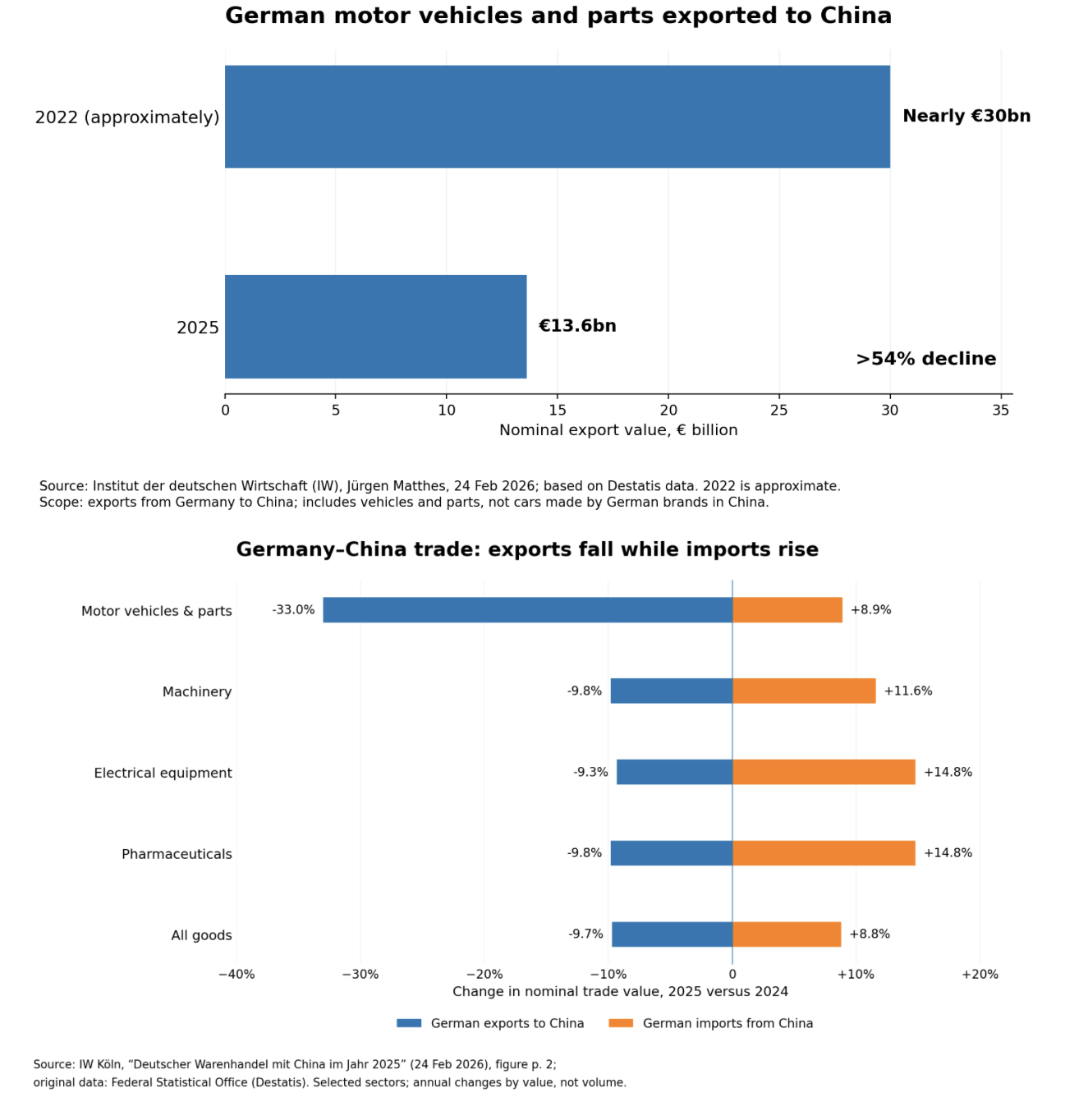
Source: graphs created by author using the noted statistics
Europe's evolving trade defences
The EU already possesses several instruments to counter unfair competition, including anti-dumping and anti-subsidy duties, notably imposed on Chinese electric vehicles in 2024. The Foreign Subsidies Regulation and the Anti-Coercion Instrument further strengthen its ability to address foreign subsidies and economic pressure. Nevertheless, Macron and Merz argue that these mechanisms remain insufficient to tackle systemic distortions affecting entire industrial sectors.
They therefore propose a new instrument allowing the EU to rapidly restrict, or even suspend, foreign access to its Single Market in severe cases. The letter also advocates stronger existing trade defences and measures to diversify supply chains, an objective reflected in the Commission's forthcoming DiversifyEU initiative, expected in December 2026.
These proposals gained political momentum at the European Council meeting of 15–16 October 2026. In their conclusions, EU leaders called on the Commission to make better use of existing trade instruments, pursue dialogue on global macroeconomic imbalances and urgently develop new mechanisms to address them. They also urged progress on the proposed Industrial Accelerator Act, which would introduce Made in EU preferences in certain public procurement and support schemes. Although no new trade-defence instrument was adopted, the conclusions signalled growing political support for a more assertive European trade policy.
China: retaliation or negotiation?
Beijing's reaction was immediate. On 6 October, the Chinese Ministry of Commerce declared that "interdependence is not a risk, intertwined interests do not pose a threat" and that "protectionism cannot enhance competitiveness", urging France and Germany to respect WTO rules and refrain from encouraging the EU to adopt protectionist measures.
Such criticism is hardly surprising. China has repeatedly challenged European trade restrictions, particularly those affecting its rapidly expanding electric-vehicle industry.
Previous disputes also illustrate the potential costs of escalation. In 2025, China imposed anti-dumping duties on European brandy, particularly affecting French cognac producers, in a dispute widely interpreted as connected to European tariffs on Chinese electric vehicles. Although Beijing presented these measures as legitimate trade defence, their consequences demonstrated the vulnerability of European exporters to Chinese restrictions.
Yet retaliation is not Beijing's only option. The EU and China have also maintained negotiations over their commercial disagreements, including during bilateral consultations in October 2026.
This combination of economic pressure and diplomatic negotiation highlights the central difficulty facing Europe. Stronger protectionist measures might help defend European industries against unfair competition, but they could also expose European exporters to retaliation. Germany, despite its changing position, remains particularly sensitive to this dilemma.
Beyond Protectionism
Ultimately, the Franco-German initiative raises a broader question about the future of Europe's economic model. For decades, the EU championed open markets and international trade liberalisation. Today, faced with increasingly powerful industrial competitors and growing geopolitical tensions, its leaders are reconsidering the limits of that openness.
Yet protectionism alone cannot restore Europe's industrial competitiveness. While trade-defence measures may protect European producers from unfair competition, they cannot compensate for structural weaknesses such as high energy costs, insufficient investment in innovation and the fragmentation of the Single Market. Strengthening European industry will therefore require not only defending it from external distortions, but also addressing the internal obstacles to its competitiveness.
The challenge for the EU is thus not merely to decide how much protection its industries need, but how to ensure they remain competitive without depending on that protection.