

By: Klara Dörrwächter
Reading time: 9 min
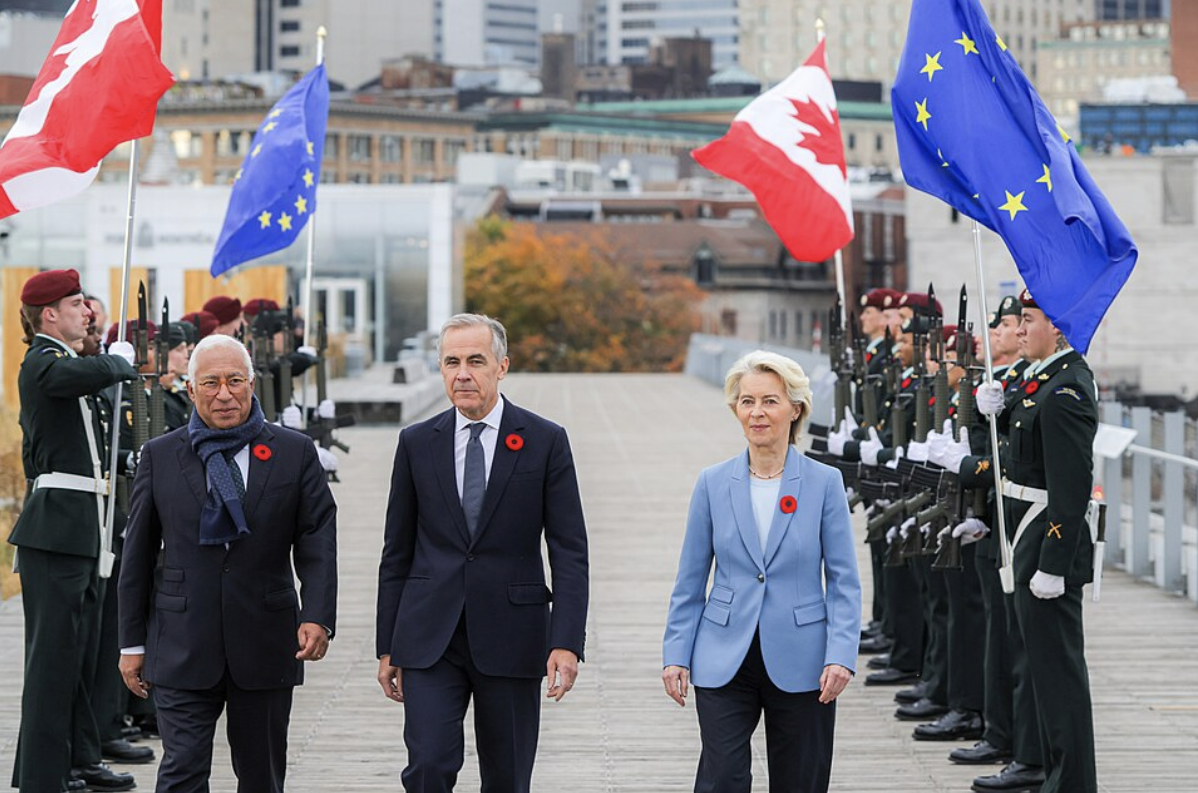
Source picture: © European Union, 2026, CC BY 4.0, via Wikimedia Commons
In the last week of October, President of the European Commission, Ursula von der Leyen, President of the EU-Council, Antonio Costa, and several other EU Commissioners flew to Montreal to meet with Canada’s Prime Minister Mark Carney for the EU-Canada Summit.
This two-day summit on the 29th and 30th of October was the 21st in a long history of mutual conferences and dialogue between the two jurisdictions.
However, this particular summit drew special public attention. In her State of the Union Speech, Ursula von der Leyen announced the idea of making Canada the EU’s first “Associate Member”. Consequently, expectations were high that the summit would clarify what this newly worded partnership would look like.
But did the summit deliver? The answer starts with the new term: What does “Associate Member” even mean? How did the EU-Canadian relations were defined before by mutual agreements? And how are those going to be changed or strengthened according to the Joint Statement after the summit? Behind all those questions looms a third country that was barely mentioned in Montreal: Canada’s recently rather unpredictable neighbour, the US, who might not be so thrilled about this flourishing friendship.
“Associate member”?
Before turning to the results of Montreal, one question needs to be answered: What actually means this new category “Associate Member” Von der Leyen blasted out to the world and what problems could it cause?
Politico introduced the “Friends with Benefits” analogy, explaining that it would go beyond only “friendship” meaning free-trade arrangements, which existed before and were signed in the CETA, but also would not cross the line to a full accession. So it opens up quite a new political range which the representatives of both countries are expected to explore in the upcoming months.
Critical voices legitimately propose the argument that Canada is geographically not part of the European continent, which contradicts the idea of an “Associate Member”. But it is important to differentiate the words “Accession” and “Association”.
“Accession” is covered by the Article 49 of the Treaty on the European Union (TEU). This article grants the right to join the EU to the countries fulfilling the following requirements: Being part of the European continent, and adopting the shared values constituted in Article 2 of the TEU. Gazing quickly at a map, it is obvious that Canada can not meet the first requirement.
However, association works differently. Article 217 of the Treaty on the Functioning of the European Union (TFEU) allows association agreements with third countries or international organizations, whether or not they are on the European continent. Those associations did exist before, like the Euro-Mediterranean Association Agreement with Morocco (2000) or the EU-Ukraine Association (2014). These agreements are mostly about bilateral trade, but the term “Associate Member” is nowhere legally defined and borrows semantically aspects of both ideas: “Associate” suggests partnership while “member” suggests joining the Union.
An Association as presented in the TFEU would nevertheless require Council unanimity and the consent of the Parliament. And here comes one major issue: Several European countries, such as Germany, France and Italy, rejected the idea of an “Associate Membership” and blocked the first draft of the declaration. They sensed issues with the undefined term and the position it would give Canada in the EU. Earlier, German Chancellor Friedrich Merz proposed a similar status for Ukraine. Ukraine then would be able to attend the minister’s meetings and EU-Council meetings without having the right to vote in major decisions. Problematic about this is that Canada and Ukraine have by far not the same status on the EU agenda: Ukraine is an official candidate for EU membership, its accession has been discussed since Russia’s invasion in 2022. Canada, on the other hand, as we saw above, is legally not able to join the Union.
This raises a more fundamental question: To what extent is this consideration of Canada as an associate member “unfair” to the candidate-states waiting in line to join the EU? These countries include the Western Balkans, Moldova and Ukraine.
Due to those critiques of the “Associate Member” wording, the term has been revised initially in the final statement of the Summit. It replaced “Associate Member” with “Alliance for the Future”.
However, Mark Carney has stressed that the new alliance is not a “marketing exercise”, thus the name should not matter too much, rather the real actions and the content of the agreements is what the spotlight should be on. Brussels and Ottawa finally agreed on defining the precise meaning of this “Association without Accession” until the next Summit in 2027. This gives them six months to decide how they can “build a partnership that comes closer to membership than anything we have done before” as von der Leyen framed it after the Summit.
Prior Relations
But what should this now-called “Alliance for the Future” look like? What consequences would it have for both sides? Before clarifying that, let's take a quick look at the existing agreements between the two economies.
First to mention is the CETA, the Comprehensive Economic and Trade Agreement. It was signed in 2016 and entered into force in 2017, aiming to abolish 98% of the tariffs enabling easier trade of goods, people and labour for both sides and opening potential new markets. The second important step towards closer ties between the two jurisdictions is growing cooperation in the defense sector. Canada and the EU have signed the Security and Defense Partnership in June 2025, and Canada officially joined the SAFE, the Security Action for Europe. This 150 Billion Euro defense instrument was launched in May 2025 to support its Member States in strategic defense planning. In June 2026 Canada joined as the first non-European country.
This second step reveals an important element shaping the EU summit and both Canada’s and EU’s interests here: Individual and Collective Sovereignty. For both parties this means distancing themselves from both the US and China as trading partners, and building on new partners in a geopolitically changing environment. As Canada’s minister of Foreign Affairs Anita Anand tells the CBC, Canada's aim is to build and stabilize its national sovereignty and a way to go is relying on trusted partners, with the EU at the very top of them.
Results of the summit
Collective and individual sovereignty thus seem to be the leading theme of the “Alliance for the Future”, deepening their ties among others in the following sectors: Energy and raw materials, tech and artificial intelligence, and defense policies. All those tighter cooperations are justified by the shared values of both jurisdictions: Multilateralism, democracy, and the rules-based international order as stated in the Joint Statement after the Summit. Von der Leyen made this point right at the start of her closing speech: “Canada is the most European country outside Europe.”
On the energy and critical raw material level, those closer ties get a real shape. An agreement was made with the European Investment Bank to send more EU investments into the procurement of Canadian critical minerals; lithium, nickel and cobalt, to be found in batteries, motors and electrical systems, key elements in advanced technologies to produce cleaner energy.
This will not only benefit Canada, but also the EU since they are primarily relying on China in those critical minerals and aim to overcome this dependence.
Moreover, addressing the Energy sector, a "Feasibility Study” will be called into life on the Export of LNG, Liquified, natural gas from Canada to Europe. Momentarily, there are the resources for such a trade, but the infrastructure is missing, since Canada always oriented more to the United States in the South, rather than to Europe in the East in the regards of LNG trading.
Also in the tech industry, especially regarding Artificial Intelligence, Canada and the EU are planning to deepen their cooperations in high-performance computing, opening the European infrastructure to researchers from Canada aiming to develop more advanced, sovereign AI technologies. In this sector as well, the wish of independence from the US and China, both leading nations in the AI Industry is a driving factor.
One sector, especially at the heart of Canada, releasing its first national security strategy in 20 years on the 29th of October, is the security and defense one. There, deeper cooperation is targeted to increase defense capabilities and international peace and crisis management. Nevertheless, they are not only focusing on the traditional defense industry but also on the maritime and space level, considering the plenty of hybrid attacks in the past few months in Europe which could be mainly traced back to Russia.
Lastly and maybe particularly interesting for University students, is the planned acceptance of a Next Generation Youth Mobility Partnership, extending the ERASMUS + programme possibly to Canada.
Beyond Brussels and Ottawa
In all this talk about what consequences the Summit might have for Canada and Europe, we must not forget who is the elephant in the room. Although it has never been said clearly, the reason behind Canada looking more eastwards towards Europe in terms of trade and security is its wish for independence from the US. The United States are Canada’s historically largest trading partner but lately tension grew on the North American continent. President Donald Trump did great work in damaging the US-Canadian relationship by imposing tariffs up to 50% on Canadian imports from early 2025, fundamentally damaging those regions depending on car and steel exports to the United States.
In one of those regions, Ontario, tens of thousands of people working in manufacturing have lost their jobs since the tariffs were constituted in the beginning of Trump's second presidential period.
Next to the economic tension, Trump’s talk about the “annexation” of Canada as the United States 51st State does not really release the tense relations on the North American continent. It explains further why Canada’s national sovereignty has not only been a topic in its first national security strategy after 20 years, but was also stressed multiple times at the summit.
However, how are the United States now reacting to this new proposed partnership? Is it perceived as an “anti-American alliance”?
After Ursula von der Leyen mentioned the possible “Associate Membership” of Canada to the European Union, Trump threatened with fundamental tariffs attacking the Union’s economy if the alliance turns out to be a “hostile” act towards the United States. An open question is how those tariffs should correlate with the agreement of the EU-US trade deal from last year which demanded the US to cap its tariffs to 15% as a ceiling from then 50% by the end of 2026.
And now?
As we see, we will have to stay tuned on how the EU-Canadian partnership further develops and how Brussels and Ottawa will make sense of the full entailment of an “Associate Membership”.
It also remains open how the US will respond. Politicians in the EU and Canada would likely agree that Washington’s recent actions have been hard to foresee, making its next steps difficult to predict.