

One Union, 27 Unemployment Protection Systems: Should the EU take a greater role in protecting unemployed citizens?
By: Uma Pérez-Pla Cañellas
Reading time: 5 min

Source:https://commons.wikimedia.org/wiki/File:Fast_Dublin_Ireland_Black_And_White_Mobile_Street_Photography_(133384037).jpeg, via Wikimedia Commons, Author: Giuseppe Milo
Let’s imagine two 20-year-old workers, one in Spain and the other in Denmark. Both are European citizens, have access to the same Single Market, and have the freedom to work across the European Union.
Yet, if both were to lose their jobs, would they receive the same level of unemployment protection?
These two workers are part of the same European Single Market, but the unemployment protection they are eligible for is not the same. The eligibility requirements, the amount of financial support provided, and duration of unemployment benefits depend largely on the respective national system.
This past March, the European Commission published the Joint Employment Report 2026, based on data from 2024. The report includes a comparison of financial protection for the unemployed, and how it has evolved across the various Member States.
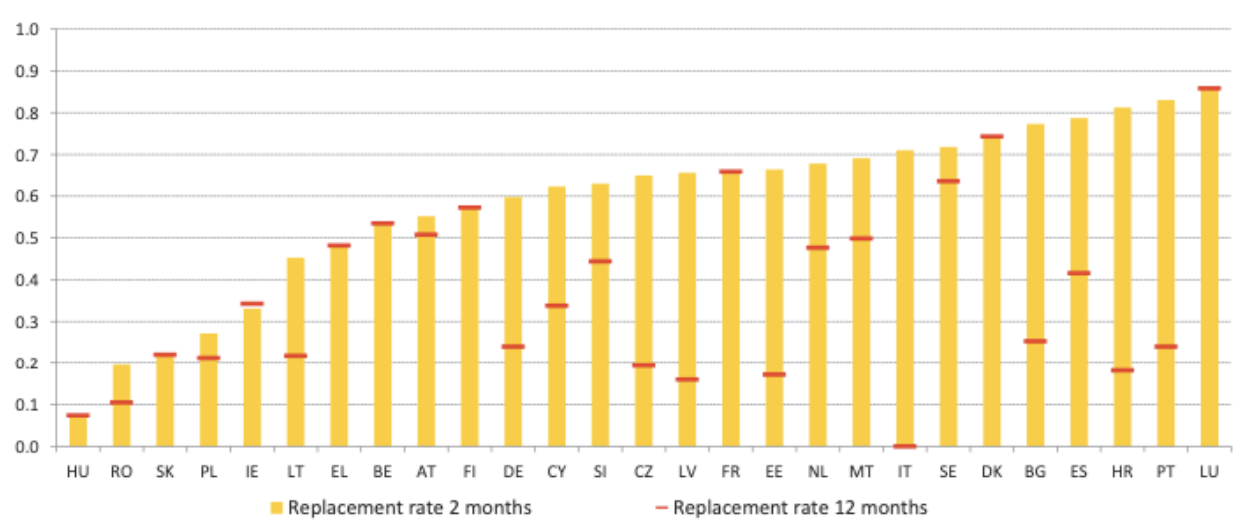
Note: The indicator is calculated for the case of a single person without children with a short work history (1 year) and aged 20. Different income components, unemployment benefits and other benefits (such as social assistance and housing benefits) are included.
Source: © European Union, 2026; European Commission and Council of the European Union (2026), Joint Employment Report 2026, Figure 2.3.12, p. 163. https://www.parlament.gv.at/dokument/XXVIII/EU/62906. Information Source: European Commission calculations, based on OECD Tax-Benefit Model.
The above graph shows the amount of a person’s previous income that they can receive while unemployed, comparing the second and twelfth months of unemployment. If we take a closer look at the data for Spain (ES) and Denmark (DK), we can see a difference in how unemployment benefits evolve. In Spain, the percentage drops from 79% in the second month to 42% in the twelfth; protection decreases by approximately 37% as unemployment drags on. In contrast, in Denmark, it remains around 74% in both the first and second months.
Based on these figures, we can see that the differences in unemployment protection lie not only in the financial support that an unemployed person initially receives, but also extend to how that support is maintained over time as the situation of unemployment persists.
But why should this issue concern us?
According to the European Parliament’s Spring 2026 Eurobarometer survey, 38% of respondents identify job security and working conditions as one of the essential factors for enjoying a good quality of life.
This figure reflects the importance that a portion of European citizens place on job stability. However, economic security does not depend solely on remaining employed, but also on the effectiveness and availability of safety nets in the event of job loss.
It is precisely here that we must ask ourselves what social protection means and what it entails. According to the International Labor Organization (ILO), social protection is the set of policies and programs designed to prevent and reduce poverty, vulnerability, and social exclusion throughout one’s life. Within this framework, unemployment benefits constitute one of the mechanisms for providing economic security.
Let’s return to the original title and its meaning: one Union, one single market, but 27 different national social protection systems for unemployment.
One Union - 27 different systems
To understand why these differences exist and what they entail, it is essential that we understand the division of responsibilities between the European Union and its Member States in this context.
Since May 1, 2010, the European Union has been applying two regulations to coordinate national social security systems: Regulation (EC) No. 883/2004 and Regulation (EC) No. 987/2009. These two regulations establish common principles and social rights to protect European citizens, thereby facilitating the coordination of the systems of the various Member States and ensuring their effective operation.
However, this coordination does not replace national laws. In other words, each Member State is responsible for determining the eligibility requirements for unemployment benefits, as well as the amount of financial support provided and the duration of these benefits.The European Union’s role is exclusively to coordinate, not to integrate or unify the various national systems.
Social protection is also recognized at the European level. Article 34 of the Charter of Fundamental Rights of the European Union recognizes the right of access to social security benefits and social services, including protection in the case of job loss.
All of this leads us to a question that goes beyond the differences between benefits: if the EU already plays a role in coordinating national systems, should it assume greater responsibilities regarding protection for unemployment, or should continue to leave its regulation primarily in the hands of the Member States?
As a first step toward reducing these disparities, the European Union’s responsibilities regarding unemployment protection could be expanded. For example, the EU could establish certain common minimum standards for all Member States. This would help strengthen workers’ sense of economic security and social cohesion within the European Single Market.
These standards could begin by introducing criteria regarding the level of economic protection and how that protection evolves as the unemployment situation persists. In this way, even if each Member State maintained its own benefits and funding system, there would be certain common guarantees.
However, the goal of giving the European Union greater responsibilities and establishing certain common criteria is not to create an identical benefits system for all Member States. Rather, it is to determine to what extent it is feasible to share certain guarantees while continuing to respect each country’s specific circumstances.
On the other hand, some might argue that unemployment protection should remain solely the responsibility of the Member States.
According to this point of view, the state should be the one to design and finance its own system, since the economic and structural differences between the EU Member States make it impossible to apply common criteria. Factors such as the cost of living, income averages, and the demands of each labor market do not make it easy to establish a common level of protection that is “appropriate” for all member states.
Furthermore, the same amount of financial support does not provide the same level of economic security across the Member States, as differences in the cost of living affects its purchasing power. Those who advocate this position believe that governments are better positioned and better equipped to decide how much to allocate to unemployment benefits and how to design them to meet the needs of the population.
Returning to our previous example that opened this discussion: two workers, one in Spain and the other in Denmark. The unemployment benefit systems differ in each case; they do not offer the same initial level of financial protection, and that protection does not evolve in the same way over the time, as the benefits (financial support) may decrease at different rates as unemployment persists.
These differences have sparked a debate that goes beyond the benefits themselves: the possibility of striking a balance between European integration and the autonomy of member states in matters of social protection.
One Union, one single market, and 27 unemployment protection systems. That brings with it the following question; Should the EU limit itself on coordinating national unemployment protection systems, or move towards greater harmonisation?