

A European Army : Will Growing Security Threats Force the EU Into Forming One?
By: Pia Ajdarovič
Reading time: 7 min
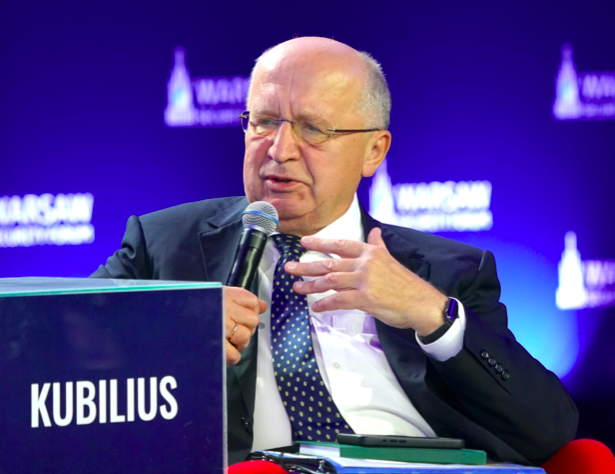
European Commissioner for Defence and Space Kubilius who in the past pushed for a European military force. Source picture: © European Union, 2026, CC BY 4.0 <https://creativecommons.org/licenses/by/4.0>, via Wikimedia Commons
In light of recent security threats, foreign invasions, and cyberattacks, EU Member States are paying increasing attention to whether they are prepared to defend themselves in the event of a major security threat. This raises the fundamental question: is mere reliance on existing defence alliances enough, or should the EU take matters into its own hands and establish a joint army consisting of forces from all 27 Member States? Three main points guide the discussion on whether the EU should have its own army: necessity, feasibility, and desirability. Or, putting it more simply: Does the EU need one? Can it actually create one? And, perhaps most importantly, should it?
A Continent At Crossroads
The Russian full-scale invasion of Ukraine in 2022 brought war back to the European continent and exposed significant vulnerabilities in Europe’s security. However, it also demonstrated that conventional warfare is far from the only threat European countries are facing today. Cyberattacks, sabotage of critical infrastructure, foreign interference, and growing geopolitical tensions have posed further concerns about the continent’s ability to defend itself. At the same time, uncertainty surrounding the United States’ long-term commitment to European security has reignited discussions about how much Europe can continue to rely on its traditional allies. While NATO remains the foundation of collective defence for most EU Member States, recent developments have brought renewed attention to the importance and need for greater European military independence. With security threats becoming increasingly complex and unpredictable, the question is no longer simply how Europe should defend itself, but whether it is prepared to assume greater responsibility for its own defence.
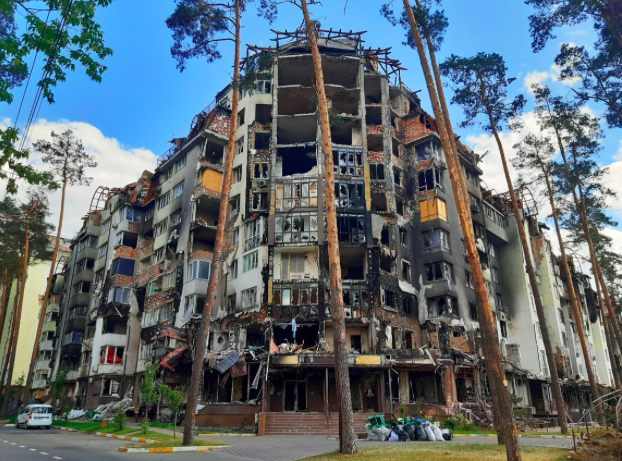
A residential building damaged during Russia's invasion of Ukraine in 2022. Photo: Rasal Hague / Wikimedia Commons, CC BY-SA 4.0
How Does The EU Defend Itself Today
While the EU has established itself as a strong economic and political power on the international stage, its Member States continue to rely primarily on NATO – a military alliance of 32 countries - for collective defence, with the United States playing a main role in this alliance. Aside from that, the European Union has developed its own defence framework through the Common Security and Defence Policy (CSDP), allowing Member States to cooperate on military and civilian missions, crisis management, and international security operations. Furthermore, the EU has also introduced several initiatives to strengthen military cooperation, including joint defence projects and the development of rapid deployment capabilities. Despite these efforts, however, the EU still does not possess a standing army of its own. National armed forces remain under the authority of their respective governments, which determine whether and how they contribute to EU military operations. Thus, although broader defence cooperation therefore already exists, it remains fundamentally different from establishing having a single EU army operating under common command.
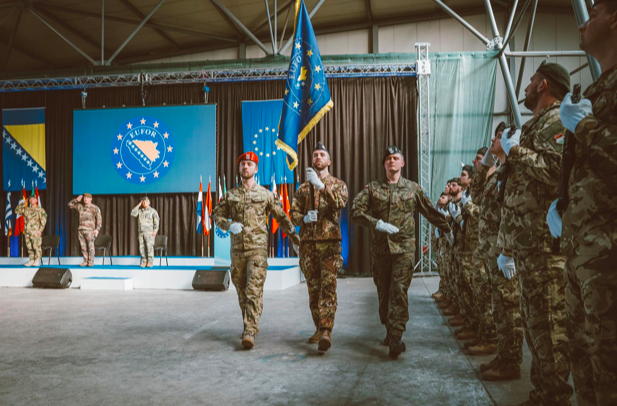
EUFOR military cooperation. Photo: Rock Cohen / Wikimedia Commons, CC BY-SA 2.0
Can The EU Even Have An Army?
Before considering whether the EU should have its own army, another question must be addressed: could it legally create one in the first place? The idea is not entirely foreign to EU law. Article 42(2) of the Treaty on European Union (TEU) already provides for the possibility of a common European defence, but only if the European Council unanimously decides so and Member States adopt the decision in accordance with their respective constitutional requirements. In practice, this would require agreement among all 27 Member States, despite their often-diverging political interests and strategic approaches to national security.
Another obstacle concerns national sovereignty. Defence remains closely connected to national authority, with Member States retaining control over their own armed forces and decisions concerning their activities. Under Article 42(4) TEU, decisions relating to the Common Security and Defence Policy generally require unanimity in the Council. Establishing a common army would therefore raise further questions about who would command it, who would decide when military force could be used, and whether Member States would be willing to give up part of their control over such decisions.
While EU law provides a possible legal pathway towards common defence, it does not automatically amount to a legal basis granting the Union the power to establish an independent army. Whether such united armed forces under the EU flag could be created under the existing treaties would depend largely on its structure, powers, and relationship with national armed forces.
Consequently, the greatest obstacle may not necessarily be the complete absence of a legal framework for such a decision, but rather the political willingness of Member States to make use of it.
European Parliament in Strasbourg. Photo: Alfredovic / Wikimedia Commons, CC BY-SA 3.0
The EU Army Debate – Why Yes And Why No?
The opponents of the idea for a common European army frequently have quite a few very reasonable historical arguments as to why such a multinational army would never function. Over the course of Europe’s recent history, a few have already existed and ceased to exist primarily for the same reason. When multiple nations, in the EU’s case over two dozen, fight under the same flag, there is a high risk of conflicting interests. The Austro-Hungarian Empire, for example, consisted of eleven ethnolinguistic groups and, during the First World War, fell apart also due to the fact that these groups did not want to fight amongst each other; they wanted independence and to fight for their own flag. Yugoslavia encountered a similar fate in the 1990s during its collapse. It was more important for soldiers to defend their own flag rather than fight for the federal army in which they didn’t fully believe.
On the other hand, some of the strongest armies of our history, like the Mongol army under Genghis Khan or the Roman Army, which primarily earned their title for wars they won and empire territory they defended, were highly ethnically diverse.
Another weight on the con side is the efficiency of such an army. As is the case with the UN's blue helmets, an army that belongs to a supranational organisation, it can only operate under strict orders from a specific body – in the case of the UN, the Security Council. While such safety nets are rightfully put in place in order to prevent misconduct or exploitation of military power, they can sometimes be an obstacle when it comes to defence. During the 1995 genocide in Srebrenica, the blue helmets were abandoned by higher military commands and forced to stand by as Bosnian Serb forces overran the designated UN “safe areas”.
On the proposing side of the idea, one could take the position that no multinational organisation or union in any shape and form can exist without armed forces. One of the main reasons the League of Nations, the precursor of the United Nations established in 1920, failed was precisely because it didn’t have an army. Of course, the EU has existed for a while without one and is, except for Brexit, sustaining its existence and territory - noting that in that time, there have been no major global conflicts.
Another argument against the establishment of a common European army is the question of who would actually pay for it. While all 27 Member States would theoretically benefit from such an army, their economic capabilities and willingness to invest in defence differ significantly. Some countries already spend considerably more on their military than others, raising the question of whether wealthier Member States would be expected to carry a larger financial burden. Such disagreements could create tensions within the Union, especially if countries contributing more financially were to demand greater influence over military decisions. After all, it is difficult to imagine that all 27 Member States would willingly contribute to an army over which they might have very limited control.
On the other hand, one of the strongest arguments in favour of a European army is the possibility of reducing the Union's dependence on foreign military powers, particularly the United States. While NATO has played a central role in maintaining European security for decades, the alliance relies heavily on American military capabilities. This raises the question of what would happen if the United States decided to reduce its military involvement in Europe or prioritise its own national interests elsewhere. A common European army could provide the Union with greater military independence and allow it to respond to security threats without relying as heavily on decisions made outside its borders. After all, if the EU wishes to establish itself as a major global political power, one could argue that it should also possess the military capabilities necessary to defend its own interests.
Ultimately, only one thing is certain. Taking into account the rise of global tension, it’s in all member states’ interest to secure peace, one way or another. Whether that may require a united EU army is still up for debate.