

Orbanism and its Epidemic in Eastern Europe
By: Nikola Kirkov
Reading time: 10 minutes
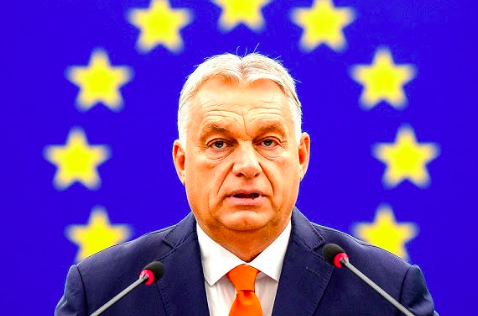
Hungarian Prime Minister Viktor Orban. AFP via Getty Images
Over the past decade, Viktor Orbán’s brand of illiberal politics has evolved from a domestic hegemony in Hungary into a transnational phenomenon shaping political discourse, particularly in Eastern Europe. Often framed as a model of ‘sovereign democracy’, Orbanism has come to represent a blend of democratic backsliding, strategic EU obstruction, and an increasingly unsettling closeness to Moscow. As Orbán’s ideology spreads across neighbouring states, from Slovakia and Czechia to Bulgaria, the region faces a critical question: whether Orbanism remains a temporary political trend or a deeper structural challenge to the EU project.
Hungary’s diagnosis: ‘patient zero’ of Orbanism
Ever since their sudden rise to dominance in domestic politics in 2010, Orbán and his party, Fidesz, have gone to great lengths in carefully curating an image of the perfect rival to the liberal democracies, gaining a considerable amount of traction in global politics since 2021. Conveniently profiting off the refugee crisis in Europe, Orbán’s primary aim was the opportunistic augmentation of political capital by relying on a radical stance against immigration policies, cementing his distaste for upholding EU law and promoting the rule of law.
Despite achieving the ‘prestigious’ status of a regime according to the European Parliament, Orbán and his political companions have invested a major public resource into promoting their ideology beyond national borders, framing it as a manifesto of far-right illiberalism. Studies have suggested that these efforts have been successful since Orbán has managed to become a star of the global far-right movement, causing a major spillover epidemic of his nuances in neighbouring countries.
Becoming the primary advocate of conservative global populism, Orbán’s political fiasco was removed from the European People’s Party (EPP), subsequently founding the Patriots for Europe (PfE) faction in the European Parliament: a political sandbox for him and those ill-minded enough to follow his model. Thus, the corruption-tainted political figure successfully utilised this opportunity to establish a gateway into the EU for his ‘Eastern Opening Policy’ toward Russia. In relation to the member state’s position in the EU, the Fidesz ‘reign’ of Hungary has been marked by a blatant disregard for the obligations of the member state in ensuring that the rule of law is not compromised and EU law is upheld.
Shockingly, cosying up to the Kremlin’s bloodthirsty regime has been proven to be deeply incompatible with EU law. Orbán has successfully breached a plethora of legal rules, particularly when it comes to the EU’s Common Foreign and Security Policy (CFSP), which requires member states to ensure that their national policies conform to the EU positions. Thus, one could hardly be shocked at the fact that Hungary’s main EU policy in the past five years has taken the form of a deeply unsettling pattern of constant vetoes against aid to Ukraine, a key feature of the country’s ‘appeasement policy’ toward Russia.
On the topic of Hungary becoming the symbol of the erosion of EU consensus, Orbán’s deeply eurosceptic government has repeatedly used its veto power to stall key EU decisions, despite seeming not to rally against receiving funds from the Union. This trend, alongside the ongoing issues of corruption and concerns about judicial independence within the country, has prompted the Union to persistently freeze a significant portion of funds for Hungary, estimated at over €11 billion.
Crucially, Hungary’s conduct in EU decision-making and its application of EU law have deteriorated to such an extent that they have sparked serious debate about introducing an expulsion clause that would allow the Union to remove member states. As of early 2026, Hungary remains a member of the European Union but is subject to ongoing Article 7 procedures regarding the rule of law, which could theoretically suspend its voting rights.
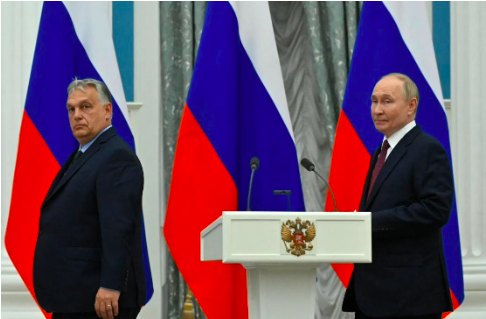
Russian President Vladimir Putin (right) and Hungarian Prime Minister Viktor Orban arrive to deliver a joint press statement following their talks at the Kremlin in Moscow on July 5. Alexander Nemenov/AFP via Getty Images
Due to Hungary’s shift from a democracy to an autocratic state characterised by a lack of an independent judiciary, centralised power, and systemic corruption linked to Orbán, the Fidesz era might be approaching its inevitable demise. With growing economic troubles and the highest inflation rates in the EU fuelling social frustration, the upcoming 2026 Hungarian parliamentary elections might prove to be Orbán’s most serious political challenge in two decades.
Fidesz’s current state exposes a lack of a fruitful electoral campaign that does not exclusively, and falsely, target Ukraine as the sole reason for Hungary’s current state, failing to focus on plans to remedy Orbán’s failed, empty promises. As dissatisfaction with the status quo has strengthened opposition forces, the face of Orbanism is confronted with a question of political survival: whether the ‘Orbán model’ can retain its domestic and international appeal.
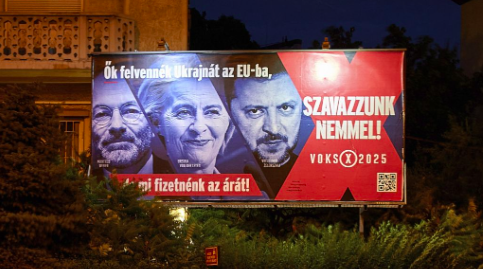
"They would bring Ukraine into the EU, but we would pay the price!" Photo: Bela Szandelszky/AP (TVP)
Slovakia’s diagnosis: inferiority masked through a sidekick façade
Fidesz’s well-worn rhetoric on migration, Ukraine, and euroscepticism (despite the country’s enjoyment of subsidies provided by Brussels) has enabled Hungary to build considerable international connections with other authoritarian-leaning states. Despite receiving the prominent endorsement of Donald Trump, incumbent president of the US, who has repeatedly labelled Orbán as a ‘great European leader’, the phenomenon of Orbanism has proven to be most successful in certain parts of the post-Soviet realm.
While cultivating ties with the Trump administration and drawing notable inspiration from Russia, Slovakia has remained Orbán’s most loyal companion and most cooperative second hand. Functionally operating as a convenient extension of Orbán’s political reach, Slovakia has efficiently helped Orbán in establishing a Ukraine-sceptic alliance in the EU, recently joined by Czechia’s Andrej Babiš.
In Slovakia, the spread of Orbanism and the sudden pro-Russia tilt began with the resurgence of Robert Fico to power, a right-wing populist directly inspired by Orbán’s playbook. Following his party’s victory in the 2023 parliamentary elections on a pledge to send ‘not one more round of ammunition’ to Ukraine, Fico has consistently been translating Orbanist notions from Hungary to the Slovak terrain. Crucially, the far-right politician has made sure to fully take advantage of his accumulated political strength by actively appropriating Hungarian trends of democratic backsliding.
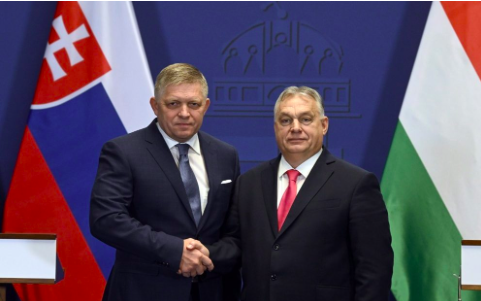
Only he and Hungarian Prime Minister Orbán are interested in the functioning of V4, believes Fico, adding that V4 is therefore currently turning into V2. [EPA-EFE/Szilard Koszticsak HUNGARY OUT]
Most notably, Fico sought to entrench political capital by taking a sledgehammer to Slovakia’s institutions, particularly targeting the judiciary and crucial bastions of freedom of speech. This goal was realised through the abolition of the Special Prosecutor’s Office, set up to investigate serious crime and corruption, and suspension of the national broadcaster (RTVS), replacing it with a new and surprisingly government-aligned one. Moreover, Slovakia has been fiercely condemned by the EU not only due to its consistent pattern of backing Hungary’s veto craze, but also due to Kremlin-style anti-NGO legislation, which has prompted institutions to launch proceedings against the member state.
Fico’s harsh pro-Russian stance and never-ending promises of halting all aid to Ukraine have left a considerably bad taste in the mouths of Slovaks. In November 2025, yet another wave of protests erupted in the country following a classroom lecture, where Fico claimed that the EU plans to ‘prolong the war’ in Ukraine and yelled at disapproving students to ‘go fight there’.
Building on the constant anti-Ukraine narratives, in the latest diplomatic spectacle surrounding the destruction of the Druzhba pipeline, Orbán and Fico have once again rushed to defend their cherished access to Russian oil, accusing Ukraine of ‘blackmail’ while conveniently concealing the fact that their countries remain among the EU’s last clients of Kremlin energy. In a display of geopolitical consistency bordering on tragicomedy, the two leaders even threatened retaliatory measures and blocked EU aid for Ukraine on the eve of the 4th anniversary of the war, seemingly determined to prove that loyalty to Putin still outweighs even the faintest sense of strategic embarrassment.
Czechia’s diagnosis: right-wing uncertainty
Remaining within the Visegrad region, the most recent addition to the Orbanist club in Eastern Europe has been Czechia, following the 2025 Czech parliamentary elections, which saw Andrej Babiš securing victory. Babiš, a populist tycoon, and his parliamentary victory raise concerns regarding the future direction of Czechia’s foreign policy, particularly regarding the EU.
Babiš’s rhetoric has caused analysts to draw parallels between his populist politics and those of Trump and Orbán on several occasions. While the PM stated that he sought to avoid confrontation with the EU, his position tends to echo Orbán’s line of nuance, advocating for a passive stance on Ukraine. Furthermore, a sense of pessimism has presented itself regarding the future of Czechia’s stance as a bastion of Ukrainian solidarity, particularly regarding the ammunition scheme launched by the country.

The central point of the coalition's platform is the defence of national sovereignty against what they perceive as overreach by Brussels. [Babiš's Facebook page]
Although it appears evident that Orbán hopes to join forces with the Czech PM in order to boost his political standing at the EU level and impede Ukraine’s trajectory towards the Union, a full pivot U-turn towards Moscow remains unlikely for now, as only 25% of Czechs hold favourable views toward Russia.
Nonetheless, political figures such as Czechia’s former foreign minister have warned that Babiš could possibly decide to assume the role of Orbán’s ‘puppet’ at the European Council table, signalling a situation too close for comfort.
Bulgaria’s diagnosis: revisionist nostalgia
Shockingly enough, unexpected political turns in Bulgaria might bring about yet another player favourable to the influence of Orbanism. As the Eastern European member state finds itself in a new wave of political crisis with upcoming parliamentary elections in April, the spotlight shines on Rumen Radev, the former president, and his bet on joining the domestic political landscape as a leader.
Days into 2026, Radev, who held onto the presidency for 9 years, announced his resignation as a head of state in order to enter the ‘real’ politics within Bulgaria by fighting corruption firsthand. In Radev's first speech after leaving the presidency, a comparison between him and Orbán already started to feel palpable. Concretely, the former president stated that the EU should take autocratic hegemonies like Russia and Trump’s U.S. as role models, accompanying populist notions revolving around sovereignty and euroscepticism, eerily similar to Orbanist viewpoints. This very suggestion prompts people to question his real motives, as his campaign motto ‘oligarchy out’ seems to clash with the fact that oligarchy constitutes an integral part of the model in Russia or Trump’s ongoing politicisation of the rule of law.
The presence of euroscepticism and views aligning with Orbán does not end there; it extends over to fiscal matters as well. Despite numerous rulings from Bulgaria’s Constitutional Court, Radev continued to utilise Bulgaria’s entrance into the eurozone in 2026 in order to generate political capital by calling for a referendum, relying on populist tactics. In its final verdict, the constitutional court deemed the referendum as inadmissible and incompatible with Bulgarian and EU law.
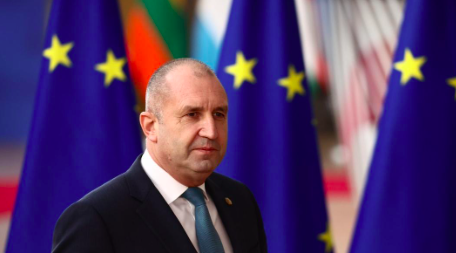
Bulgaria’s President Rumen Radev arrives for a special meeting of the European Council in Brussels, Belgium, 09 February 2023. Photo: EPA-EFE/STEPHANIE LECOCQ
Similar to Orbán, a distinct characteristic of Radev’s political narrative has been a series of Kremlin-adjacent statements in recent years. On several occasions, he has called Kyiv’s prospects of victory against Russia ‘doomed’, advocating for a halt to aid towards Ukraine and clashing with President Zelenskyy in 2023 when he said that military aid to Kyiv would only prolong the conflict.
Arguably, the culmination of his flirtation with Orbánesque rhetoric seems to be found in his answers regarding Ukraine’s territorial integrity. During a presidential debate in 2021 before Radev’s re-election, when confronted with the question of who Crimea belongs to, the ex-president answered that ‘Crimea is Russian’, sparking a diplomatic pandemonium between Bulgaria and its allies.
Despite absurdly suggesting that President Zelenskyy had implied Bulgarian territories should fall under Russian occupation after the Ukrainian leader merely invited him to ‘put himself in his shoes’, Radev’s own pro-Russian rhetoric directly undermines the EU’s common position and established principles of international and European law while directly legitimising arguments that enable Russia to sustain its imperial ambitions, including in the Odesa region, home to 150,000 ethnic Bulgarians.
Ultimately, the growing influence of Orbanism across Eastern Europe reveals how easily illiberal narratives can travel when political opportunism gets boosted by geopolitical instability. Yet the durability of this model remains far from guaranteed: mounting economic pressures, democratic backsliding, domestic dissatisfaction, and shifting public attitudes towards revisionist nostalgia suggest that its appeal may be approaching its inevitable demise.